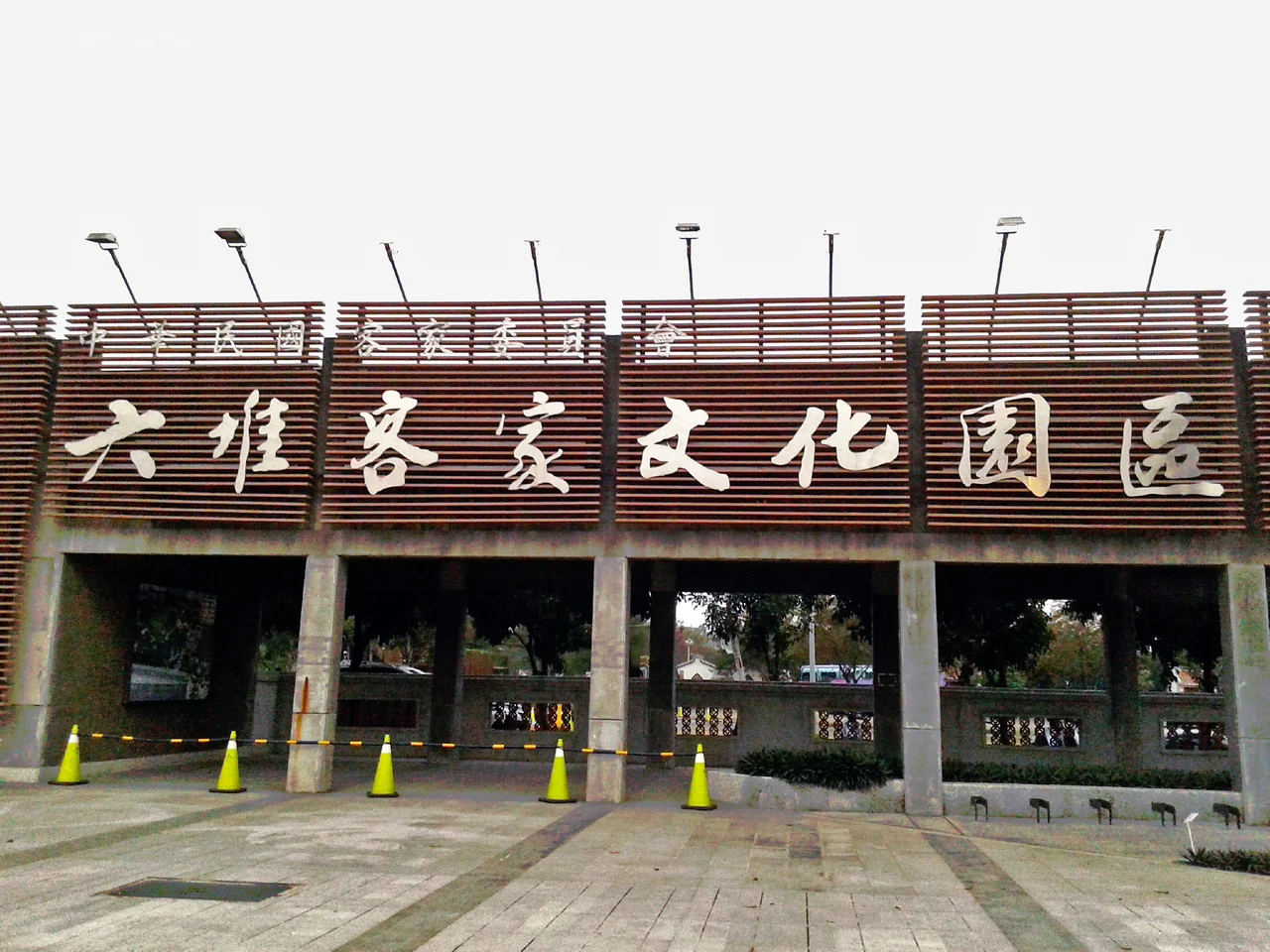

Liudui Hakka Cultural Park
The Hakka say they are a people who carry their culture on their backs. Driven south across centuries by war and famine, the Hakka communities of Taiwan's Pingtung Plain never let go of their dialect, their music, their methods of fermenting and building and farming. The Liudui Hakka Cultural Park in Neipu Township is where that long migration finally has a home large enough to hold it — 30 hectares of wetlands, farmland, settlement architecture, and exhibition halls dedicated to telling the story of who the Hakka of southern Taiwan are, and how they arrived here.
A Tobacco Barn Becomes a Cultural Landmark
The land itself carries history. In 1961, the site functioned as a tobacco barn area, part of the agricultural economy that once defined Pingtung County's flatlands. For decades it stood as a working facility, tied to the rhythms of harvest and curing. The transformation began in 2009, when the owners chose to donate the land and its structures rather than sell or develop them. What followed was a careful conversion: architects and cultural planners worked to turn the old barns into something that honored both the agrarian past and the Hakka heritage embedded in every Pingtung village. The park formally opened on 22 October 2011, inaugurating a new kind of institution — not a conventional museum behind walls, but a living landscape where visitors could walk among reconstructed Hakka settlement architecture, stroll along wooden trails, and step into wetland gardens designed to reflect the water-management traditions the Hakka brought with them from Guangdong.
The Name Behind the Park — Six Armies, One People
"Liudui" — the name of the park and the cultural region it celebrates — translates roughly as "Six Armies" or "Six Brigades," a reference to the six military and administrative divisions the Hakka people of southern Taiwan organized in 1721 to defend their communities during the Zhu Yigui rebellion. The Hakka of the Pingtung Plain and Kaohsiung Basin banded together into these six regional units, and the collective identity they forged persisted long after the military emergency passed. Today, Liudui refers to the broader cultural region: a sweep of townships in Pingtung and Kaohsiung where Hakka traditions remain alive in temple festivals, in the *hakka tung blossom* that blooms each spring, and in a dialect that distinguishes the community from the surrounding Hokkien-speaking majority. The park exists to make that heritage visible.
Across 30 Hectares, a World Reconstructed
The park's scale allows it to do something a conventional gallery cannot: it reproduces environments, not just objects. The Hakka Settlement Architecture zone reconstructs the courtyard compounds and defensive earthen walls that characterized Hakka villages across the Pingtung Plain. Beyond the buildings, a Nine Flowers Garden Area and a Seasonal Farmland Area cycle through the crops and plantings that marked the Hakka agricultural calendar. A Natural Prairie section gives way to the Hakka Ditch Area, where traditional irrigation channels recall the hydraulic engineering knowledge the Hakka brought from their home regions on the Chinese mainland. For quieter moments there is a Wetland Garden, a Wooden Trail that winds between paddocks and ponds, and a Countryside Area where the landscape simply breathes.
Inside the Old Barns, the Stories Go Deeper
The tobacco barns that gave the site its original identity have been repurposed as exhibition spaces, and the architecture itself becomes part of the display. The Tobacco Barn Exhibition Hall uses the original structure to frame a history of the crop that once sustained this community. Nearby, the Rice Mill Exhibition Hall recalls another pillar of the Hakka economy. The permanent exhibitions explore Hakka material culture, social organization, and the distinct identity that took shape as the community adapted to southern Taiwan's climate and terrain. The Hakkaland Children's Museum brings younger visitors directly into that world, using interactive approaches to convey traditions that might otherwise remain abstract. A Multimedia Exhibition Hall offers more contemporary approaches to the same stories.
Southern Taiwan at the Edge of the Mountains
Neipu Township sits in the wide flat basin where the Central Mountain Range releases its rivers onto the coastal plain. To the east, the ridgelines rise sharply; to the west, the land opens toward the Taiwan Strait. The Hakka communities here have farmed this basin for more than three centuries, shaping the landscape around them. On clear days from the air, the patchwork of paddies and fruit orchards that surrounds the park spreads out in orderly green and gold rectangles, interrupted here and there by the red-roofed courtyard houses that remain the most visible sign of Hakka settlement. The park is accessible by bus from Pingtung Station on the Taiwan Railway, placing it within reach of Kaohsiung city without requiring a car.
From the Air
The Liudui Hakka Cultural Park sits at 22.6594°N, 120.5589°E in Neipu Township, Pingtung County, approximately 25 kilometers southeast of Kaohsiung International Airport (RCKH). From cruising altitude, the Pingtung Plain is easily identified as the broad flat basin east of Kaohsiung, bounded to the east by the steep wall of the Central Mountain Range. At low altitudes, the park's 30-hectare footprint can be identified by its green wetland areas contrasting with the surrounding agricultural patchwork. Recommended viewing altitude is 3,000–5,000 feet for context of the wider Pingtung basin. RCKH is the nearest commercial airport, 25 km to the northwest.
Nearby Stories
- Taimali 7.2 km away
- Meinong East Gate Tower 15 km away
- Kunci Temple 20 km away
- Checheng Fu'an Temple 42 km away
- Dongji Island 49 km away
- Orchid Island 69 km away
- South Penghu Marine National Park 77 km away
- Hong Kong 12 549 km away