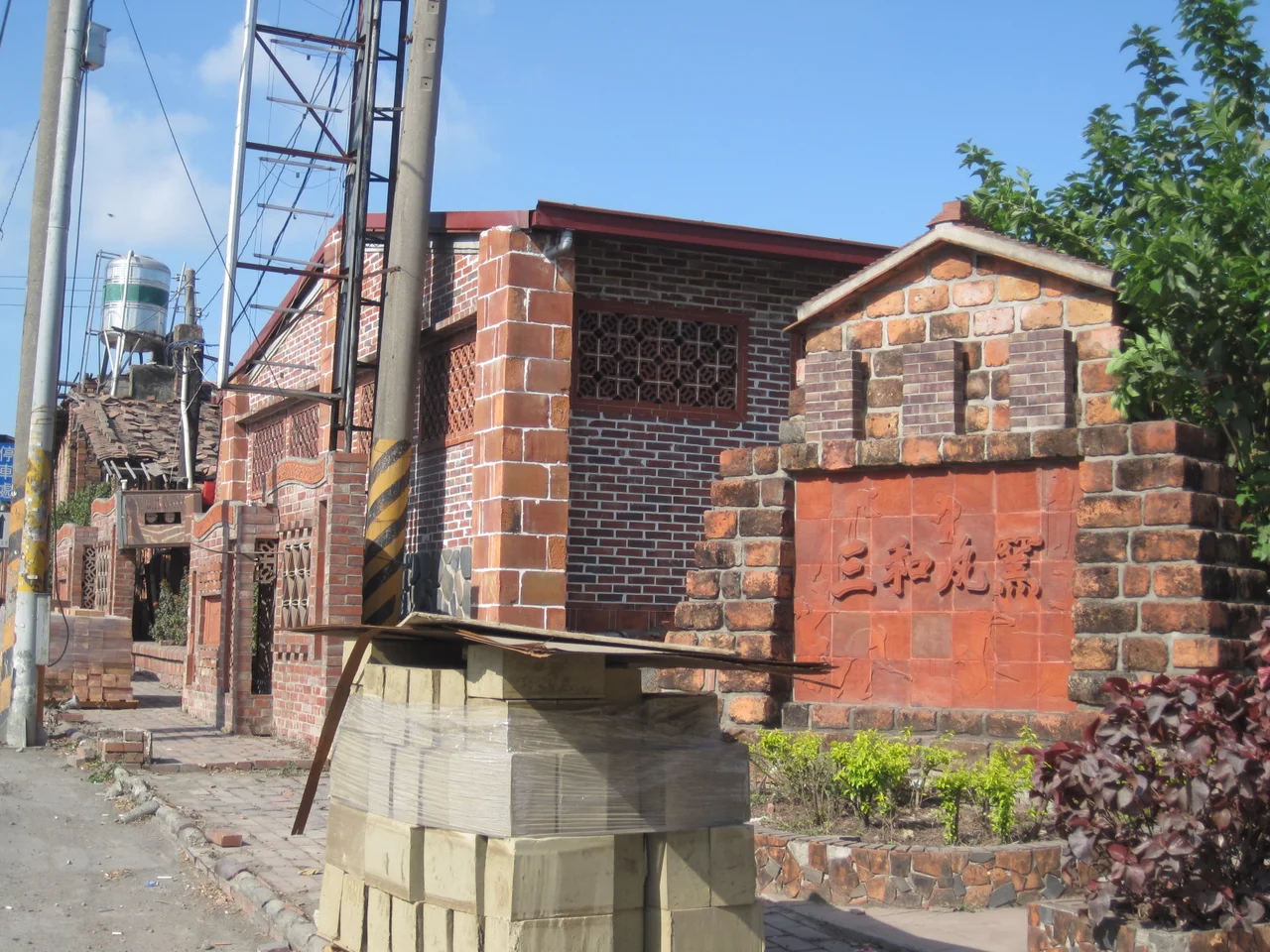

Sanhe Tile Kiln
Every old building in Taiwan that has survived earthquake, war, and the pressure of development contains fired clay from a place like Dashu. At its peak during the Japanese colonial period, this small district along the Gaoping River operated twenty-three kiln factories with more than 130 kilns, producing the roof tiles and red bricks that shaped the architectural character of southern Taiwan. Then the market shifted. Concrete and steel replaced traditional materials. One by one the kilns went dark, and by 1988 only one remained operating. That survivor is the Sanhe Tile Kiln — founded in 1918, renamed multiple times across more than a century of history, and now a registered historical building that has found a new purpose without abandoning its old one.
Clay, Water, and the Gaoping River
The tile industry in Dashu District did not arise by accident. The Gaoping River, which flows along the district's eastern flank, deposited fine alluvial clay of exceptional quality — clay without the impurities that could cause tiles to crack in the kiln. Access to water was equally important, both for processing the clay and for transportation. It was not until the late Qing Dynasty that the first kiln factories appeared in Dashu, after craftsmen brought brick-making techniques from mainland China. But it was during the Japanese colonial period that the industry reached its remarkable scale: twenty-three factories, more than 130 kilns, a district defined by the smell of wood smoke and the rhythmic sound of clay being worked. Dashu became the primary production and distribution center for roof tiles across Taiwan, supplying the building materials for an entire era of construction.
A Factory With Five Names
The kiln now known as Sanhe Tile Kiln has carried several names across its long life, each reflecting a change in ownership or circumstance. Hsu An-Jan founded it in 1918 — the seventh year of the Taisho era under Japanese rule — and named it the Shun An Hao Brick Factory. During the later years of the colonial period, the factory expanded, absorbed neighboring kilns, and became Yuan Shun An Brick Factory. After Taiwan's return to Chinese administration following World War II, it was renamed again: first Yuan Shun An Tile Factory, then, in 1975, Sanhe Tile Factory — the name it bears today. When the Chin Yuan Hsing Tile Factory, the last of its competitors in Dashu, closed in 1988, Sanhe became the district's sole surviving kiln. The industry that had once filled these hills with smoke and activity had contracted to a single point.
The Fourth Generation and a New Idea
What saved the Sanhe Tile Kiln from following its competitors into closure was not market demand — demand for traditional roof tiles had declined steadily since the 1960s as reinforced concrete construction took over. What saved it was a decision by the fourth-generation owner, Li Chun-Hong, to think about the kiln differently. In 1994, Li organized the Tile Kiln Culture Association and began connecting the factory to community development activities and workshops, reviving local memory of the craft. Recognition followed: in 2004, the Kaohsiung City Government registered Sanhe as a historical building. Two years later, the Association joined the Community Craft Development Program of the National Taiwan Craft Research and Development Institute, developing a micro-craft network and creating products that drew on brick and tile aesthetics. By 2011, a formal cultural and creative design company had been established under the Sanhe Tile Kiln brand.
The Building Itself
What visitors encounter at Sanhe is a structure that embodies its own history: the walls are made of straw-mixed bricks, red bricks, and roof tiles that the kiln fired in previous decades. The building is literally constructed from its own products, making it a monument to the craft it practices. The former factory floor now serves as an exhibition space where visitors can trace the history of brick-making in Dashu, examine traditional kiln construction methods, and see examples of the creative products that Sanhe has developed in its second life. The bricks currently produced at Sanhe are used primarily in the restoration of old buildings — places where the original materials matter, where a modern substitute would be wrong. The kiln is also producing environmentally friendly bricks made from discarded brick material and rice husk ash, a practical application of both tradition and innovation.
Dashu District and the River Plain
Sanhe Tile Kiln stands in Dashu District, a semi-rural area northwest of central Kaohsiung where the Gaoping River valley opens into the broader coastal plain. The surrounding landscape retains an agricultural character — orchards, paddies, and older brick farmhouses that are themselves part of what Sanhe helps preserve. The factory is accessible on foot from Jiuqutang Station on the Taiwan Railway, making it reachable without a car from Kaohsiung city. The contrast between the kiln's worn red-brick walls and the surrounding countryside is striking: a small, specific, entirely serious place dedicated to the proposition that some things are worth firing again.
From the Air
The Sanhe Tile Kiln sits at 22.6633°N, 120.4269°E in Dashu District, approximately 18 kilometers northeast of Kaohsiung International Airport (RCKH). From the air, Dashu District is the semi-rural zone northeast of the main Kaohsiung urban area, where the Gaoping River curves through an agricultural valley. The kiln's location near the riverbank reflects the historical dependency on Gaoping River clay that drove the tile industry here. At 3,000–5,000 feet, the transition from dense urban Kaohsiung to the green river valley of Dashu is clearly visible. RCKH is the nearest commercial airport, approximately 18 km to the southwest.
Nearby Stories
- Taimali 7.2 km away
- Meinong East Gate Tower 15 km away
- Kunci Temple 20 km away
- Checheng Fu'an Temple 42 km away
- Dongji Island 49 km away
- Orchid Island 69 km away
- South Penghu Marine National Park 77 km away
- Hong Kong 12 549 km away