
2018 Attica wildfires
One hundred and four people died at Mati. They were not statistics. They were fifty women, forty-three men, and eleven children, one of them an infant. Many were holidaymakers and residents of a small seaside resort east of Athens who, on the afternoon of 23 July 2018, had only minutes to understand that a wall of fire was coming and almost no way to escape it. Rescuers would later find twenty-six of them gathered together near a low cliff above the water, some still embracing, caught within sight of a sea they never reached. This is among the darkest days in modern Greek memory, and it is best told plainly.
The Day the Wind Turned
It began with two fires and a furious wind. Just after one o'clock, a blaze broke out west of Athens near Kineta. Hours later a second ignited to the north, near Penteli, and the gusts that day reached 124 km per hour, a force 12 on the Beaufort scale. The Penteli fire raced east toward the coast, tearing through Neos Voutzas, Mati, and Kokkino Limanaki, just north of the port of Rafina. Investigators later concluded the deadly fire most likely started from wood being burned in a garden in the Daou area; a 65-year-old local man was eventually charged. A home security camera caught the moment a small fire took hold in a clearing at 4:41 in the afternoon. The wind did the rest.
Trapped Between Flame and Sea
Mati's geography became a trap. The resort's streets were narrow and tangled, many of them informal constructions built without permits, and as the fire arrived they choked with cars trying to flee. The flames, fanned to temperatures around 800 degrees Celsius, overran houses and vehicles within metres of the shore. Roughly 400 people waded out into the water and waited there for hours to be rescued. Boats pulled survivors from the beaches and the open sea and recovered the bodies of those who had not made it; two people drowned when a vessel rescuing them from a hotel capsized. Elsewhere, an entire summer camp of 620 children was evacuated overnight, a piece of the day that ended in survival rather than grief.
A Nation in Mourning
Greece stopped. Prime Minister Alexis Tsipras declared a state of emergency in Attica. Flags above the Acropolis and the Greek parliament were lowered to half mast, and the European flags outside the Commission in Brussels followed. Aid offers arrived from across the world, and the EU Civil Protection Mechanism mobilised water-bombing aircraft, fire engines, and crews from member states, while the Copernicus satellite system mapped the burned coastline. Within the country, the response was intimate as much as institutional: businesses handed out food and water, donation drives sprang up overnight, and ordinary citizens opened their homes to people who had lost everything in an afternoon.
Reckoning and Unhealed Ground
The grief soon turned to anger. A March 2019 report described "chaos and a collapse of the system," with mismanagement and a lack of coordination among police and fire services. The Prime Minister promised a rebuilt "model town" within a year; a year later the land still lay scorched, and survivors had received compensation of as little as 6,000 euros amid bureaucratic delays. In April 2024, five former firefighting and disaster-response officials were convicted of criminal negligence and sentenced to terms of up to 111 years, but the court capped servable time at five years and allowed fines in lieu of prison, releasing them. For many families of the 104, justice felt as incomplete as the rebuilding. Mati endures as a place of mourning, and as a warning about what fire and wind can do to a coast in minutes.
From the Air
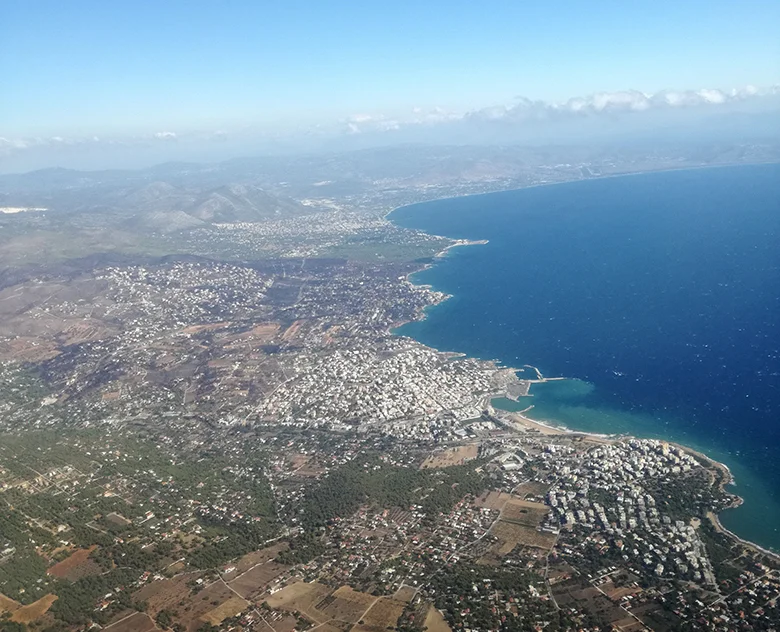
Mati lies on the east Attica coast near Rafina and Nea Makri, at roughly 38.05 degrees north, 23.87 degrees east, facing the Gulf of Petalioi. The wooded slopes of Mount Penteli rise inland to the west and make a clear navigational landmark; the coastline and the port of Rafina anchor the scene from the air. Athens International Airport (LGAV) is about 15 km to the south. Recommended viewing altitude 2,000 to 4,000 feet AGL; note that strong, gusty northerly winds (the meltemi) are common here in summer and can produce turbulence and reduced visibility from smoke or haze.
Nearby Stories
- Great Sand Beach 5 km away
- Battle of Delium 7.7 km away
- Tower of Aliartos 9 km away
- HMHS Britannic 10 km away
- Saronic Gulf 15 km away
- Sousaki Volcano 17 km away
- Sanctuary of Apollo Maleatas 24 km away
- Skyros 66 km away
Sources
- 2018 Attica wildfires - Wikipedia
- 5 former officials are convicted over Greece's deadliest wildfire but are freed after being fined — AP via Washington Post
- Greece wildfires: families embraced until final moment — Al Jazeera
- FIRE GLOBE: Attica Region, Greece (July 2018) — International Association of Wildland Fire