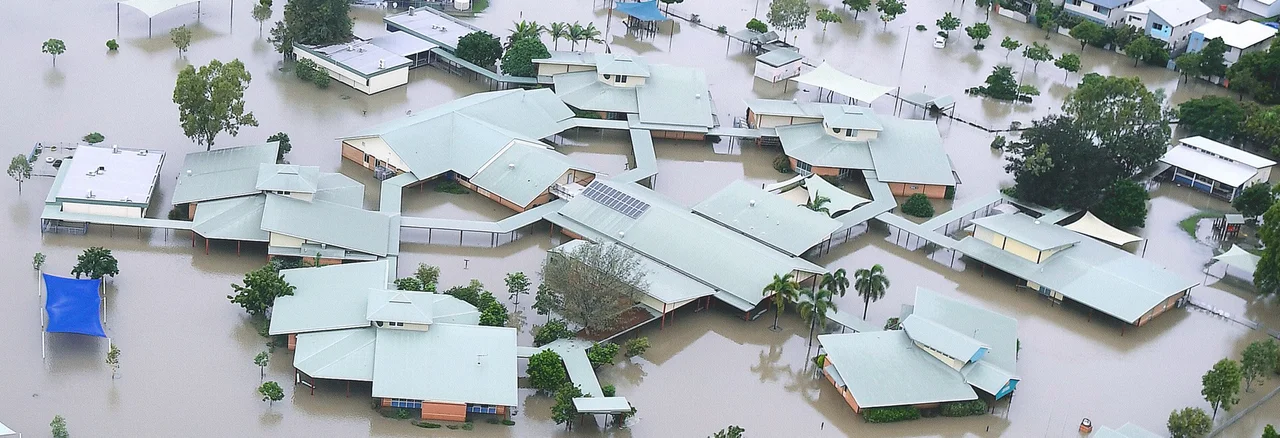

2019 Townsville flood
For a week at the start of February 2019, the rain over Townsville simply would not stop. A tropical low had stalled inland, locked in place by a sluggish monsoon trough, and it sat there day after day, pouring water onto a city already saturated. By the time it moved on, around 3,300 homes had been damaged and roughly 1,500 made uninhabitable. Townsville had weathered some twenty major floods since the 1860s, but this was among the worst disasters the region had ever known - and people who lived through it are rebuilding from it still.
The Storm That Stopped
The setup was deceptively simple. Moist northerly air, driven by the tropical low, collided with south-easterly winds off the coast, and where the two air masses met they wrung out rain in enormous quantities. The system barely budged for about a week. Some suburbs - Rosslea, Hermit Park, Idalia - went under; in the northern suburb of Bluewater, sudden intense downpours sent flash flooding tearing through. This is a city that knows the violent swing between drought and deluge intimately, but the sheer persistence of this storm overwhelmed defences and turned familiar streets into waterways. Townsville sits in the dry tropics, where long rainless stretches can give way, almost overnight, to a monsoon dumping a year's worth of water in a week. The same trough that drowned the coast fed catastrophe inland, where it fell on country already cracked by years of drought.
Opening the Gates
At the heart of the crisis was the Ross River Dam. As the water kept rising, the dam climbed past 200 percent of its capacity, and on 3 February emergency planners faced an agonising choice: hold back a dangerously overfull dam, or release the pressure and worsen the flooding downstream. They opened the spillway gates fully. The decision was the right one for the dam's safety, but it sent a surge into the Ross River and the neighbourhoods along it. The river clawed at its own banks - erosion gnawed away the rock and concrete beneath a riverside path, and record water at Aplins Weir damaged a pedestrian bridge. Families downstream watched the water keep coming.
The Cost in Lives
Behind the numbers were people. Two men were found dead in the floodwaters, and a third person reported missing was never found - a family that hired a helicopter to search the swollen river days later, refusing to give up. The danger did not end when the rain did. The floods stirred a soil-borne bacterium that causes melioidosis, and two more people died of the infection in the weeks that followed, with at least ten others hospitalised. Out west, where the same weather system fell on country gripped by drought, the losses were staggering in a different way: as many as half a million cattle are thought to have perished in the floodwaters and mud, a blow that scarred graziers for years.
The Tinny Army
What people in Townsville remember alongside the loss is who showed up. State Emergency Service crews, the rural fire service, council workers, the Australian Defence Force and volunteer groups all moved in to rescue and recover. But the image that endured was homegrown: ordinary residents launching their small aluminium dinghies - tinnies - to pull neighbours from flooded houses, until there were so many boats and willing hands that local media named them the "tinny army." When the water finally fell, it left behind a vast clean-up, some 30,000 insurance claims, and damage estimated at around 1.243 billion dollars. The recovery was long, measured not in weeks but in years of gutted houses, insurance battles and slow rebuilding. In a city built on the knife-edge between flood and drought, 2019 became a marker against which other hard years are measured - and a sharp reminder of how quickly the dry tropics can turn.
From the Air
The 2019 flood centred on Townsville at roughly 19.26°S, 146.82°E, on the Queensland coast at Cleveland Bay. The Ross River runs through the city to the sea, with the Ross River Dam upstream to the south-west; the dam and the river corridor were the focus of the disaster and remain the key landmarks for understanding the event from above. Castle Hill's pink granite dome rises over the city centre. Nearest airport is Townsville (YBTL / TSV). The wet-season monsoon that drove the flood brings low cloud and heavy rain from roughly December to March; the clearest viewing is in the dry season, May to October.
Nearby Stories
- Ayr 13 km away
- SS Yongala 34 km away
- Great Palm Island 35 km away
- Bindal People 50 km away
- Cardwell UFO Festival 83 km away
- Hinchinbrook Island 113 km away
- Porcupine Gorge 215 km away
- Samarai 998 km away