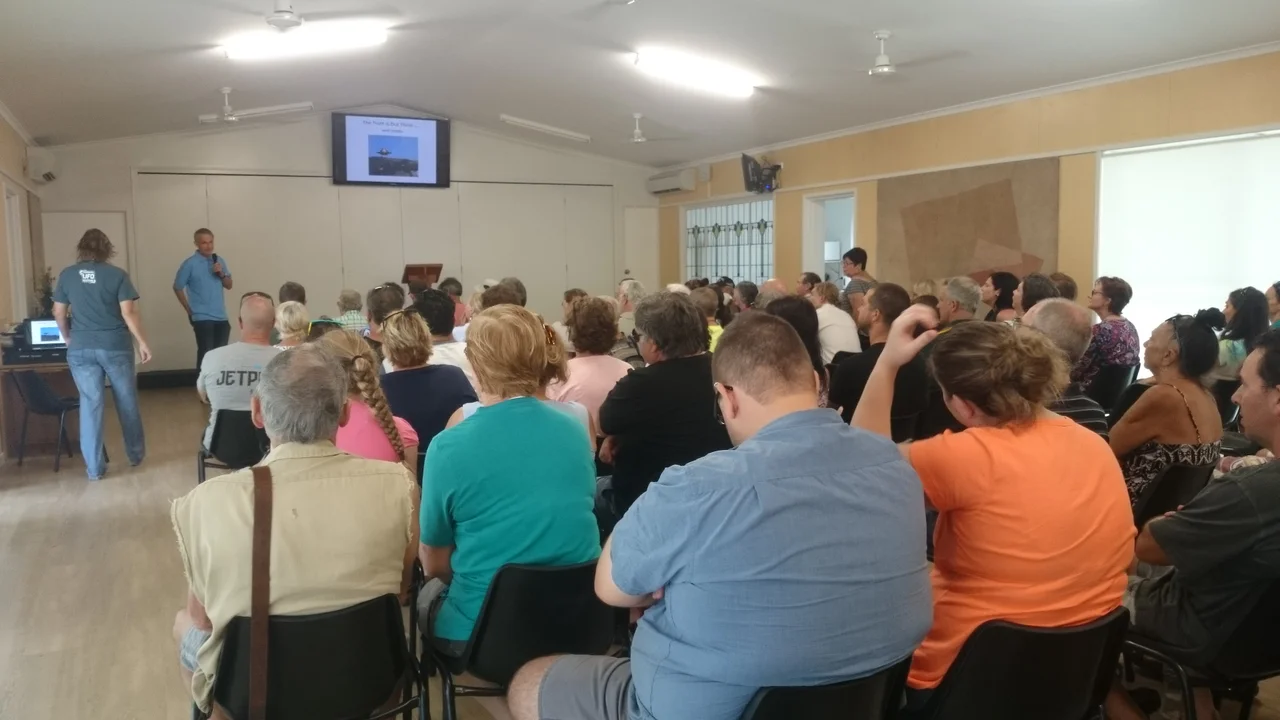

Cardwell UFO Festival
Cardwell is the kind of place where not much is supposed to happen - a small town strung along the tropical Queensland coast, palm trees, a jetty, the green hump of Hinchinbrook Island filling the eastern horizon. And then, once a year in August, it fills up with people scanning the sky. The Cardwell UFO Festival bills itself as the only event of its kind in Australia, and for a couple of days the town leans cheerfully into the strange: market stalls and food, family fun, an alien-themed costume party, and a forum where ordinary people stand up and describe the things they swear they have seen.
A Birthday Party for a Town
The festival was the idea of Thea Ormonde, whose own childhood encounter sparked a lifelong fascination with the unexplained. In 2014, casting around for a way to mark Cardwell's 150th anniversary, she landed on something the district had quietly carried for decades: a reputation. This stretch of coast and hinterland has long been thick with stories of odd lights and odder sightings, and Ormonde turned that local lore into a celebration. What began as a quirky one-off for the town's sesquicentenary grew into a two-day fixture that now draws thousands - sceptics and true believers mingling at the same market day, which is rather the point.
The Saucer in the Lagoon
The festival's deepest roots reach back to a January morning in 1966, just up the road near Tully. A 28-year-old banana farmer named George Pedley was driving his tractor across Albert Pennisi's property when, by his account, a large grey saucer-shaped object rose with a hiss from Horseshoe Lagoon, climbed to treetop height, tilted, and shot away to the southwest in a burst of speed. The whole thing lasted seconds. What it left behind became famous: a near-circular depression of flattened, swirled reeds in the lagoon, one of several that came to be called the Tully Saucer Nests. The case made national news and is still a cornerstone of Australian UFO lore - the kind of unresolved story a festival like this exists to keep alive.
The C-Files
At the heart of the weekend is the C-Files, the festival's open forum - a deliberate play on a certain television show, and an invitation for anyone to take the microphone. People come to recount their UFO experiences, but the conversation rarely stops at flying objects. The folklore of the Australian outback is wonderfully broad, and the C-Files makes room for all of it: the Min Min lights that famously hover and recede across the plains, tales of hairy men in the rainforest, large black cats prowling the bush, and other mysteries the region has accumulated over the years. A 2016 forum featured a guest speaker from Queensland UFO Research, lending the proceedings a note of earnest inquiry amid the fun.
Why Here
There is something fitting about all this happening in Cardwell. The town sits where dense, dripping rainforest meets the reef-fringed sea, a landscape that has always felt a little uncanny - the sort of place where a strange light over the water or a sound in the canes invites a story rather than a shrug. The festival never insists you believe anything. It simply gives the believing and the doubting a shared weekend, a costume party, and a forum, and lets the tropical night do the rest. In a country full of small-town festivals built around pumpkins and prawns, Cardwell chose the wide dark sky - and made it the friendliest mystery in Queensland.
From the Air
Cardwell sits at 18.27 degrees South, 146.03 degrees East, on the tropical coast of far north Queensland between Townsville and Cairns, with Hinchinbrook Island looming immediately offshore to the east. From the air the town is easy to fix: a thin coastal strip pinned between the Cardwell Range rainforest and the Hinchinbrook Channel, with the island's jagged granite peaks the dominant landmark. The Tully Saucer Nest site lies near Tully, just to the north. The nearest small airfields are Cardwell/Dallachy (YCDW) and Tully (YTUY), with sealed major airports at Townsville (YBTL) and Cairns (YBCS). The festival is held in August, in the dry season - cooler, clearer skies and the best chance of an unobstructed view of that famous horizon.
Nearby Stories
- Hull River Aboriginal Settlement 7.5 km away
- The Great Barrier Reef: The Living Structure Visible from Space - Now Dying 47 km away
- Orpheus Island National Park 48 km away
- Cyclone Yasi 79 km away
- Magnetic Island 79 km away
- Rocky Creek World War Two Hospital Complex 83 km away
- Undara Volcanic National Park 100 km away
- Porcupine Gorge 247 km away