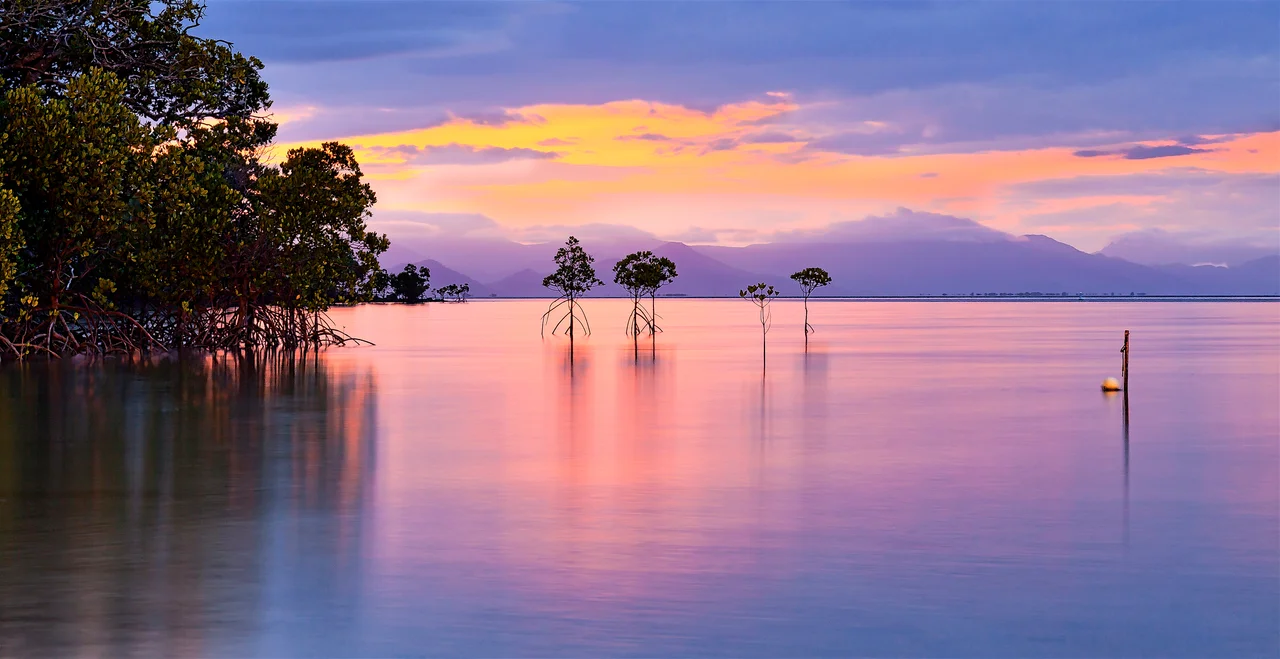

Orpheus Island National Park
Underwater, off the shore of a small island called Goolboddi, sits a coral the size of a small house. Scientists who measured it in 2021 found it was more than ten metres across, among the very largest Porites corals on the entire Great Barrier Reef, and likely several centuries old, older than the European name the island wears. Manbarra Traditional Owners gave it the name Muga dhambi, big coral. It is a fitting emblem for Orpheus Island: a place where the quiet, slow, spectacular life of the reef has been left mostly to itself.
Goolboddi
Orpheus Island is a continental island, a drowned ridge of the mainland rather than a coral cay, long and narrow and mountainous, lying in the Palm group within the Shire of Hinchinbrook with little Pelorus Island just eight hundred metres off its northern tip. Before Europeans arrived it was the country of Aboriginal people, probably the Nyawaygi, who knew it as Goolboddi. Its current name came in 1887, when Lieutenant G. E. Richards bestowed it after HMS Orpheus, a Royal Navy ship lost off New Zealand in 1863 with heavy loss of life, one of that colony's worst maritime disasters and an odd memorial to attach to so peaceful a place. The national park, declared in 1960, takes in Orpheus itself and also Albino Rock, a small outcrop a few kilometres east of Great Palm Island.
A Classroom on the Reef
Where Great Palm carries a heavy human history, Orpheus has become a place of study and quiet. James Cook University runs a research station here, a working base for marine science with laboratories, aquariums, vessels and beds for around sixty people, set against some of the best fringing reef in Queensland. The waters around the island are extraordinarily rich, home to well over a thousand species of fish and hundreds of kinds of coral, a living laboratory a few fin-kicks from shore. Since 2018 the group Reef Ecologic has held an annual reef restoration and leadership workshop at the station. Citizen scientists logging sightings on the island have recorded hundreds of species, from corals and fish to the bright green tree frogs that turn up, improbably, on a reef island. It is the Great Barrier Reef used as a textbook, read patiently, page by living page.
The Giant Clams of Pioneer Bay
Minutes by boat from the island's shore lies one of its strangest wonders: a garden of giant clams. Hundreds of them rest on the seabed at Pioneer Bay, each weighing as much as two hundred kilograms, their mantles rippling in blues and greens as they filter the warm water. They were not always here. In the 1980s, with the species hunted toward collapse across the Indo-Pacific, scientists planted a clam nursery on the reef to pull it back from the edge. The garden grew into the population that snorkellers glide over today, a rescue made visible, evidence that ruin is not always the last word on the reef.
The Exclusive Shore
On a corner of the island, screened by forest, stands one of the Great Barrier Reef's most exclusive retreats. Orpheus Island Lodge holds just fourteen suites and no more than twenty-eight guests at a time, an intimacy that is the whole point, with the reef beginning a few steps from the sand. From here visitors snorkel the fringing coral, dive among hundreds of species of fish, and motor out to the clam garden. The contrast with neighbouring Great Palm could hardly be sharper: one island a community shaped by exile, the other a place most people reach only by helicopter. The same warm sea connects them, and the same reef, indifferent to the borders drawn above the waterline.
From the Air
Orpheus Island National Park centres on Orpheus Island (Goolboddi) at roughly 18.62 degrees south, 146.49 degrees east, in the Palm Islands group on the inner Great Barrier Reef, with Pelorus Island just 800 m to the north and the park also taking in Albino Rock near Great Palm Island. The island is long, narrow and mountainous, fringed by reef and notably greener and quieter than developed resort islands. There is no public airfield; access is by boat or helicopter from Townsville Airport (YBTL / TSV), the nearest major field, with Palm Island Airport (YPAM) close by. Calm, clear water makes the fringing reefs and the giant clam garden visible from low altitude in good light. Best in the dry season; cyclonic weather December to April.
Nearby Stories
- Hinchinbrook Island 21 km away
- Mount Spec Road and Little Crystal Creek Bridge 28 km away
- The Great Barrier Reef: The Living Structure Visible from Space - Now Dying 32 km away
- Cape Cleveland Light 42 km away
- Mount Bartle Frere 100 km away
- SS Yongala 110 km away
- Undara Volcanic National Park 143 km away
- Porcupine Gorge 236 km away