_014.jpg)
2024 United Kingdom Riots
Three children died at a Taylor Swift-themed dance workshop in Southport on 29 July 2024. Bebe King was six. Elsie Dot Stancombe was seven. Alice Dasilva Aguiar was nine. Eight other children were hurt, five of them critically; two adults at the event were critically injured trying to protect the children. The town's grief was real and bottomless. What happened over the following week was something separate: a coordinated wave of far-right unrest across England and Northern Ireland, built on the false claim that the attacker was a Muslim asylum seeker, that spread through social media before the police could correct it, and that fed on Islamophobia and anti-immigrant sentiment in ways that hurt many of the very communities Southport itself contains.
What the Police Knew, What the Internet Said
The attacker was a seventeen-year-old British citizen born in Cardiff to Rwandan parents, who had moved to the Southport area with his family in 2013, with no known links to Islam. The police could not initially name him because of his age. Into that information gap the disinformation flowed. A false name, Ali Al-Shakati, was invented and circulated on an anti-lockdown X account, then amplified by Channel3Now, a website known for fake news, and by far-right figures. The lie that the killer was a Muslim asylum seeker reached millions of British phones within hours of the attack. Police inspectors who reviewed the response later said the information had been left up too long, that platforms had failed to act, and that the result was a riot.
Southport, Then Everywhere
On the evening of 30 July, a crowd gathered near Southport Mosque, throwing stones at the building and at the police line in front of it. The local Labour MP Patrick Hurley said the rioters were not Southport people but had come in from elsewhere, were using the murdered children's deaths for their own ends, and had insulted the grieving town. Over fifty police officers were hurt that night. Three police dogs were wounded. Across the next week the pattern repeated in different cities: Manchester, Hartlepool, Sunderland, Liverpool, Hull, Belfast, Rotherham, Middlesbrough, Bristol, Tamworth, Plymouth. Mosques were targeted. Hotels housing asylum seekers were set on fire while people were inside. A library serving a poor neighbourhood in Liverpool was burned down. In Hull a mob attacked three Romanian men in a car. In Belfast immigrant-owned businesses were burned out and a man in his fifties was beaten and his head stamped on.
The People in the Hotels
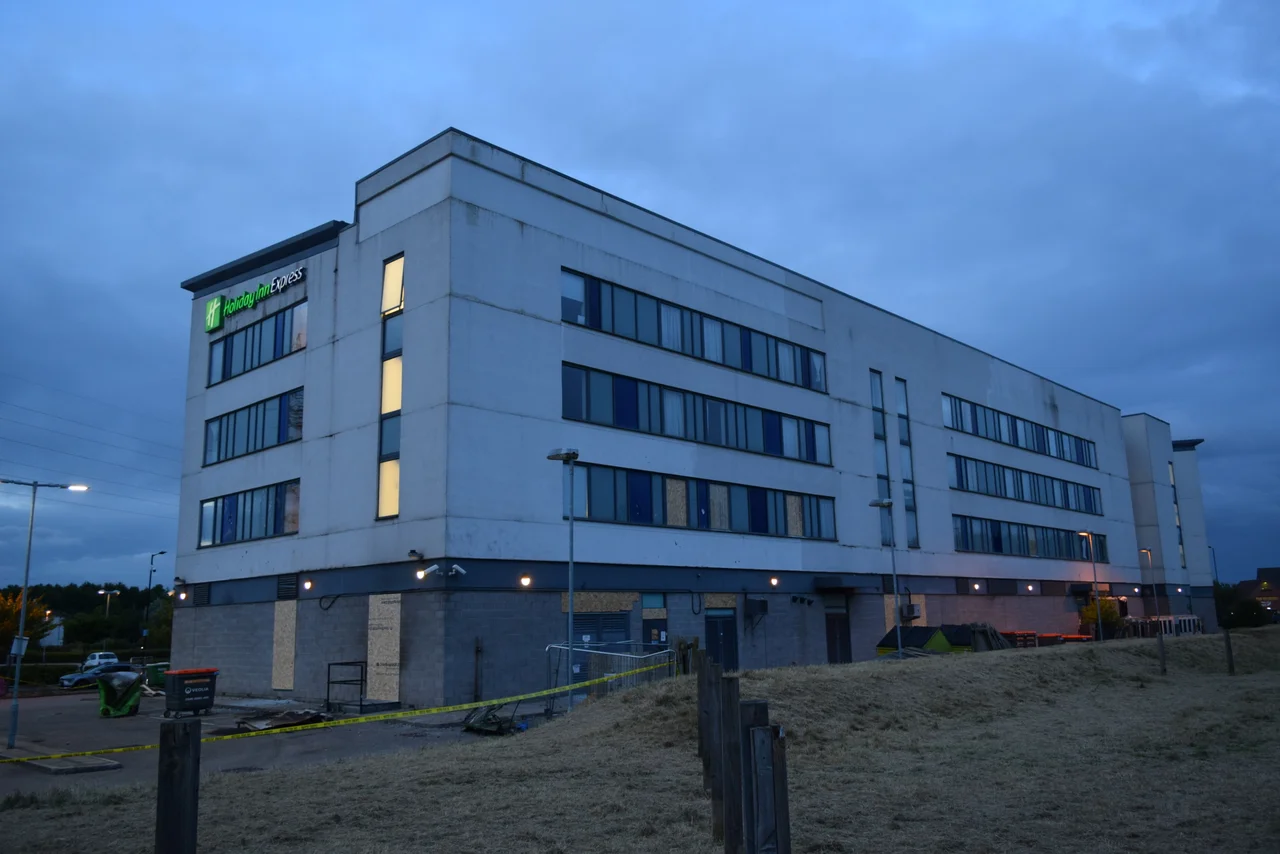
It is worth saying clearly who the people in those hotels were. They were asylum seekers, that is, people who had applied for refugee status and were waiting for their claims to be decided. They had come from Syria, Afghanistan, Eritrea, Iran, Sudan, places whose names appear in news bulletins about war and political collapse. They were not allowed to work while their cases were pending and were housed by the Home Office in budget hotels in towns like Rotherham and Tamworth. When mask-wearing men set fire to the Holiday Inn Express in Rotherham on 4 August, the people inside heard the chants, smelled the smoke, and did not know whether the police would arrive before the fire did. Fifty-one officers were injured holding the line in front of the building. The asylum seekers inside survived, but the experience is not something you walk away from undamaged.
The Counter-Mobilisation
By the second week the pattern changed. On 7 August, when over a hundred far-right protests had been announced online with immigration lawyers' offices on the target list, around twenty-five thousand counter-protesters turned out across the country. In Walthamstow alone an estimated ten thousand anti-racism demonstrators filled the streets. In Brighton, eight far-right protesters were surrounded by police who needed to protect them from two thousand counter-protesters. In Liverpool, hundreds formed a human shield around a former church used by an asylum-seeker charity. Stand Up to Racism, the Muslim Council of Britain, churches across Northern Ireland, and Jewish, Sikh and Hindu communities all released statements condemning the violence. Most of the planned far-right gatherings did not materialise. The numbers, in the end, were not on the rioters' side.
Sentences, Suicides, and the Argument After
By July 2025, 1,840 people had been arrested in connection with the unrest and 1,103 charged. Sentences ranged from twenty months to nine years. Two twelve-year-old boys were among those convicted. Peter Lynch, aged sixty-one, who had shouted abuse at police outside the Rotherham hotel, was jailed for two years and eight months and hanged himself at HMP Moorland on 19 October 2024, two months into his sentence; his death prompted a wider conversation about who exactly was being radicalised online and what their lives looked like when they walked into the streets. A police inspectorate review in May 2025 concluded that most rioters were locals, that the violence was mainly unconnected to organised extremist ideology, that social deprivation and austerity and falling trust in policing had created the conditions, and that disinformation had lit the fuse. The names of the three children remain. King Charles III visited Southport on 20 August and met their families. Their grief is not part of the riots' story. It came first and stayed after, and Southport itself has had to find its own way back to ordinary mornings without them.
From the Air
The Southport attack site coordinates are approximately 53.65 N, 3.01 W on the Lancashire coast. Recommended viewing altitude 3,000 to 5,000 feet to take in the Southport-Birkdale shoreline and the wider Sefton coast. Nearest airports: Blackpool (EGNH) 13 nautical miles north, Liverpool John Lennon (EGGP) 17 nautical miles south, RAF Woodvale (EGOW) 4 nautical miles south. The 2024 unrest spanned many towns across England and Northern Ireland and is not a single visitable site; Southport's pier, promenade, and Lord Street are the landmarks most associated with the immediate context.
Nearby Stories
- Kingsway Tunnel 3.1 km away
- Helmshore Mills Textile Museum 8.3 km away
- Heysham Port 9 km away
- Tatton Park 13 km away
- Abergele Rail Disaster 18 km away
- Malham Cove 23 km away
- Llandudno 47 km away
- Egremont Castle 57 km away