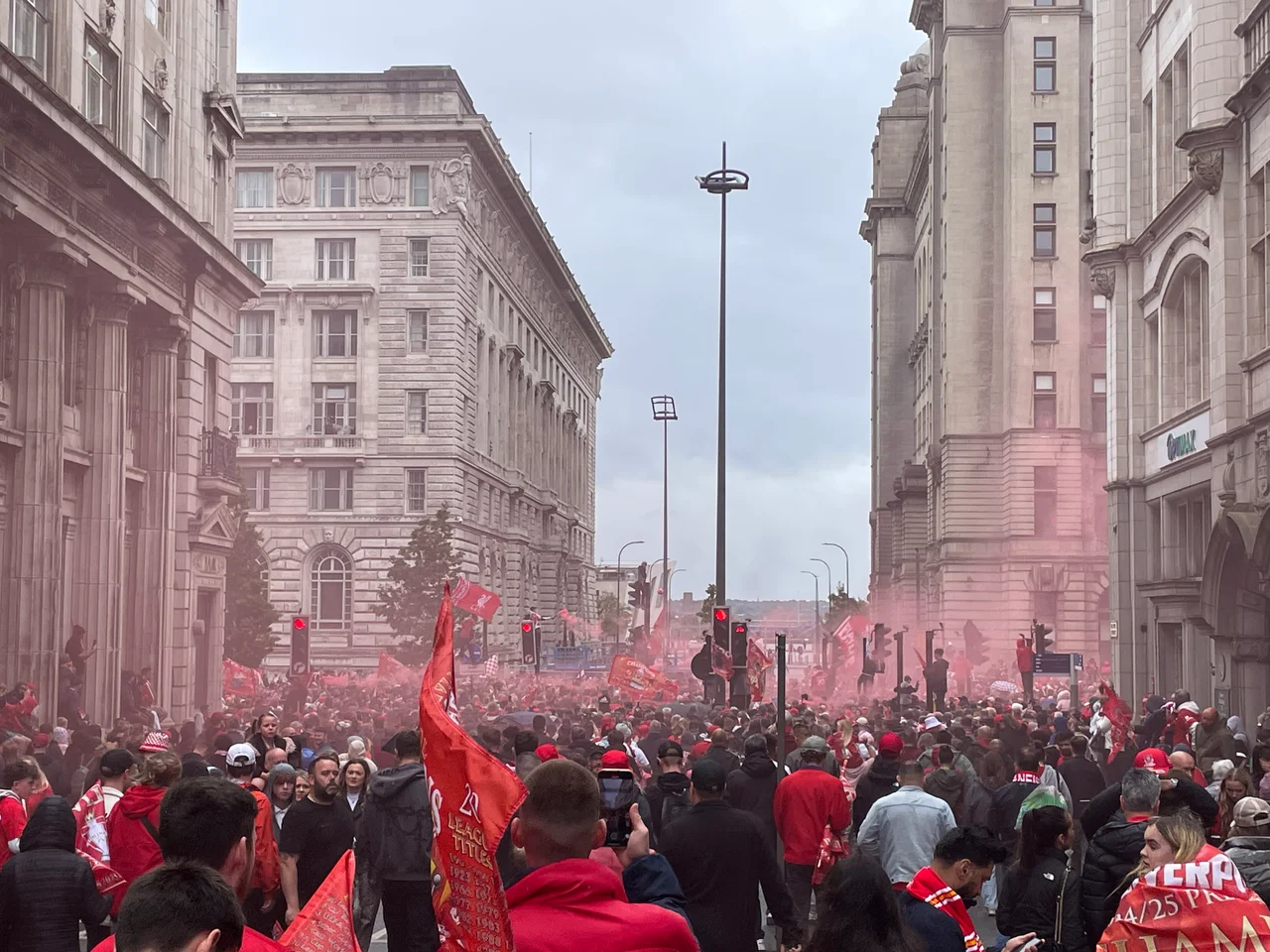

2025 Liverpool parade attack
Liverpool had been waiting thirty-five years for the Premier League title their club had just won. On the afternoon of 26 May 2025, an estimated one million people lined the ten-mile parade route from Allerton Maze to The Strand. Children sat on shoulders. Families had brought packed lunches. The open-top bus carrying the team had passed through Water Street ten minutes earlier, and the crowd was still there, still cheering, when a grey Ford Galaxy accelerated into them between six minutes to six and six o'clock in the evening. More than a hundred and thirty people were injured. Among them were children as young as nine. No one died. Liverpool's response over the days that followed became its own kind of answer to what had been done to it.
The Parade
Liverpool Football Club had just clinched the 2024-25 Premier League title, their second top-flight championship of the decade and the first under manager Arne Slot. The victory parade had been announced on 28 April and was a long-anticipated communal celebration in a city where football is more than recreation. The bus left Allerton Maze and worked its way north through the city. St John Ambulance was providing event cover with twelve ambulances on standby. An estimated one million supporters lined the route, the largest crowd Liverpool had assembled since the 2019 Champions League parade. By six o'clock, the bus had passed through Water Street in the city centre and was heading down to The Strand by the riverfront. The crowd along Water Street stayed where they were, still talking, still photographing, still in the kind of communal mood that football parades produce.
What Happened on Water Street
Between 17:59 and 18:01 BST, Paul Doyle, a 53-year-old man from West Derby, drove his grey Ford Galaxy into the crowd. According to a witness account, he had argued with pedestrians before the vehicle accelerated. The car struck multiple people and trapped some beneath it. When the vehicle stopped, supporters tried to drag him out, and people began smashing the windows. Doyle then accelerated again and collided with more people. Footage from the vehicle's dashboard camera, later played at his trial, recorded him shouting "move" and swearing at the crowd, including after a ten-year-old girl was struck. When the car finally came to rest, fans tried to pull him out; police officers intervened to protect him from the crowd. By half past nine that evening, North West Ambulance Service reported that the scene had been cleared. The injured ranged in age from nine to seventy-eight. Three adults and one child had been pulled from beneath the car.
The Casualty Count
Police initially identified seventy-nine injured people; the figure rose in the days that followed to over one hundred and thirty. At least fifty were taken to hospital. Four children were among them, and prosecutors later filed charges relating to two infants. The doctors at Aintree, the Royal Liverpool, and Alder Hey worked through the night. Several patients had life-threatening injuries. None of them died. The final survivor to leave hospital was discharged on 30 June, having spent thirty-five days in care. The casualty list reflected the parade itself: fans of every age, in family groups, drawn together by a football victory and caught by a violence none of them had any reason to expect. The injured are not statistics. They are the people who lined Water Street to celebrate, including children whose only memory of that afternoon will now be marked by what happened.
Investigation and Trial
Merseyside Police arrested Doyle at the scene. The force announced within hours that they were treating the incident as isolated and not related to terrorism, an unusually transparent decision that Jonathan Hall KC, the Independent Reviewer of Terrorism Legislation, said should set a precedent for future incidents. Doyle was charged initially with dangerous driving and multiple counts of grievous bodily harm with intent. On 27 May he was arrested on suspicion of attempted murder and driving while unfit through drugs. He told interviewers he had acted in "blind panic" and "in fear of his life" because of the crowd's behaviour towards him. He was remanded to HMP Wakefield. On 14 August prosecutors filed twenty-four additional charges, including counts relating to the two infants. Doyle pleaded not guilty on 4 September. The trial began on 25 November. On 26 November, the second day, Doyle changed his plea to guilty on all 31 charges. On 16 December he was sentenced to 21 years and 6 months in prison. The judge said Doyle had generated "fear and panic" and that his "disregard for human life defied ordinary understanding".
The City's Answer
King Charles III said that "the strength of community spirit for which Liverpool is renowned will be a comfort and support to those in need". Prime Minister Sir Keir Starmer travelled to the city on 28 May to meet local police chiefs. Liverpool's mayor and the LFC management held a joint press conference. The football club's players visited the injured in hospital. Liverpool is a city with a long memory of communal injury and a long practice of responding to it, from the Hillsborough campaigns to the response after Sean Cox was attacked on Anfield Road in 2018. Survivors and witnesses gathered at Water Street in the weeks that followed to lay flowers and to talk. The youngest victims received specialist trauma support through the NHS. The trial concluded before Christmas, six months after the day itself. The parade route is still walked by tourists who pass through Water Street without thinking; the city has chosen to keep walking through it, to refuse to let one driver in a panic on a Bank Holiday Monday redefine the streets where a million people had come to celebrate.
From the Air
Located at 53.406N, 2.994W on Water Street in central Liverpool, a short street running west from Castle Street down to The Strand and the waterfront. From altitude, central Liverpool's grid of Georgian and Victorian streets is the dominant feature, with the Royal Liver Building and Three Graces visible on the waterfront. The Mersey opens to the west. Nearest airports: Liverpool John Lennon (EGGP, 6nm southeast) and Hawarden (EGNR, 13nm south).
Nearby Stories
- RAF Wrexham 3.3 km away
- Birkdale Palace Hotel 3.7 km away
- Turton Tower 4.1 km away
- Tatton Park 5.6 km away
- Abergele Rail Disaster 9.6 km away
- Diglake Colliery Disaster 13 km away
- Ysbyty Ifan 16 km away
- Celtic Array 62 km away