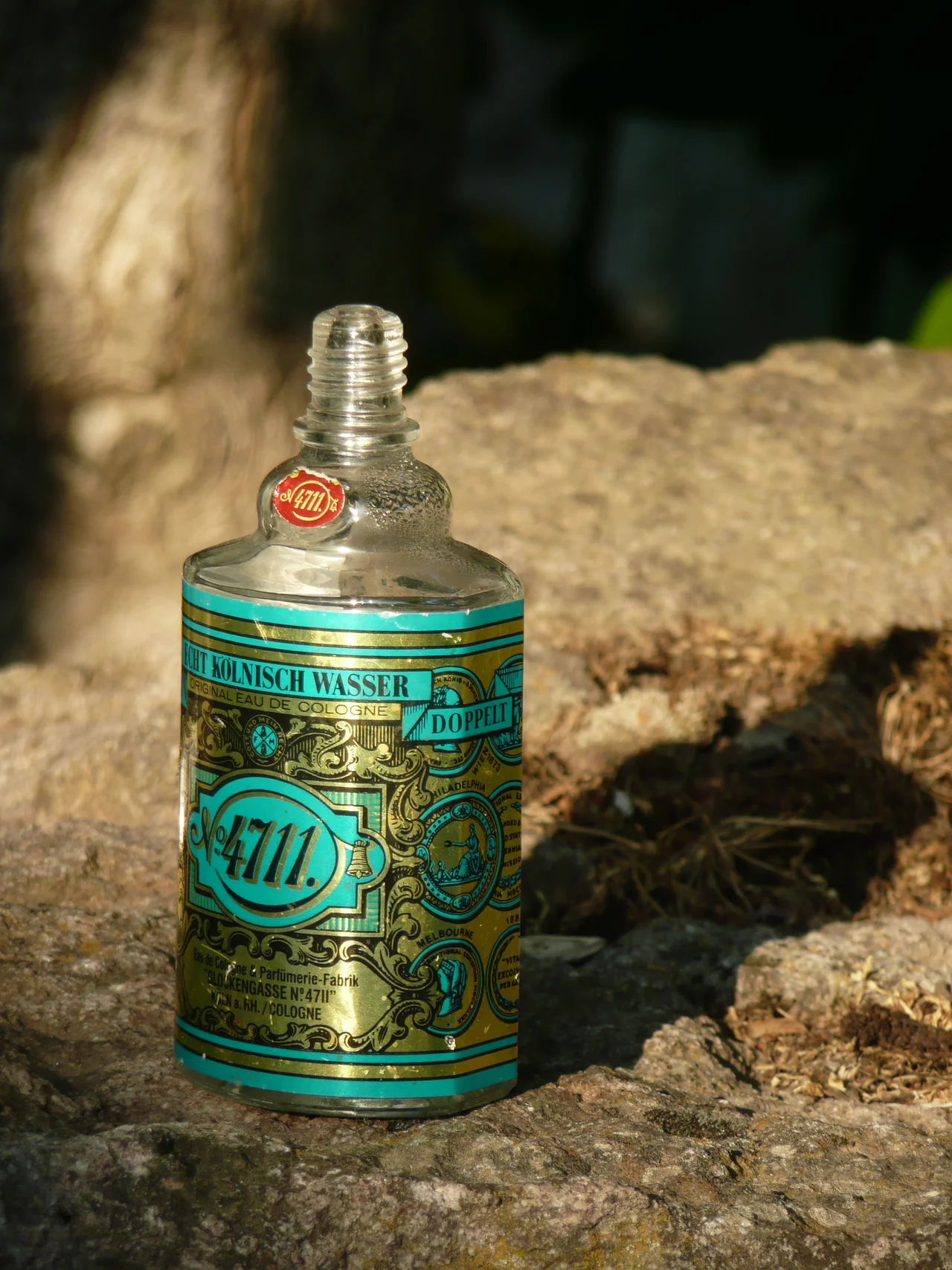

4711
It is a four-digit number, painted in cobalt blue on a green and gold label, and it has outlasted the Empire that gave it to a building. In October 1794, the French Revolutionary Army marched into Cologne and discovered a city without house numbers. Their solution, dictated for both administration and conscription, was to assign every door a single running number. The eleven-thousandth-and-something house on the list was a modest property on the Glockengasse - and the merchant who would soon occupy it had a secret recipe wrapped in tissue, gifted by a Carthusian monk at his wedding two years earlier. The number was 4711. The recipe was for what its inventor called aqua mirabilis. Together they would become the longest-running fragrance brand on Earth.
The Monk's Wedding Gift
On 8 October 1792, the merchant Wilhelm Mülhens married in Cologne, and a Carthusian monk - the order famous for distilling Chartreuse a few hundred kilometers to the south - pressed a folded paper into his hand. According to the company's own legend, the paper held a formula for a citrus-bright tonic meant to be both drunk and dabbed, a remedy for almost anything a body could complain of. Italian perfumers had already made Cologne famous for fragrant waters; Johann Maria Farina had been selling his own Eau de Cologne since the 1700s, naming the city he had adopted. Mülhens chose not to compete on artistry. He set up a small workshop on the Glockengasse, bottled the monk's recipe, and waited for the French to do the rest.
How a House Got Its Number
Cologne in 1794 was an unhappy free city about to be conquered. On 3 October, with French troops massed at the gates, the city council voted to install streetlights and to number every house, citizen or stranger. Three days later the French walked in. Within forty-eight hours, every local official had been ordered to inventory the inhabitants of his district. The numbers were assigned house by house in a single running sequence across the entire city - a system that lasted only until 1811, when Cologne reverted to per-street numbering. The original Glockengasse building marked 4711 was eventually torn down. The number, however, refused to die. It had migrated to the bottle, and the bottle was selling everywhere French soldiers carried it home.
A Lawsuit, a Loophole, a Mortara Farina
Success bred imitators, and Mülhens reached for the most valuable name in fragrance: Farina. The Italian Farina family of Cologne, real makers of real Eau de Cologne since the early eighteenth century, sued. The dispute dragged on from 1800 to 1881, an eighty-one-year quarrel over a single surname. In 1832 the Mülhens family finally lost. They responded with one of the most audacious workarounds in commercial history: they tracked down an unrelated Mr. Farina in the small Italian town of Mortara and hired him, so they could keep printing the name on the label. The official company name remained a magnificent mouthful - Eau de Cologne & Parfümerie Fabrik Glockengasse No. 4711 gegenüber der Pferdepost von Ferd. Mülhens in Köln am Rhein - until 1990.
Submarines and Truman Capote
By the twentieth century, 4711 had drifted into places its inventor could not have imagined. The German Kriegsmarine issued bottles to U-boat crews, hoping to mask the smell of unwashed sailors crammed into steel cylinders for weeks; the crews mostly hoarded the bottles as gifts for mothers and wives back home. Truman Capote put it in Holly Golightly's medicine cabinet in Breakfast at Tiffany's. Frank-N-Furter wore it as a tattoo on his thigh in Rocky Horror. In Finland, where desperate drinkers had been known to swallow cologne for the alcohol, the Poison Information Centre took 4711 as its first telephone number. The brand survived the bombing of Cologne, the death of the Mülhens family business, takeover by Wella, absorption by Procter & Gamble, and a 2006 sale to Mäurer & Wirtz of Stolberg - the same formula, the company maintains, that the monk wrote down in 1792.
Glockengasse Today
The original house at Glockengasse 4711 is gone. A neo-Gothic flagship store at Glockengasse 4 occupies the spot, with a carillon that plays the Marseillaise each hour - a wink at the French soldiers who, the company's twentieth-century advertising falsely insisted, painted the famous number on the door themselves while seated on horseback. That image is pure invention, traced to a 1920s tapestry that ad executives later promoted as history. The truth is quieter and stranger: an Italian fragrance, a German merchant, a French clerk's bookkeeping, and a wedding gift from a silent monk - layered onto each other for two and a quarter centuries in a single bottle of green water.
From the Air
Glockengasse 4, in Cologne's Altstadt-Nord at 50.9385 N, 6.9523 E, sits a few hundred meters southwest of Cologne Cathedral and just west of the Rhine. From cruising altitude over the Lower Rhine plain, look for the cathedral's twin spires - the 4711 store is in the dense street grid immediately to their southwest. Cologne Bonn Airport (EDDK / CGN) is roughly 15 km southeast; Düsseldorf (EDDL / DUS) is 35 km north. Best viewing in clear weather between 3,000 and 8,000 ft on approach to either.
Nearby Stories
- Diamond Interchange: How a Simple Idea Reshapes Towns Like Julich 2.8 km away
- Dusseldorf-Unterbach 6.1 km away
- Baumwollspinnerei Ermen & Engels 11 km away
- RAF Bruggen 15 km away
- Hagen Open-air Museum 21 km away
- Belgium 130 km away
- Marcinelle Mining Disaster 173 km away
- Zwingenberg Castle 178 km away