,_Sir_Benfro_-_Pembrokeshire,_Wales_01.jpg)
Abercastle
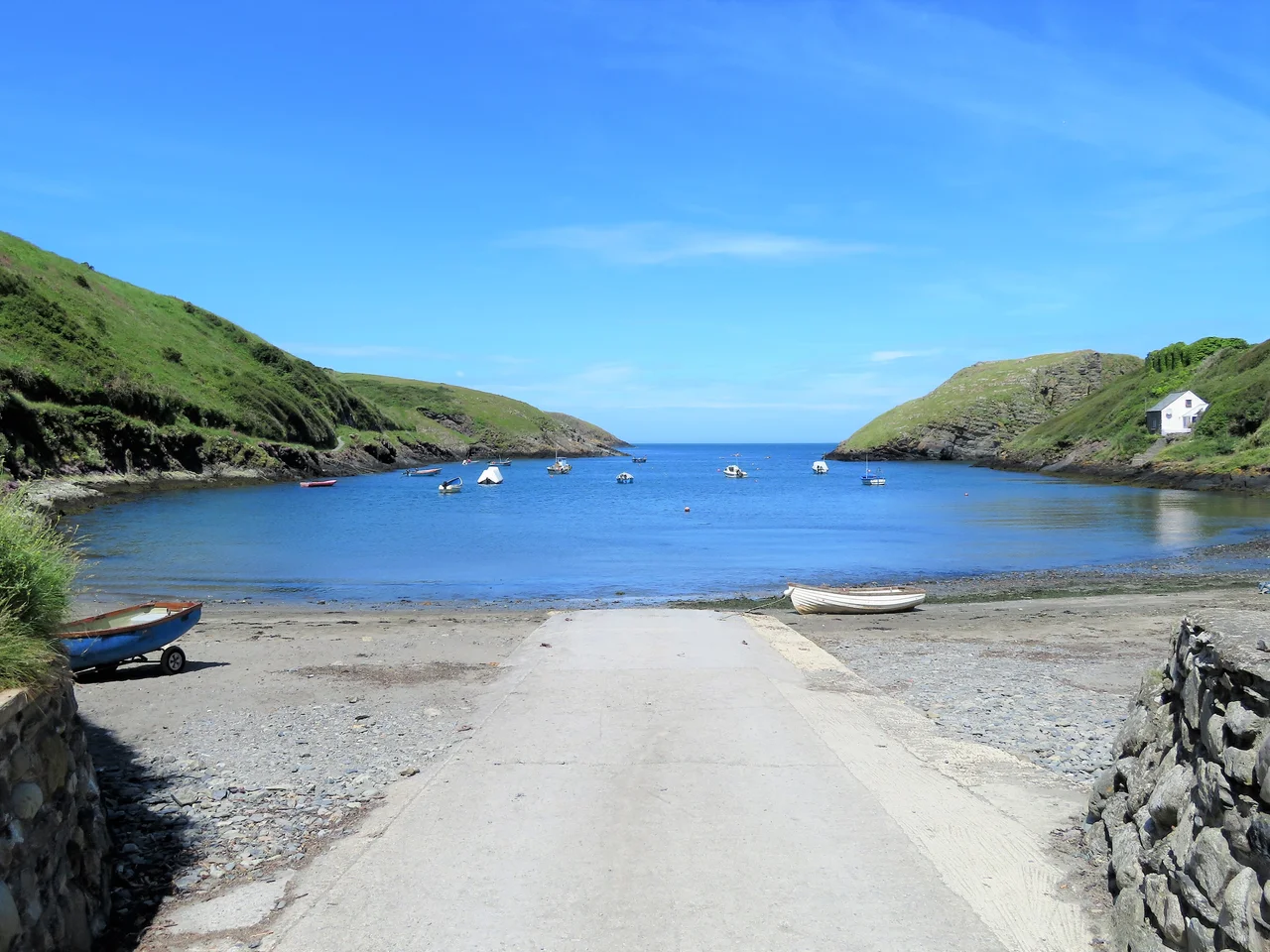
On Saturday 12 August 1876, a 20-foot dory called Centennial sailed into the small harbour at Abercastle after sixty-six days at sea. Her captain was Alfred Johnson, a Danish-born American who had set out from Gloucester, Massachusetts, with the unsupported intention of being the first person ever to sail solo across the Atlantic. He was the first. The village he chose for his landing - by accident, as much as anything; he was aiming for Liverpool - is barely a hamlet. A working harbour, a slipway, a few stone cottages. The same northwest exposure that sheltered Johnson from the southwesterly gales has sheltered fishing boats here for centuries. And on the cliff above, much older than any of it, stands a Neolithic burial chamber the locals call Samson's Stone.
Sixty-Six Days
Alfred Johnson was twenty-nine, a Gloucester fisherman, and he had built the Centennial specifically for the crossing - a modified dory with a small cabin, named after the 1876 centennial of American independence. He carried provisions, navigation instruments, and an unreasonable amount of confidence. The Atlantic in those days was crossed by steamers and large sailing ships; the idea of crossing alone in a 30-foot open boat was widely judged either insane or impossible. Johnson set out from Gloucester, Massachusetts, on 15 June 1876. He fought through storms, was rolled by a wave that nearly ended the voyage off Newfoundland, and arrived at Abercastle on Saturday 12 August - sixty-six days after leaving Massachusetts. He had been aiming for Liverpool but came in well south. A St Davids poet, Tony Davies, later wrote a verse for him: 'Sixty-six days, three thousand miles, / Record breaking, Abercastle smiles, / Liverpool, trip complete, / The courage of Captain Johnson and Centennial's feat.' A small plaque on the harbour wall now marks where he came ashore.
What the Harbour Carried
Long before Johnson, Abercastle had been a working harbour for over a thousand years. Local slate left here by sea, along with grain, limestone, butter, honey, corn, and a little coal - the modest mixed exports of a remote agricultural and quarrying community. The nineteenth-century limekilns whose ruins still stand on the cliff edge processed local limestone into mortar and fertiliser. Trade declined as roads and railways reached the rest of Pembrokeshire, and Abercastle dwindled. The harbour now serves the local fishing fleet, plus visiting sea kayakers and the small armada of small boats that summer brings. The slipway runs down to soft sand. The Strumble Shuttle, the coastal bus, calls here. Nothing about the place suggests it once received an ocean crossing for the books.
Samson's Stone
On the headland half a mile west of the harbour stands Carreg Samson, a Neolithic dolmen built around 3500 BC - roughly the same age as Stonehenge, and a thousand years older than the pyramids at Giza. The massive capstone, about 15 feet long and 9 feet wide, is supported by three of an original seven upright stones. It once sat at the heart of a covered burial chamber, mounded over with earth and smaller stones. The mound is long gone, weathered away or scavenged for building material, but the central skeleton of stones remains - exposed to the sea wind on the cliff, looking as if a small house has lost its walls. Excavations in 1968 found an early Neolithic bowl inside. Local legend - which obviously cannot bear too much examination - holds that the 6th-century Welsh saint Samson placed the capstone in position with his little finger. The stone is named for him. There are nearly eighty similar dolmens scattered across northern Pembrokeshire, many oriented northeast-to-southwest and sited close to the coast. Together they record an ancient seaborne culture that traded along the western seaways between Wales, Ireland, France, and Iberia long before Rome or the Vikings or the Normans got involved.
The Leysian on the Sea Floor
Out on the west side of the harbour, fifty metres from the cliffs and fifteen metres down, lies the wreck of the SS Leysian. The 3,800-ton steamship ran aground here in 1917 and sank a few months later. There was no loss of life. Today she is a popular dive site, the wreckage settled into a marine garden busy with fish - including, divers report, a notably large pollock that has made the wreck its territory. In June 2019 the Nautical Archaeology Society field school began a detailed survey of the site. Like much of this coast, Abercastle Bay holds its stories underwater as well as above.
Walking the Coast Path
The Pembrokeshire Coast Path passes directly through Abercastle, threading between the cliffs and the harbour. Walked north, the path leads to Porthgain in about forty minutes - past the abandoned slate quarries that once shipped through these harbours, past sea stacks and arches carved by Atlantic swell. Walked south, it rounds Strumble Head and continues toward St Davids and Whitesands Bay. Either direction, this is some of the most dramatic coastal walking in Britain - steep, exposed, often weathered by wind or spray. Abercastle itself is a pause, a place to come down off the cliff to a public telephone, a few parking spaces, and a slipway that has been receiving boats since the Bronze Age. The harbour faces northwest, which means the Atlantic blow that flattens everything else along this coast slides past instead of crashing in. That is why the dolmen-builders chose this stretch, why the trading ships used it, why Alfred Johnson found shelter here. Geography did the work. The rest is just centuries.
From the Air
Abercastle is a tiny coastal hamlet at 51.96 N, 5.12 W on the north Pembrokeshire coast, between St Davids Head and Strumble Head. From the air, look for a small, sheltered northwest-facing inlet with a stone harbour and a handful of cottages; Carreg Samson dolmen is on the cliff about half a mile west of the harbour and is just visible as a small grey trilithon on the headland. The Pembrokeshire Coast Path runs along the clifftop. Best viewing 1,500-4,000 feet. Nearest airports: EGFE (Haverfordwest) 16 nm south-southeast, EGFH (Swansea) 70 nm east. The coast here is exposed to Atlantic weather; expect wind, fog, and frequent rain. Calm clear days reveal the full sweep from Strumble Head to St Davids Head.
Nearby Stories
- RAF Angle 0.9 km away
- Cardigan Bay Special Area of Conservation 5.4 km away
- Abercych 11 km away
- Cantre'r Gwaelod 12 km away
- Burry Port Lifeboat Station 22 km away
- Johnstown Castle 61 km away
- Hook Lighthouse 92 km away
- 1979 Fastnet Race 157 km away