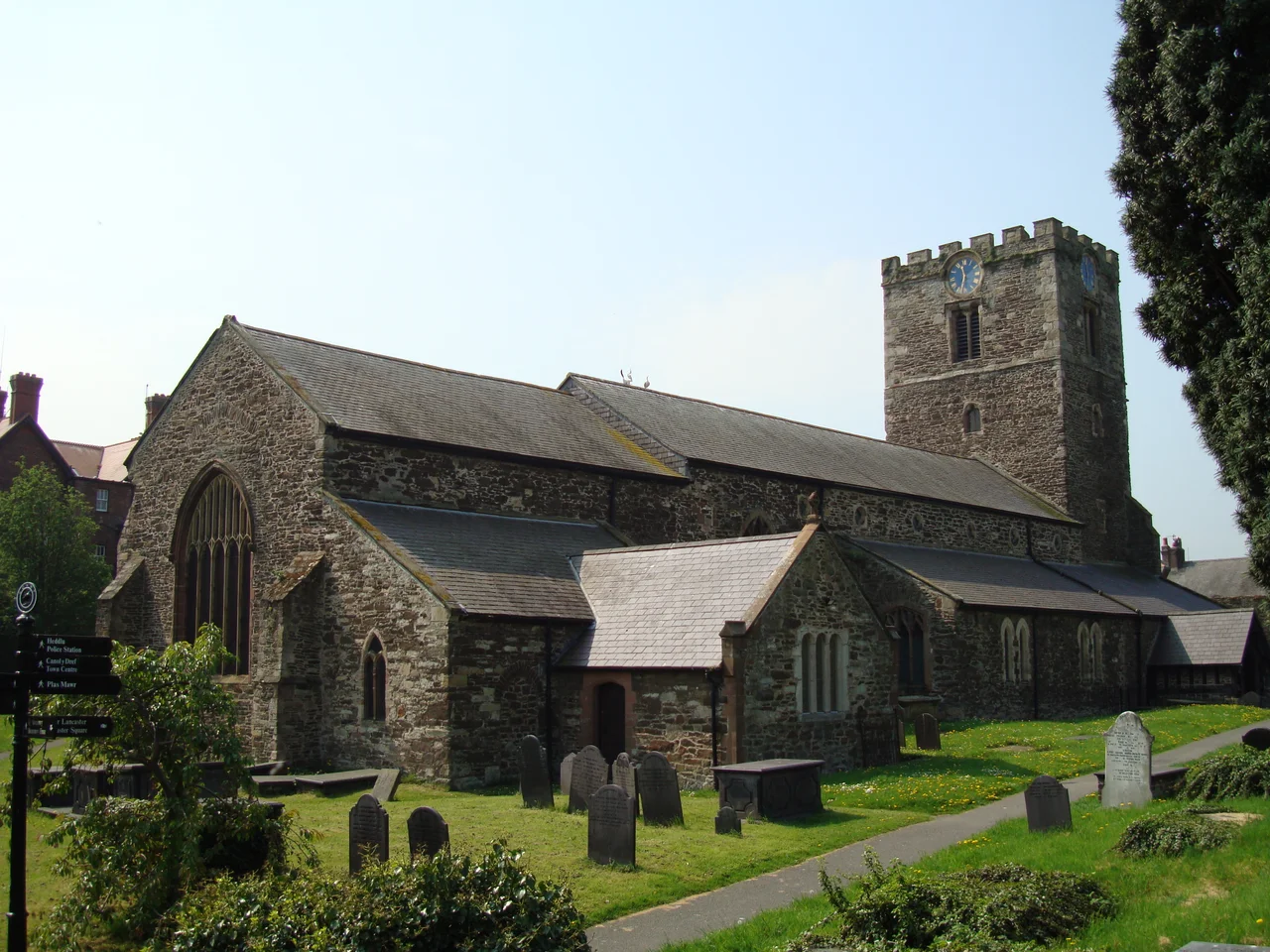

Aberconwy Abbey
Llywelyn the Great died in April 1240 and was buried at his own abbey on the west bank of the Conwy estuary. His son Dafydd was laid beside him six years later. By 1283 their tombs lay in the way of Edward I of England, who had decided that the abbey site would make an excellent foundation for a colonial castle and walled town. The monks were ordered eight miles upriver to a new home at Maenan. The bones of the Welsh princes were lifted and moved with them. The abbey church was repurposed as the parish church of Conwy, where parts of it still stand: the west wall with its three lancet windows, the lower parts of the east wall, the fine west doorway probably moved from the abbey chapter house. Everything else of Aberconwy is gone.
Cistercians at the river mouth
The story begins quietly. In 1186 a group of Cistercian monks from Strata Florida Abbey, in mid-Wales, set up a daughter house at Rhedynog Felen near Caernarfon. About four or five years later they moved east to the mouth of the River Conwy. In 1199, Llywelyn ap Iorwerth - the prince history calls Llywelyn the Great - gave them large grants of land. Thanks to his patronage the abbey came to hold more than forty thousand acres, more than any other Welsh abbey, and Llywelyn was regarded as its founder. The Cistercian rule emphasised manual labour, agricultural improvement, and remote settings; the order had built up a sophisticated network of granges across upland Wales for sheep grazing and grain. Aberconwy sat at the heart of that network, holding lands from the coast deep into the mountains.
Tombs of the princes
Llywelyn the Great died at Aberconwy on 11 April 1240 and was buried in the abbey church. His son and successor, Dafydd ap Llywelyn, was buried beside him in 1246. Two years later, in 1248, the abbot of Aberconwy and the abbot of Strata Florida arranged for the remains of Llywelyn's other son - Gruffydd ap Llywelyn, who had died in 1244 trying to escape from the Tower of London - to be repatriated and reburied at Aberconwy. By the mid-thirteenth century the abbey had become the dynastic mausoleum of the House of Aberffraw, the ruling line of Gwynedd. Its abbots were also political figures: in 1262 the abbot acted as sole representative for Llywelyn ap Gruffudd, the last independent Welsh prince, in negotiations with the English crown.
1282: the trap
Llywelyn ap Gruffudd, called Tywysog Cymru - Prince of Wales - had spent decades navigating the relationship between Gwynedd and the English crown. In 1282 Edward I came north with one of the largest armies medieval England had ever assembled, encircling Snowdonia. On 11 December 1282, Llywelyn was lured into a trap and killed. The Welsh kingdom collapsed within months. The following year Edward forced the monks of Aberconwy to leave their abbey by the river and move to a new site at Maenan, eight miles up the Conwy valley. He financed the construction of the new buildings himself. The price of that royal generosity was the abbey's old foundations. On the site where Llywelyn the Great had been buried, Edward built Conwy Castle and the walled town - a deliberate, symbolic obliteration of a Welsh dynastic heart by the king who had ended the dynasty.
Maenan and dissolution
The move was complete by 1284. The new Maenan Abbey functioned for another two and a half centuries, far enough up the valley to be quieter and harder to reach, with land grants that kept it economically viable. In the fifteenth century the abbot John ap Rhys became involved in a feud with the abbey's mother house at Strata Florida and led a raid - with monks and soldiers - on his fellow Cistercians, an act so unusual it found its way into the records. In 1535 the abbey was valued at one hundred and sixty-two pounds. Two years later, in 1537, it was dissolved on Henry VIII's orders. Little remains of the Maenan buildings today; some stonework was robbed for local use, and the site is largely subsumed under later structures.
What is still there
If you want to find Aberconwy Abbey now, look at the parish church of St Mary and All Saints inside the walls of Conwy. The three lancet windows in the west wall, the lower courses of the east wall, the fine west doorway - all are believed to survive from the abbey church the monks were forced to leave. The rest of the abbey complex stood north and east of the church, in the area where Conwy Castle now rises from the rock. The position of Llywelyn the Great's tomb within the original church is not certainly known; his bones moved with the monks to Maenan, and from there to who knows where after the dissolution. Some say they were transferred to Llanrwst and lie now in the Gwydir Chapel. The certainty has gone with the buildings.
Flight Context
The site of Aberconwy Abbey - now occupied by the parish church and the castle - lies at 53.281 north, 3.829 west, on the west bank of the Conwy estuary just upstream of the modern bridges. The new Maenan Abbey site sits about eight miles south up the valley near Llanrwst. Best viewed at 1,500 to 2,500 ft AGL flying along the Conwy estuary from north to south. Nearest airports: Caernarfon (EGCK) twelve miles west, RAF Valley (EGOV) on Anglesey, and Hawarden (EGNR) east toward Chester. The parish church is a long stone-roofed building visible from above just inside the walled town.
From the Air
53.281°N, 3.829°W (original site, now under Conwy Castle and St Mary's). Maenan site ~8 miles south. Best viewed at 1,500-2,500 ft AGL. Nearest airports: EGCK Caernarfon, EGOV Valley, EGNR Hawarden.
Nearby Stories
- Caldy 1 km away
- Moelfre, Anglesey 1.2 km away
- Pen-yr-Orsedd Quarry 2.5 km away
- Ysbyty Ifan 7.5 km away
- Birkdale Palace Hotel 9.5 km away
- Wrexham County Borough Museum 12 km away
- Celtic Array 22 km away
- Southport Lifeboat Station 45 km away