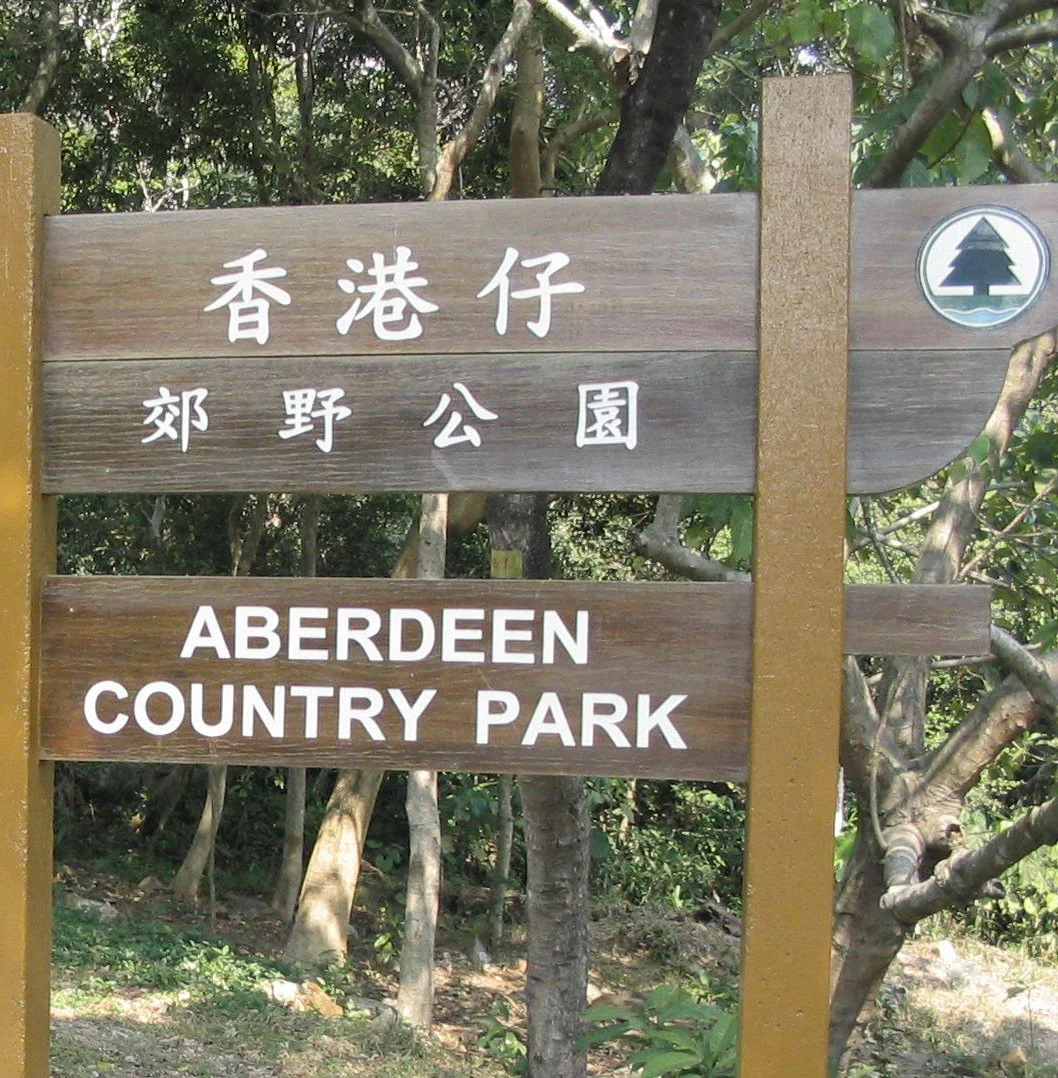

Aberdeen Country Park
Turn south off the dense commercial streets of Aberdeen and the city falls away with startling speed. The hills above the harbour town have been a country park since official designation in 1977, but the land itself has been set aside far longer — the Upper and Lower Aberdeen Reservoirs at its heart were completed in 1932, built to serve a growing colonial city that needed clean water more than another neighbourhood. Today those reservoirs sit quietly in a bowl of forested hillside, ringed by trails that carry walkers from the noise of the harbour district into something that feels like it belongs to a different century.
Ancient Rock, Modern Escape
Aberdeen Country Park covers 4.23 square kilometres at the southern end of Hong Kong Island, stretching from the Aberdeen reservoir valleys north to Wan Chai Gap. The geology beneath it is old: the bedrock is volcanic rock of the Repulse Bay Formation, laid down during the Lower and Middle Jurassic Period, hundreds of millions of years before any city existed here. The same rock that underlies much of Hong Kong Island's southern shore gives the terrain its characteristic rugged quality — steep ridges, narrow valleys, and the sudden drops that make the views so dramatic.
The park was designated on 28 October 1977, making it one of the oldest country parks in Hong Kong. The reservoirs at its core — built before the designation — are now fully integrated into the landscape, their engineered shorelines long since softened by decades of growth. From Peak Road and Guildford Road on the park's upper edges, the scenery opens across both the reservoir valley and, on clear days, the South China Sea beyond.
Forest That Grew Back
The woodland visitors walk through today was not always here. Like much of Hong Kong's hill country, the forests of Aberdeen Country Park were largely stripped during the Second World War and the Japanese occupation of Hong Kong from 1941 to 1945. Timber was taken for fuel and construction; the hills were left bare. What has grown back is a combination of post-war replanting and natural regeneration — a process that took decades but has produced the well-shaded, layered canopy that now covers much of the park.
The dominant trees are Brisbane box, schima, gordonia, ivy tree, and rose myrtle — species well adapted to Hong Kong's subtropical climate and the thin, rocky soils of the hillsides. The understorey has filled in thickly in the decades since replanting, giving the trails a cool, enclosed quality even in summer. Walking here, it is easy to forget how recently — in ecological terms — this woodland came back from almost nothing.
A Kite's Territory
The park's birdlife is one of its quiet pleasures. The black-eared kite has made the reservoir area its own, and on most visits you can watch the birds riding thermals above the water or gliding along the ridgelines in the unhurried manner of animals with nothing to prove. Kites are a distinctive presence across Hong Kong's waterways and hills, but the sheltered reservoir valleys of Aberdeen Country Park offer them reliable hunting ground and roost sites.
Other species found here include the greater coucal — a large, heavy bird with deep chestnut wings and a booming call — as well as the hwamei, magpie-robin, magpie, crested mynah, and kingfisher. Patient walkers occasionally encounter pangolins along the quieter forest trails, their armoured forms moving deliberately through the leaf litter. Squirrels are more reliably spotted. The park's wildlife is not dramatic by national park standards, but for a city of Hong Kong's density, the presence of any of it so close to the urban core feels like a small miracle.
The Southern Edge of the City
Aberdeen Country Park occupies a position that says something about how Hong Kong Island developed — or rather, how it did not develop, in this one direction. The south side of the island remains comparatively underdeveloped, its coastline still largely free of the towers that define the harbour-facing north shore. Aberdeen itself retains traces of its fishing village identity, with the famous floating restaurants and the typhoon shelter still drawing visitors. The country park above it is part of the same pattern: land that the city reached around rather than through.
The park connects to a broader network of hiking trails that traverse Hong Kong Island's ridge system. From the upper edges of Aberdeen Country Park, trails extend toward Victoria Peak to the north and the southern coastal paths toward Deep Water Bay and Repulse Bay. For anyone spending time in Hong Kong, the park is a reminder that the city contains, just above the skyline, a quieter landscape that has been waiting there all along.
From the Air
Aberdeen Country Park sits at approximately 22.26°N, 114.16°E on the southern slope of Hong Kong Island, just inland from the Aberdeen harbour area. Approaching from the south at 3,000–5,000 feet over the South China Sea, the park's forested hillsides are clearly visible as a green band contrasting with the dense urban development of Aberdeen below. The two reservoir basins are visible from above as bright surfaces cut into the dark green forest. Victoria Peak, the island's highest point, rises to the north. Hong Kong International Airport (VHHH) lies approximately 28 km to the west on Lantau Island.
Nearby Stories
- Lok Ma Chau Loop 2.3 km away
- Portas do Cerco 2.3 km away
- Kweilin Incident 17 km away
- Wanshan Archipelago Campaign 34 km away
- Nanxiong Formation 115 km away
- Battle of Nanpeng Island 148 km away
- Heyuan 169 km away
- Cape Maobitou 632 km away