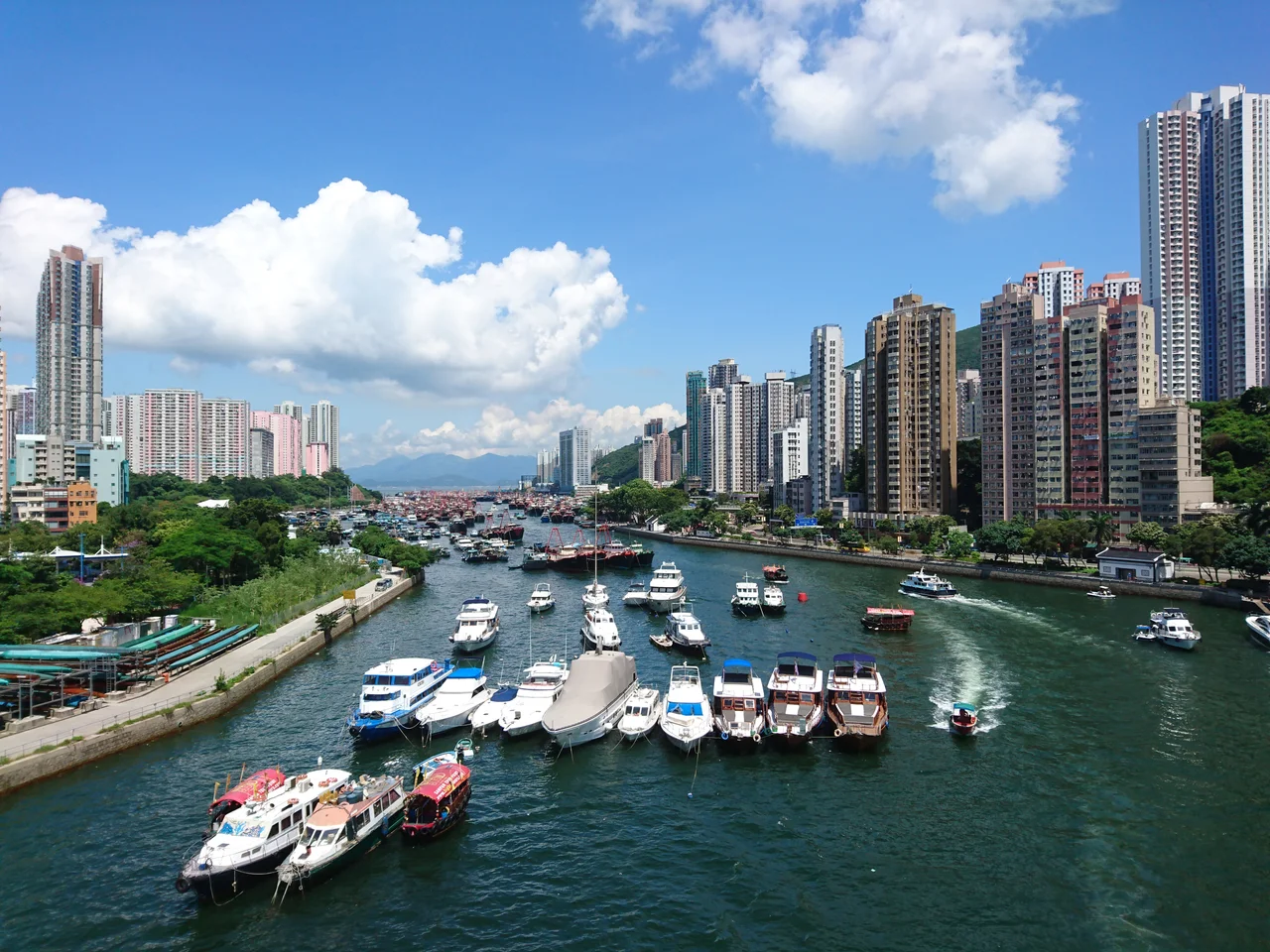

Aberdeen, Hong Kong
Long before the British named it after a Scottish earl, this harbour had a name of its own — Hong Kong. The village that would lend its Cantonese phrase hēung góng, "Fragrant Harbour," to an entire colony sat here on the southwestern shore of Hong Kong Island, and early foreign arrivals simply carried the misunderstanding north. By the time anyone sorted it out, the name had stuck to the whole island. The original place, the actual harbour, became Aberdeen: renamed for George Hamilton-Gordon, 4th Earl of Aberdeen and British Prime Minister, who never set foot on it.
The People Who Stayed on the Water
Before there was a colony, there were the Tanka — a maritime people who lived aboard their boats in Aberdeen Harbour rather than on land. The Tanka fished these waters, sheltered here through typhoons, and kept to themselves, a community whose lives unfolded on floating platforms of wood and rope rather than in houses on hills. Their relationship to the shore was always transactional: they came in to trade, to resupply, then returned to the harbour's rocking world. Decades of land reclamation and housing development pulled most Tanka families ashore through the latter half of the twentieth century. A few dozen people still live on boats in the harbour today — not as a relic preserved for tourists, but as a continuation of a way of life that simply hasn't fully ended. When you hire a sampan to cross the harbour, the operator may be among them.
Where Hong Kong Got Its Name
The origin story sits inside a straightforward historical mix-up. During the Ming Dynasty, the settlement here was called Hong Kong — in Cantonese, the village of the fragrant harbour, likely a reference to the incense trade or fragrant timber stored near the waterfront. When British ships first anchored in these waters in the early nineteenth century, sailors and officials heard the name and assumed it applied to the island itself. By 1841, when the Treaty of Nanking ceded the island to Britain, "Hong Kong" already meant the whole place. The original village was renamed Aberdeen. During the Japanese occupation from 1941 to 1945, the Japanese military — recognising the irony — called it Moto Hong Kong, meaning "The Origin of Hong Kong." That particular truth hasn't been forgotten.
Fish Balls, Floating Restaurants, and a Fallen Palace
Aberdeen's food culture runs deep and specific. For sixty-five years, a family-run shop called Shan Loon Tse Kee Fish Balls Restaurant served Chiuchow-style fish balls in soup noodles from a narrow street address — until rising prices and staffing problems closed it in March 2012. Its customers had included Hong Kong governors, chief executives, actors, and food critics. The restaurant helped make the phrase "Aberdeen Fish Balls Noodles Culture" a recognisable concept across the city. The larger and more spectacular fixture was the Jumbo Floating Restaurant, a vessel designed to resemble an imperial palace — ornate roof tiers, red lacquer, golden trim — moored in the harbour between Wong Chuk Hang and Ap Lei Chau. Opened in 1976, it attracted more than 30 million visitors over its lifetime. It closed in 2020 and capsized in 2022 after leaving Hong Kong, taking the city's most theatrical dining experience with it.
Dragon Boats and a Harbour on Camera
Each year during the Tuen Ng Festival, Aberdeen Harbour hosts the Southern District dragon boat races. The event draws locals and visitors along the promenade, where the wooden boats and their crews compete in the channel between the harbour walls. The harbour has drawn a different kind of attention from filmmakers. In 1973, Bruce Lee's Enter the Dragon used it as the departure point for the story's villain's island. Pierce Brosnan navigated its waters in the Noble House television miniseries in 1987. Jean-Claude Van Damme swam between fishing vessels here in Double Impact in 1991. Aberdeen Harbour appeared in multiple Tomb Raider films and was the opening setting of the video game Shenmue II, which recreated it in an architecturally improbable but atmospherically faithful way. The harbour's combination of dense boat life, hillside backdrop, and industrial-yet-intimate scale gives it an immediacy that cameras have been drawn to for half a century.
Hillsides, Sports Grounds, and Ocean Park Next Door
Aberdeen today is a working neighbourhood of about 80,000 people, wrapped around the harbour and climbing into the hills toward Aberdeen Country Park. The park surrounds the Aberdeen Reservoirs and is one of the most accessible green spaces in the Southern District — a favourite for barbecues, school outings, and evening walks after work. Down near the water, the Aberdeen Promenade runs along the harbour's town-side edge, used nightly by residents jogging or exercising between seven and eleven in the evening. Ocean Park, Hong Kong's large marine-themed amusement park, lies directly adjacent and draws steady streams of visitors who often continue to Aberdeen for the harbour views and seafood. The Ap Lei Chau Bridge links the town to the island of the same name just across the channel, where another community — one of the densest on earth — lives stacked in towers above the waterline.
From the Air
Aberdeen sits at approximately 22.248°N, 114.152°E on the southwest coast of Hong Kong Island. The harbour is clearly visible from the air as a sheltered channel between Hong Kong Island and the smaller Ap Lei Chau island to the south. At 1,500 to 3,000 feet, the dense boat activity in the typhoon shelters, the Ap Lei Chau Bridge, and the hillside residential towers behind the promenade are all distinguishable. The Aberdeen Reservoirs appear as twin blue-green patches in the hills to the northeast. The nearest major airport is Hong Kong International (VHHH), approximately 20 nautical miles to the northwest on Lantau Island. The harbour's orientation — running roughly east-west — and the gap between Hong Kong Island and Ap Lei Chau make it a useful visual landmark for coastal approaches.
Nearby Stories
- Lok Ma Chau Loop 2.3 km away
- Portas do Cerco 2.3 km away
- Kweilin Incident 17 km away
- Wanshan Archipelago Campaign 34 km away
- Nanxiong Formation 115 km away
- Battle of Nanpeng Island 148 km away
- Heyuan 169 km away
- Cape Maobitou 632 km away