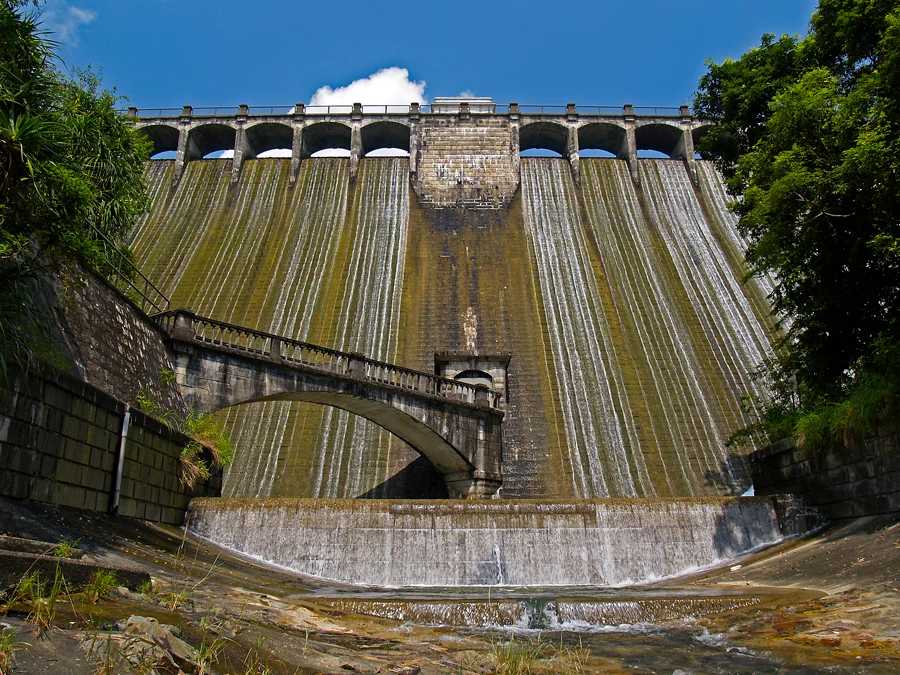

Aberdeen Reservoirs
The paper factory came first. In 1890, the Tai Shing Paper Factory built a private reservoir in the hills above Aberdeen to supply water for its operations and for nearby residents. Nobody planned it as public infrastructure. The colonial government simply bought it — for HK$460,000 — when the city needed more water, then built a second, larger reservoir directly above it. Governor William Peel opened the Upper Reservoir at a ceremony on 15 December 1931; the Lower Reservoir completed impounding in 1932, bringing both into full operation. The twin reservoirs became the fourth and last group ever built on Hong Kong Island, and the stone structures that held them are now declared monuments.
A Factory's Reservoir Becomes the City's
The Lower Aberdeen Reservoir's origins as industrial infrastructure give it an unusual history among Hong Kong's water supply systems. The Tai Shing Paper Factory needed reliable water for its processes, and the hills above Aberdeen offered a natural catchment. When the colonial government acquired the reservoir and expanded it to a capacity of 486,000 cubic metres, it added an entirely new upper reservoir with a capacity of 773,000 cubic metres above the original one — bringing the combined total to 1,259,000 cubic metres. Together they were designed to supplement the Pok Fu Lam Reservoir in supplying the western side of Hong Kong Island, addressing the chronic water shortages that nineteenth-century development had made worse. The transition from private mill reservoir to public water supply captures something essential about how colonial Hong Kong worked: urgent need, opportunistic acquisition, and expansion built on top of whatever came before.
Stone, Dams, and the Weight of Monument Status
In September 2009, Hong Kong's government declared forty-one pre-World War II waterworks structures across six reservoir areas as protected monuments. The Aberdeen Reservoirs contributed four: the dam, valve house, and bridge of the Upper Reservoir, and the dam of the Lower Reservoir. The structures are built in the colonial waterworks style — cut stone, carefully fitted, designed to last — and their designation places them alongside works at Pok Fu Lam, Tai Tam, Wong Nai Chung, Kowloon, and Shing Mun. Walking up to the Upper Reservoir dam means approaching something that was engineered to hold back hundreds of thousands of cubic metres of water and has done so for nearly a century. The stonework is unhurried and precise. It was built by people who expected it to outlast them, and it has.
Country Park at the Edge of the City
In 1977, a 4.23 square kilometre area surrounding the reservoirs was designated as Aberdeen Country Park — one of the earliest country parks established in Hong Kong under the 1976 Country Parks Ordinance. Locally, residents call it Aberdeen Reservoir Park. It is reachable on foot from the surrounding neighbourhoods, which makes it a genuinely popular green space rather than a distant destination. Families bring barbecue equipment on weekends. Schools hold their fall picnic days here. Social organisations use its tree-shaded areas for group activities throughout the year. The park sits directly above the dense housing and harbour life of Aberdeen town, separated only by a few hundred metres of elevation. Looking down through the trees toward the water gives a sense of how compressed Hong Kong's geography actually is — city, reservoir, hillside, and harbour stacked within walking distance of each other.
From the Air
The Aberdeen Reservoirs sit at approximately 22.257°N, 114.163°E in the hills above Aberdeen on Hong Kong Island's south side. From the air at 2,000 to 4,000 feet, the two reservoirs appear as paired blue-green pools set in forested hillside, easily distinguished from the surrounding urban density. The upper reservoir is noticeably higher and smaller; the lower spreads wider in the valley below it. Aberdeen town and its harbour are visible just south and downhill. Hong Kong International Airport (VHHH) is roughly 20 nautical miles to the northwest. The reservoirs sit inside Aberdeen Country Park, and the treeline surrounding them contrasts sharply with the high-rise towers of the residential areas immediately to the north and south.
Nearby Stories
- Lok Ma Chau Loop 2.3 km away
- Portas do Cerco 2.3 km away
- Kweilin Incident 17 km away
- Wanshan Archipelago Campaign 34 km away
- Nanxiong Formation 115 km away
- Battle of Nanpeng Island 148 km away
- Heyuan 169 km away
- Cape Maobitou 632 km away