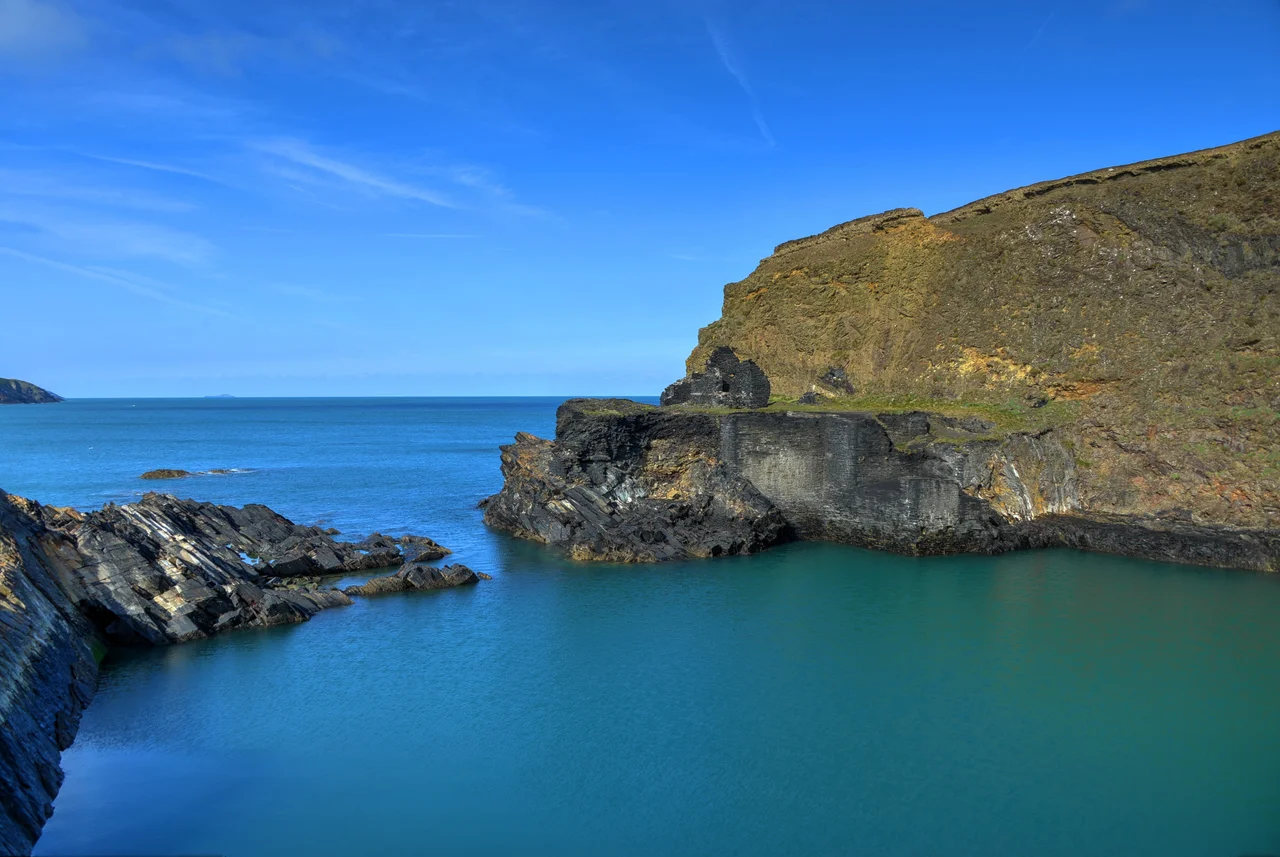

Abereiddy
The water in the lagoon is genuinely blue - a milky, suspended turquoise that has no business existing on the Welsh coast. It is a slate quarry, not a tropical reef. The colour comes from microscopic mineral particles suspended in cold Atlantic water that floods the pit through a man-made breach in the seawall. The slate dust gives the water its strange opacity. The slate cliff above gives the cliff divers their platform. In September 2012 the Red Bull Cliff Diving World Series came here for the first time, fourteen of the world's best divers throwing themselves from twenty-seven metres into water that until 1904 had been a working industrial site. The first divers in the Blue Lagoon had been quarrymen who fell.
How the Lagoon Was Made
Abereiddy was a slate village. Through the nineteenth century, men worked the cliffs here for the same dark, fissile rock that roofed half of Victorian Britain. The Abereiddy quarry was small compared to the giants further north at Porthgain or inland at Penrhyn, but it operated a steam-hauled lift to bring slate up from the working face, and a tramway carrying slate to the harbour at Porthgain a couple of miles north. When the quarry closed in 1904 the cut was abandoned to weather and water. Sometime in the early twentieth century - the exact date is unclear, and locally disputed - the seaward wall was deliberately breached. The Atlantic flooded in. What had been a deep open pit became a saltwater lagoon roughly twenty-five metres deep, connected to the open sea through a single narrow channel. The slate dust still in the water stayed suspended. The lagoon turned, and stayed, the strange blue that gives it its name.
The Beach and the Blue Flag
The small beach at Abereiddy received the Blue Flag rural beach award in 2005, recognising its water quality and facilities - public toilets, parking, no major facilities beyond the ice cream van that turns up reliably each summer. The beach is shingle and sand, the cliffs Ordovician slate, and the surf can be rough on a windy day. The Pembrokeshire Coast Path runs through the village, leading north to Porthgain (about forty minutes' walk) and south-east around St Davids Head toward Whitesands Bay. The Common behind the beach belongs to the Manor of Llanrhian, a medieval land division that has somehow survived a thousand years of administrative reorganisation. The hamlet itself is tiny - a handful of houses, an abandoned terrace of quarrymen's cottages called The Street whose roofless walls stand as a small ruin in the middle of the village.
27 Metres
In September 2012 the Red Bull Cliff Diving World Series came to Abereiddy for its UK debut. The organisers built a 27-metre platform jutting out from the lagoon's slate wall - the equivalent of a nine-storey building. Fourteen of the world's best high divers competed: men jumped from twenty-seven metres, women from a slightly lower platform. The divers fall for around three seconds, hitting the water at roughly 85 km/h (53 mph). They enter feet-first to survive the impact. The Blue Lagoon proved an ideal venue - deep enough, sheltered enough, and dramatic enough that the photography was extraordinary. The series returned in September 2013 and September 2016. Less officially, Abereiddy is one of the most popular spots in Wales for 'coasteering' - a sport invented in Pembrokeshire that combines cliff jumping, sea swimming, and scrambling along rock features in wetsuits and helmets. The slate cliffs of the lagoon are graduated; novices jump from a few metres, the bold from much higher. Local outdoor centres run trips most days in summer.
The Fossils in the Shale
Geologists know Abereiddy for entirely different reasons. The south side of the bay exposes steeply dipping beds from the Upper Llanvirn epoch of the Ordovician - around 460 million years old - and these shales contain abundant graptolite fossils, particularly Didymograptus murchisoni, a tuning-fork-shaped colonial creature that drifted through Ordovician oceans long before fish existed. The fossils sit in soft, flaky shales that regularly tumble down the cliff onto the beach. Fossil collecting at Abereiddy requires neither hammering nor permit - the geological clock does the work, dropping fresh shale onto the foreshore with every storm. Casual collectors find graptolites within a few minutes. The discoverable pieces are part of why this stretch is on the Pembrokeshire Coastal Path's list of must-see sites: walk down to the beach, pick up a stone, and you may be holding the imprint of an animal that died nearly half a billion years ago.
Filmic Abereiddy
The Blue Lagoon's strange beauty has made it a magnet for film crews. In 2000 the music video for Delerium's 'Silence' (featuring Sarah McLachlan) was filmed at the lagoon - Sarah McLachlan running across slate clifftops, the impossible blue water visible behind her. The 1961 Hammer-style adventure Fury at Smugglers' Bay, starring Peter Cushing, used Abereiddy as its main location, the cove standing in for a wreckers' cove on the Cornish coast. In 2009 Visit Wales filmed a short promotional piece called 'Ice Cream' centred on the village ice cream van. In 2024 a group of twelve Nottingham Trent film students wrote, directed, produced, and edited a short film called Walk Upon The Water at the lagoon, which went on to several festivals. Most visitors come for the photographs more than the films - the place is too photogenic not to be photographed. On a clear morning, with the sun low and the water glowing milk-blue and the slate walls black against the sky, Abereiddy looks like an industrial accident that somehow turned into landscape art.
From the Air
Abereiddy is a small coastal hamlet at 51.93 N, 5.20 W on the north Pembrokeshire coast, between Porthgain and St Davids Head. From the air, the Blue Lagoon is unmistakable - a near-circular pool of brilliant blue-green water set into the slate cliffs, with a narrow channel connecting it to the open Atlantic. The small beach is immediately south, with The Street's ruined cottages just inland. The Pembrokeshire Coast Path runs along the clifftop. Best viewing 1,500-4,000 feet for the lagoon's colour to read properly. Nearest airports: EGFE (Haverfordwest) 14 nm south-southeast, EGFH (Swansea) 72 nm east. Exposed Atlantic coast - expect wind, fog, and rain; calm sunny mornings give the lagoon its most photogenic light.
Nearby Stories
- RAF Angle 0.9 km away
- Cardigan Bay Special Area of Conservation 5.4 km away
- Abercych 11 km away
- Cantre'r Gwaelod 12 km away
- Burry Port Lifeboat Station 22 km away
- Johnstown Castle 61 km away
- Hook Lighthouse 92 km away
- 1979 Fastnet Race 157 km away