
Aberfan
It was a Friday morning. The children had been in school for about twenty minutes when the mountain came down. They had sung in assembly, hung up their coats, and were just beginning lessons in their classrooms at Pantglas Junior School. The half-term holiday was set to begin that afternoon, and many of them were thinking about it. At 9:15 a.m. on 21 October 1966, a saturated colliery spoil tip on the slope above the village of Aberfan broke loose and slid down. It struck the school. One hundred and sixteen children, almost a whole generation of that village, died that morning, along with twenty-eight adults. They were five years old, eight, ten. They were Brian and Dawn and Wendy and David. They were children. Aberfan is the name of where they lived.
Before the Tip
Aberfan sits at the bottom of the western slope of the River Taff in the Taff Valley, a few miles south of Merthyr Tydfil. Before 1869, it was two cottages and an inn for farmers and bargemen working the Glamorganshire Canal. Then John Nixon sank the Merthyr Vale Colliery, and a village grew around the pit head: rows of terraced houses on Moy Road, a school, chapels at every other corner. By the mid twentieth century, Aberfan was a tight working community of perhaps five thousand people. Most adults knew most children by name. The mountain rising west of the village, Mynydd Merthyr, had become a dumping ground for the waste rock and slurry brought up out of the colliery, piled into seven enormous tips. Tip No. 7 had been built over a natural spring. People in the village had noticed it moving. They had complained. The complaints had been filed and forgotten.
9:15 in the Morning
It had rained heavily for days. On the upper flank of Tip No. 7, the saturated waste began to subside, three to six metres at first. Then, just after a quarter past nine, more than 150,000 cubic metres of black slurry tore loose and flowed down the mountain at speed. A farm went first. Twenty terraced houses on Moy Road went next, crushed and buried. The slide then struck the northern side of Pantglas Junior School and part of the senior school behind it. The classrooms filled with mud and rock. Survivors who pulled themselves out and rescuers who came running from the colliery and the surrounding villages dug with their hands. By nightfall, almost no one alive was being pulled out anymore. The dead were carried to Bethania Chapel down the road, which had been turned into a temporary mortuary so parents could come and identify their sons and daughters. The village had lost half its children.
The Mountain and the Inquiry
The Tribunal of Inquiry, chaired by Lord Justice Edmund Davies, sat for seventy-six days. Its report, published in 1967, was unambiguous. The disaster was entirely the fault of the National Coal Board. The tip should never have been built over a spring. Warnings had been ignored. "The Aberfan disaster is a terrifying tale of bungling ineptitude by many men charged with tasks for which they were totally unfitted," the tribunal wrote. No one at the Coal Board was prosecuted. No one was dismissed. Lord Robens, the chairman, kept his job. The bereaved families had also to fight the Coal Board to have the remaining tips removed, and they had to use money from the disaster fund, donated by the public, to do it. The government refunded that money only in 1997, three decades after the children died. The decision to use bereaved families' donations to clear the tips that had killed their children is, in some ways, the second great injustice of Aberfan.
The Place Where the School Stood
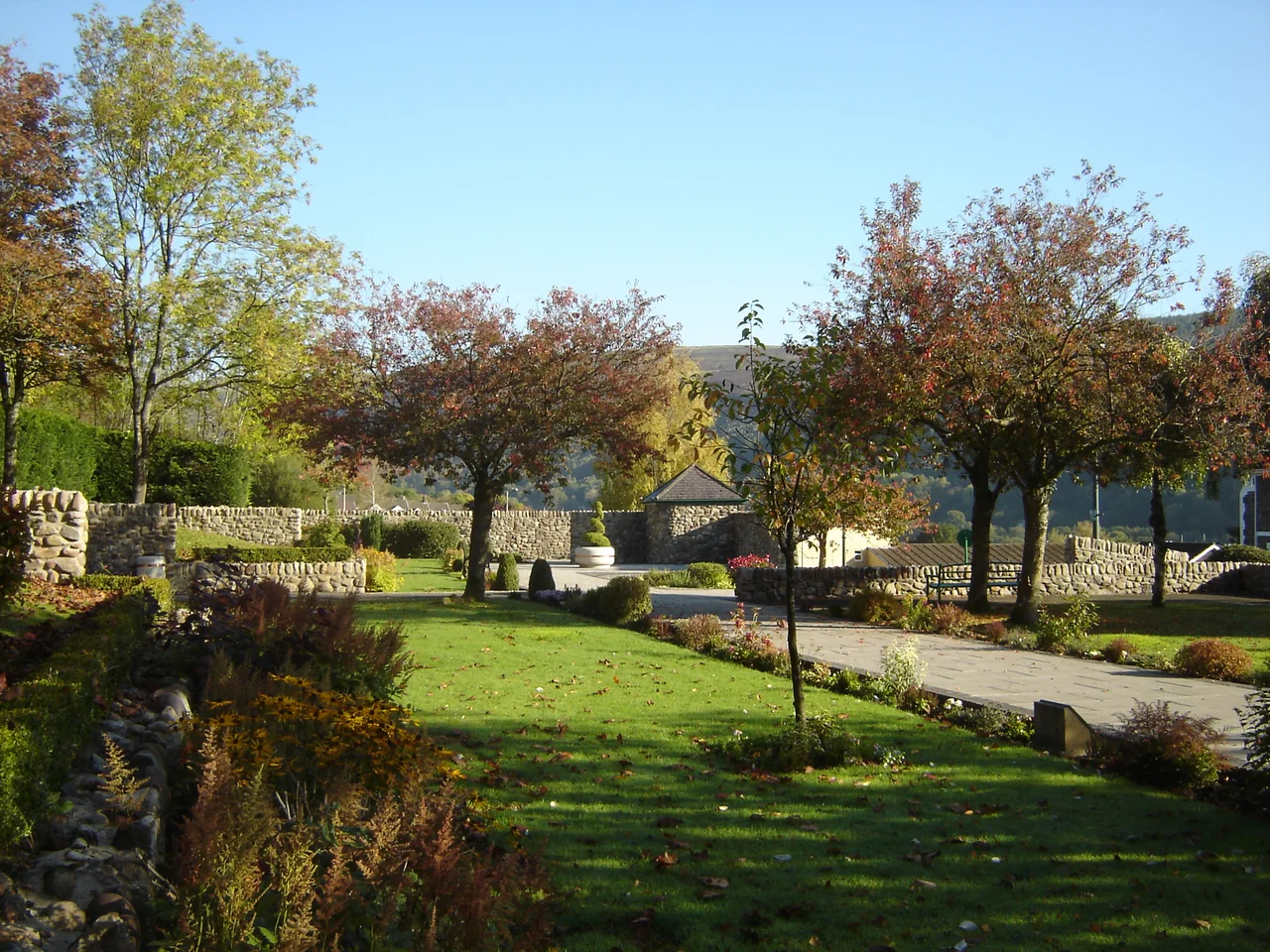
Where Pantglas Junior School was, there is now a memorial garden. It is the size of the school footprint, gentle and unhurried, with benches and planted beds tended by people who remember. Up the hill, in the Aberfan Cemetery, a long line of white granite arches marks the graves of the children. Their parents lie among them now, many of them, having waited as long as they could. The Queen visited on 29 October 1966, eight days after the disaster, and returned several times over the decades; one of those returns, in 1974, opened the memorial garden. Other gifts came from elsewhere: Coventry, a city that knew what loss looked like, raised funds for a playground built on the site of the old Merthyr Vale School in 1972. In 2022, the cemetery and the path of the slide were placed on the national register of historic gardens, recognised as a place of great national importance and meaning.
What Aberfan Asks
Aberfan is still a village. Children walk to two primary schools, one of them taking lessons in Welsh. The colliery is gone, closed in 1989, twenty-three years after the disaster. The A470 thunders past the eastern edge of the village; the Taff Trail, a cycle path, runs gently down where the canal used to be. It is possible to visit Aberfan and find it unremarkable, a quiet Welsh village like any other in the valleys. Then you find the memorial garden, or the arches in the cemetery, and the names come at you one after another, almost more than you can read. Aberfan was failed by the institutions that should have protected it, and the survivors have spent their lives carrying what was left for them to carry. Their children were not statistics or symbols. They were going to grow up. The village asks only that they be remembered as the children they were.
From the Air
Aberfan lies at 51.69 N, 3.35 W on the western side of the Taff Valley, roughly four miles south of Merthyr Tydfil. Best viewed at 2,500 to 3,500 feet with the A470 corridor and Taff Trail clearly visible threading the valley floor. Mynydd Merthyr rises to the west; the village sits in its lee. Cardiff (EGFF) is about 18 nm south along the same valley. Bristol (EGGD) is 35 nm to the southeast. Visibility in the valleys is often reduced by low cloud and rain on south-westerly flows; treat any flight here with the respect this ground deserves.
Nearby Stories
- Portishead Point Lighthouse 3 km away
- St Fagans National Museum of History 5 km away
- Museum of Cider 6.5 km away
- Monmouth 8.3 km away
- Carreg Cennen Castle 11 km away
- Builth Castle 14 km away
- Craig Gwrtheyrn 29 km away
- Ilfracombe Lifeboat Station 37 km away