
Academy of Athens
Walk down Panepistimiou Street in central Athens and the noise of traffic suddenly competes with something improbable: a brilliant white temple, fronted by towering Ionic columns and flanked by two tall pillars bearing the figures of Athena and Apollo. It looks like a building that wandered out of the fifth century BC and decided to stay. In fact it is barely older than the automobile that idles in front of it. This is the Academy of Athens, Greece's national academy, and it is the most theatrical of the three neoclassical buildings that make up the so-called Athenian Trilogy.
A Trilogy in Marble
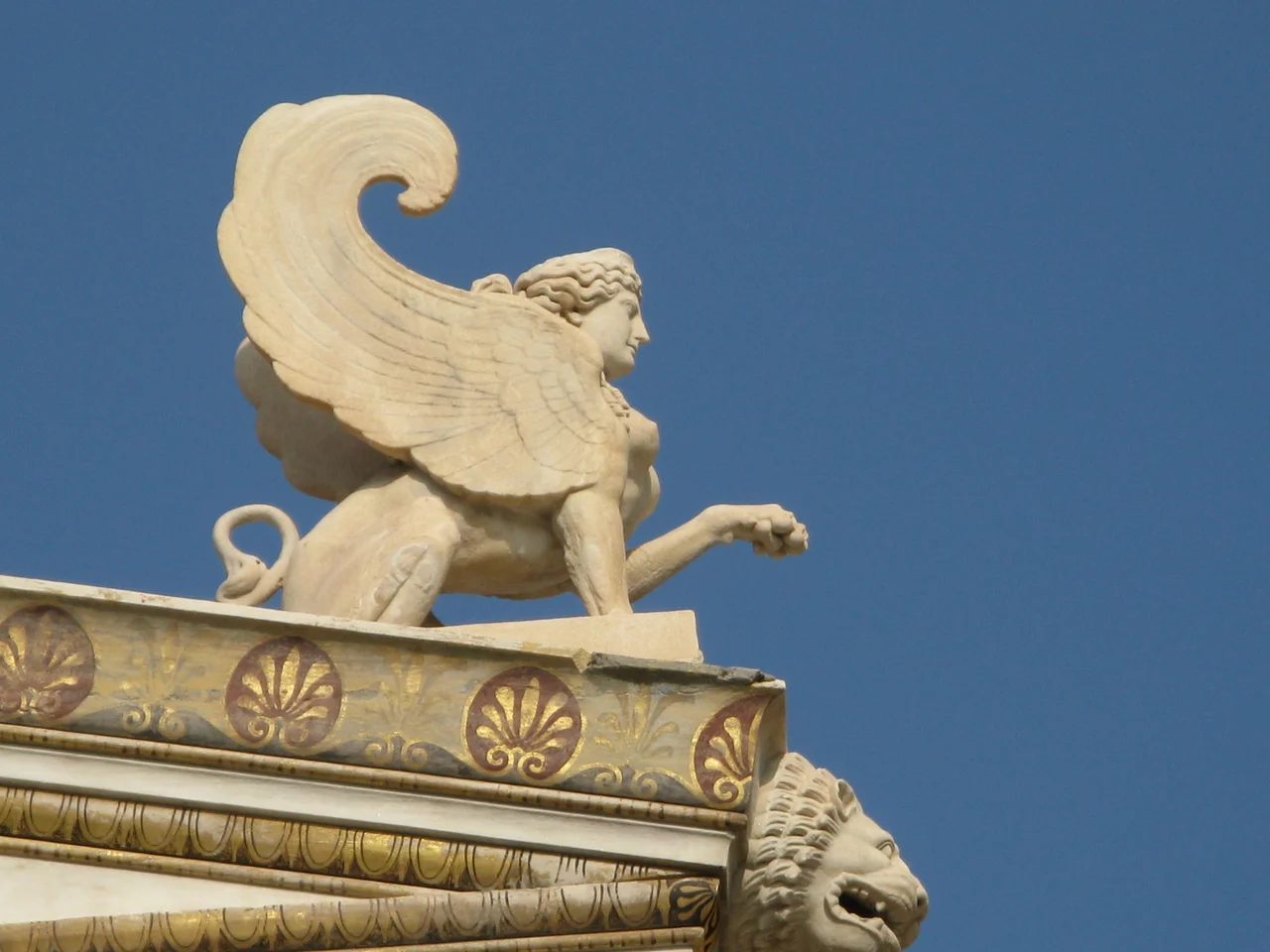
The Academy was conceived in 1859 as one panel of a triptych. The Danish architect Theophil Hansen designed it alongside the University and the National Library, three buildings meant to stand in a row as a single architectural statement about a young nation reaching back to its ancient inheritance. Hansen, who had studied the temples of the Acropolis up close, did not imitate them so much as recombine them. Athena rises atop one flanking column, Apollo with his lyre atop the other, and below them sit the marble figures of Plato and Socrates, the building's intellectual patron saints, executed by the Italian sculptor Piccarelli. Inside, the Austrian painter Christian Griepenkerl filled the ceilings with murals from Greek myth.
The Sinas Fortune
None of it would have risen without one family's money. The financier Simon Sinas funded the project specifically, laying the foundation stone on 2 August 1859. But the building took more than a quarter century to finish. Work raced ahead under Ernst Ziller until the political turmoil of King Otto's final years stopped construction in 1864. It resumed in 1868 and limped toward completion only in 1885, at a staggering cost of 2,843,319 gold drachmas, most of it paid by Sinas and, after his death, by his widow Ifigeneia. For decades Athenians called it the Sinaean Academy, a private gift waiting for a public purpose.
The Birth of Athena, Carved in Stone
Look up at the central pediment and you find the building's masterpiece: a crowded marble scene of the birth of Athena, sculpted by the Greek neoclassical artist Leonidas Drosis from a design by the painter Carl Rahl. It was good enough to win first prize at the Vienna Exhibition of 1873, an international stamp of approval for a Greek artist working a Greek theme on a Greek building. The composition gathers the gods of Olympus around the moment the goddess of wisdom springs fully formed from the head of Zeus, a fitting subject for a structure dedicated to knowledge.
An Academy Without an Academy
For years the gleaming temple housed everything except the institution it was built for. Ziller handed the finished building to Prime Minister Charilaos Trikoupis on 20 March 1887, but Greece had no national academy to put inside it. So it improvised: the Numismatic Museum moved in around 1890, the Byzantine Museum and the State Archives in 1914. Only on 18 March 1926 did the building finally receive the newly founded Academy of Athens, an institution that deliberately echoes Plato's ancient Academy and today runs fourteen research centres and a library. In 2004, as Athens hosted the Olympics, the building became the motif of a 100-euro commemorative gold coin, a reminder that the city of Athena measured its glory in thought as much as in sport.
From the Air
The Academy of Athens stands in the city centre at 37.98 degrees north, 23.73 degrees east, between Panepistimiou and Akadimias Streets and just northeast of the Acropolis, which makes the most reliable visual anchor from the air. Athens International Airport (LGAV) lies about 30 km to the east-southeast. The dense urban core is best viewed from 2,500 to 4,000 feet AGL; visibility over central Athens is usually good but can be reduced by summer haze.
Nearby Stories
- Great Sand Beach 5 km away
- Battle of Delium 7.7 km away
- Tower of Aliartos 9 km away
- HMHS Britannic 10 km away
- Saronic Gulf 15 km away
- Sousaki Volcano 17 km away
- Sanctuary of Apollo Maleatas 24 km away
- Skyros 66 km away