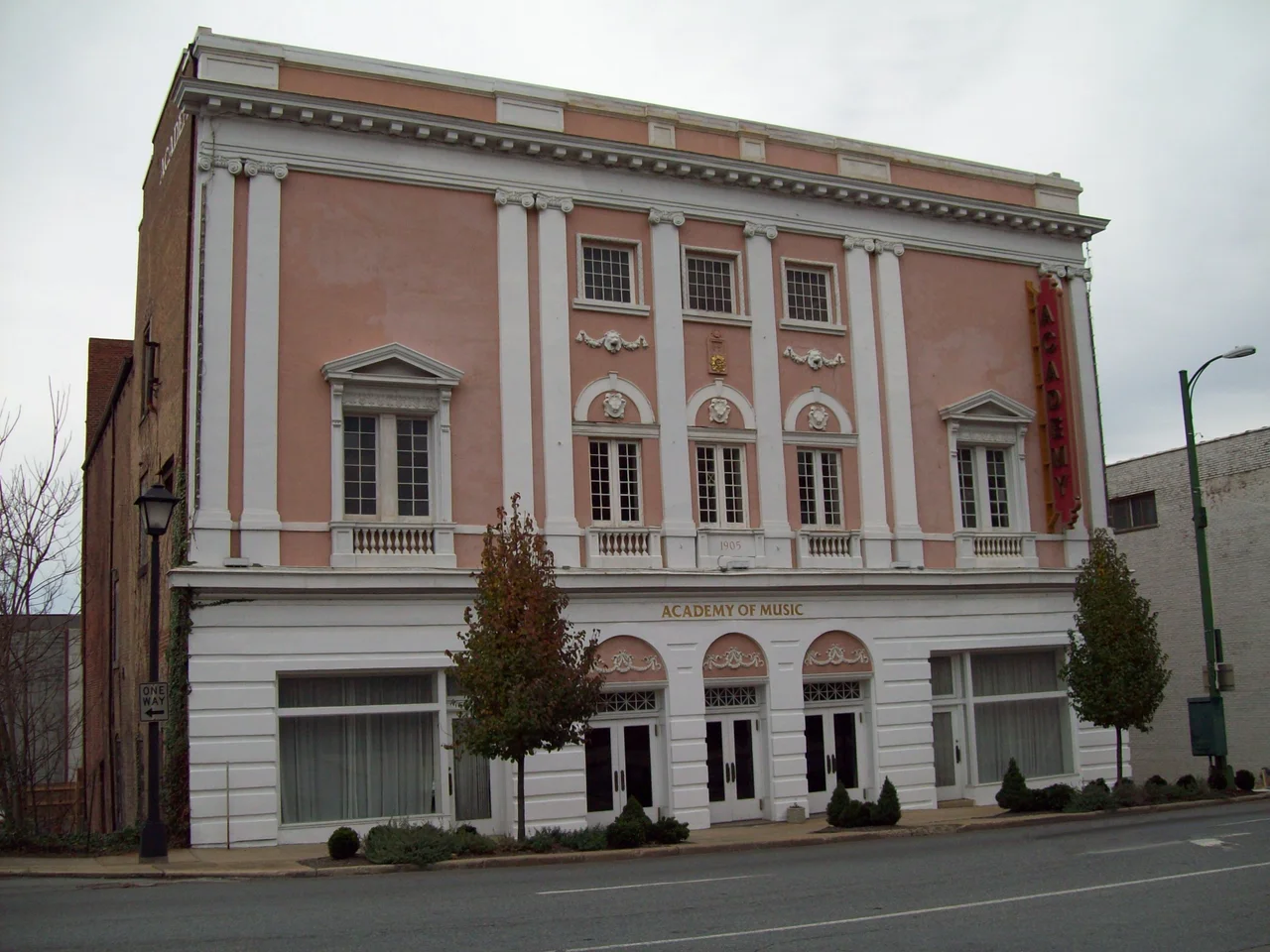

Academy of Music
Sarah Bernhardt played here. So did Anna Pavlova. The Polish pianist Ignace Paderewski sat at a Steinway on this Lynchburg stage and filled the room with Chopin, and somewhere out in the dark the audience held its collective breath. The Academy of Music opened on Main Street in 1905, a Beaux-Arts theater built by the firm of Frye & Chesterman with a Neoclassical interior of plaster swags and gilded boxes. For a few decades it was a regular stop on the touring circuit that ran between New York and Atlanta, and the biggest names on either side of the Atlantic worked its boards. Then vaudeville died, then movies arrived, and most of the legitimate theaters of its generation in Virginia were torn down. This one survived.
A Stop on the Circuit
In the early twentieth century, touring theatrical companies needed a network of houses between the big cities, places where a leading lady could play one night, sleep on a train, and open in the next town the day after. Lynchburg, a tobacco and rail town of seven hills above the James River, was perfectly placed for that kind of work. The Academy of Music gave traveling productions a proper Beaux-Arts stage with a deep proscenium and the kind of acoustics that let a soft voice carry to the gallery. Anna Pavlova, the Russian ballerina who carried Swan Lake to audiences who had never seen ballet before, danced on this floor. Sarah Bernhardt, by then aging and using a wooden leg, played her famous declamatory roles in French to crowds who mostly did not speak the language and applauded anyway. Mrs. Patrick Campbell, John Drew, Otis Skinner, DeWolf Hopper, Alma Gluck — the bill reads like a directory of the late Edwardian stage.
Three Stories of Plaster and Gilt
Frye & Chesterman designed in the Beaux-Arts vocabulary that was fashionable for public buildings around the turn of the century, an American take on the École des Beaux-Arts in Paris. The exterior runs three stories of dressed stone and brick. The interior was Neoclassical: a deep horseshoe of seats facing a proscenium framed in plaster ornament, with two tiers of boxes flanking the stage. The detailing was meant to do what European opera houses did, which was to make ordinary citizens feel briefly like guests of a small republic of refinement. The theater seated a little over a thousand. When the house lights went down, the gilt caught the footlights and the room glowed.
Long Dark, Long Restoration
The Academy stopped functioning as a touring house in the mid-twentieth century, as live theater gave way to motion pictures and then television. For decades the building sat in various states of use and disrepair, its mechanical systems failing, its plaster cracking, its paint peeling. The National Register of Historic Places listed it in 1969, which helped slow the decline but did not pay for repairs. The Lynchburg Academy of Fine Arts spent years scraping together restoration money. In 2008 a federal earmark of $245,000 from the Community Development Fund of HUD, secured by Representative Bob Goodlatte, went toward the work. Today the Academy operates as part of the Academy Center of the Arts, a venue for music, theater, and community programming downtown.
What It Means to Survive
Most of the legitimate theaters built in Virginia between 1890 and 1915 are gone. They were torn down to widen streets, converted to discount stores, lost to fires, or simply allowed to collapse. The Academy of Music is one of the only ones still standing, still functioning, still hosting performers on the stage it was built for. The building is a kind of physical memory of a moment when traveling companies criss-crossed the American South, when small cities expected and received world-class artists, and when a Polish pianist could come to Lynchburg, play Chopin, and disappear back into the night by rail.
From the Air
Located in downtown Lynchburg, Virginia at approximately 37.4169 N, 79.1456 W, on Main Street between Sixth and Seventh. Three stories tall, masonry, with a flat roof and Beaux-Arts facade. Visible at lower altitudes among the downtown grid above the James River. Nearest airport: Lynchburg Regional / Preston Glenn Field (KLYH), about 5 nm south.
Nearby Stories
- Appomattox-Buckingham State Forest 4.8 km away
- Hollins University 12 km away
- Franklin County, Virginia 13 km away
- Buena Vista, Virginia 15 km away
- Smith Mountain Lake 24 km away
- Alleghany County, Virginia 26 km away
- Murder of Hannah Graham 36 km away
- Staunton River State Park 44 km away