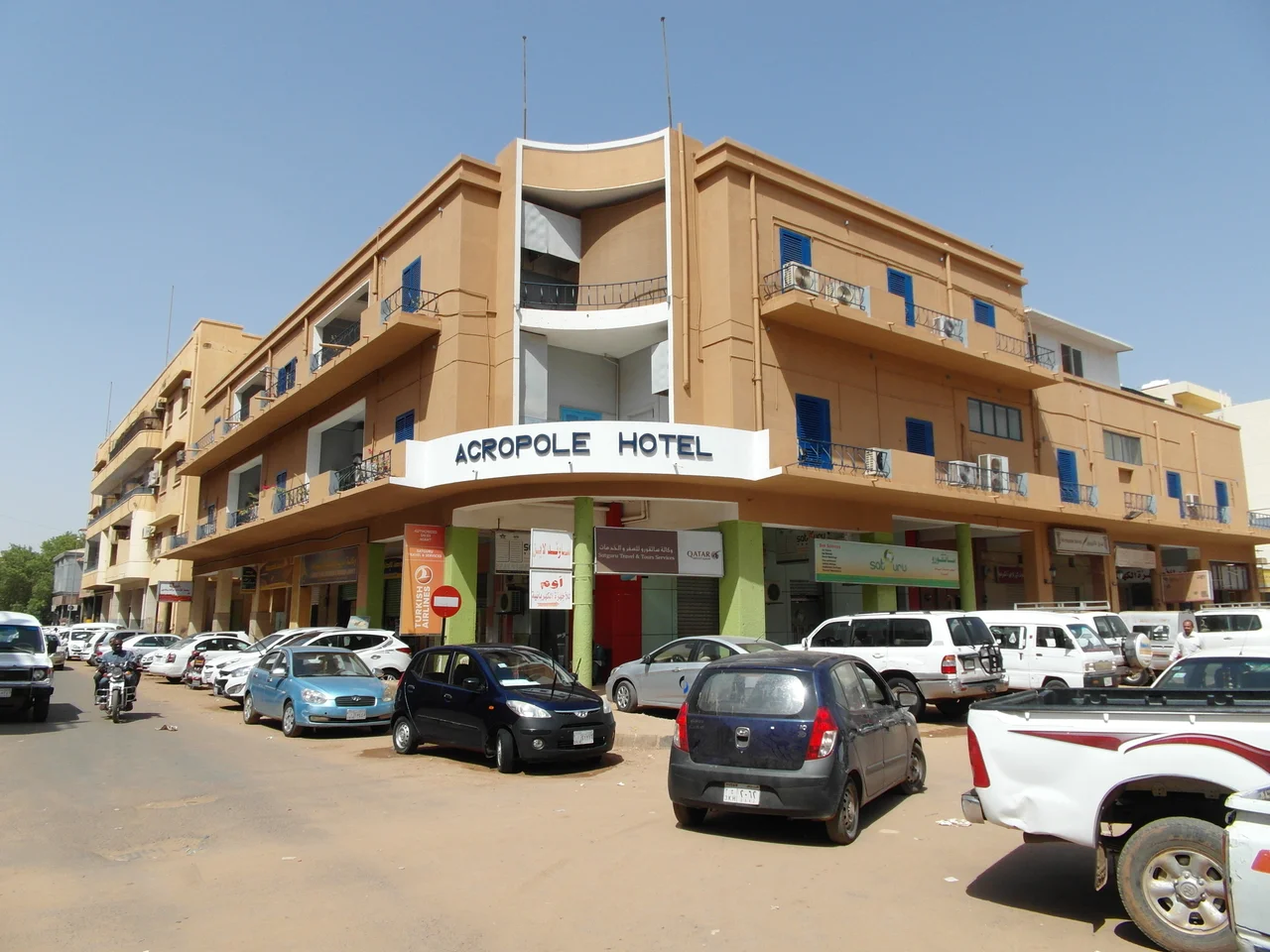

Acropole Hotel
One of the things Thanasis Pagoulatos managed to carry out of Khartoum, through streets littered with dead bodies and past Rapid Support Forces fighters who had already ransacked his hotel, was a handwritten note from Mother Teresa. He was seventy-nine years old. He and his sister-in-law Nora, widow of his brother George, had been trapped inside the Acropole Hotel for ten days without electricity or running water, along with four guests and three staff. When the French Armed Forces finally got them out, the hotel closed its doors for the first time in seventy-one years. The note came with him.
A Night Club Opposite the Governor's Palace
Panagiotis Pagoulatos, known as Panaghis, left the Ionian island of Cephalonia during the Second World War. He washed up in Khartoum, then the capital of Anglo-Egyptian Sudan, where a sizeable Greek community was already thriving. He married Flora, a Greek woman from Alexandria. The Washington Post later summarized his rise in one glorious sentence: "During the day, he was employed by the British government. After hours, he worked as a private accountant, soon amassing enough capital to open a night club just opposite the governor's palace." When the British Governor-General Sir Alexander Knox Helm shut the Great Britain Bar down for the noise, the Pagoulatoses pivoted. A liquor dealership, a wine store, a confectionery. And then, in 1952, a ten-room hotel called the Acropole.
Independence, Coups, and the September Laws
Sudan became independent on 1 January 1956. The Greek settlers, some six thousand strong at the community's peak, received Sudanese nationality certificates. Panaghis died in 1965 and his three sons took over: Thanasis, George, and Gerasimos, better known as Makis, who was actually born inside the hotel. They survived the 1969 coup that nationalized most Greek-Sudanese enterprises, spared only because they rented their building. They survived the failed 1971 Communist coup, which pushed Sudan back toward the West and refilled the bar. Then in 1983 came President Gaafar Nimeiry's September Laws, which poured sharia into the Blue Nile along with every bottle of liquor in the country. The Acropole had been distributing Amstel beer nationwide. Suddenly it wasn't.
Famine, Fax Machines, and Mother Teresa
What followed was the strangest of blessings. The famines in Darfur and Ethiopia sent every NGO on earth scrambling for Khartoum, and the Acropole was the only hotel with working telephone, telex, and fax lines. Robert D. Kaplan called it "a monument to the inventive cunning and shrewdness of the Greek trading community in Africa." Others gave it what one writer termed a "Raiders of the Lost Ark vibe." Mother Teresa stayed. Bob Geldof wrote a letter of thanks, still framed on the office wall when the war came. Archaeologists working on the Meroitic ruins to the north made it their Khartoum base, year after year, for decades. The 1995 Washington Post called the forty-one-room hotel "a rare oasis of efficient telecommunications and the friendliest atmosphere between Cairo and Nairobi."
George Pagoulatos, the Best Ambassador of Sudan
George Pagoulatos ran the hotel like the captain of an ocean liner, as one obituary put it. His wife was of Italian origin; they had grown up in Sudan together and had been married forty-three years. He rose at 5:30 every morning for fifty years. Sir David Chipperfield featured him at the 2016 Venice Biennale of Architecture, in the presentation of a planned museum at the UNESCO World Heritage Site of Naqa. George died on 1 July 2022. Germany's Süddeutsche Zeitung called him "the best ambassador of Sudan." The entry-way of the Acropole was covered in team photographs from archaeological missions the family had supported for decades. These were not tourists. These were researchers who had, as George once said, solved problems together over twenty years and become something more like family.
April 15, 2023
On 15 April 2023, the Sudanese civil war erupted in downtown Khartoum, and the Acropole stood directly in the crossfire between the Sudanese Armed Forces and the Rapid Support Forces. Thanasis and Nora sheltered in the hotel with a handful of guests and staff. RSF fighters broke in and robbed them. When the Greek family and their guests finally made it out, they walked past bodies in the streets. The French military evacuated them to Djibouti, from where they continued to Athens. Thanasis told Reuters he hoped to return. Seventy-one years of continuous operation ended in ten days. The hotel where every Khartoum foreign correspondent had filed copy, where Mother Teresa had slept, where a fax machine had once been worth more than gold, closed its doors for the first time since 1952. Somewhere in Athens, Thanasis Pagoulatos still has Mother Teresa's note.
From the Air
The Acropole Hotel stood at approximately 15.60°N, 32.53°E in downtown Khartoum at the confluence of the Blue and White Niles. Nearest airport is Khartoum International (IATA: KRT, ICAO: HSSS), though it closed at the start of the 2023 civil war. Recommended viewing altitude 6,000-10,000 ft AGL to appreciate the Nile confluence and the tripartite city of Khartoum, Omdurman, and Bahri.
Nearby Stories
- Esh Shaheinab 27 km away
- Naqa 56 km away
- Mahdist War 65 km away
- Musawwarat es-Sufra 100 km away
- Gezira State 101 km away
- Northern Sudan 215 km away