.jpg)
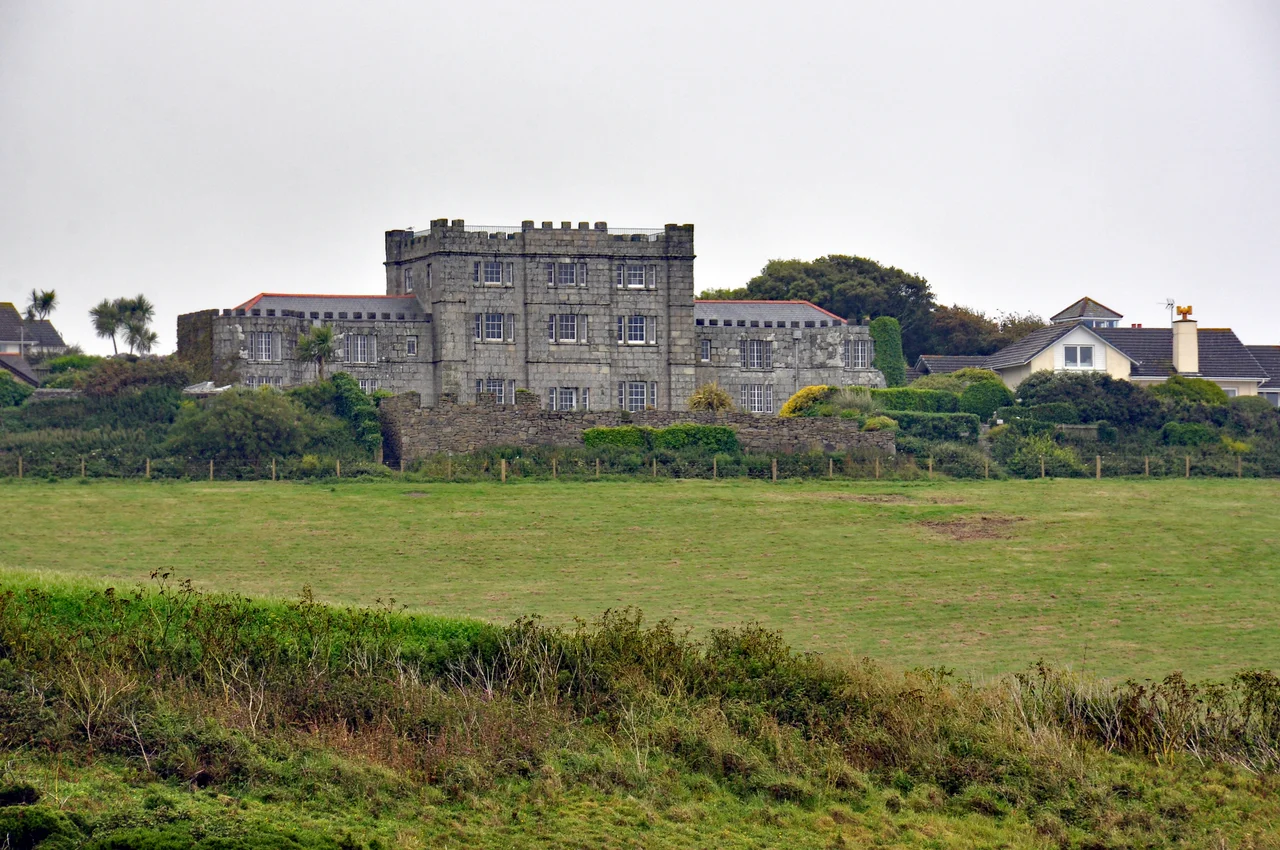
Acton Castle
John Stackhouse built a castle so he could study seaweed. That sentence sounds like a joke, but it is the literal origin of Acton Castle - a small castellated granite mansion that still stands on the cliffs near Perranuthnoe, looking down on Mount's Bay. Stackhouse was a distinguished botanist of Pendarves, with an interest in marine algae and in plants mentioned by the ancient Greek author Theophrastus. He needed a coastal base from which to walk down to the rocks and the rockpools, gather seaweed in tanks, and produce what would become his illustrated work Nereis Britannica - one of the first serious British treatises on seaweed, published in three parts between 1795 and 1801. So around 1775 he built himself a battlemented house above the cove, named it after his wife's family, and got to work on the algae. Then a smuggler named John Carter moved in.
Built for Seaweed
The castle is small but emphatic - dressed granite facade and chimneys, walls topped with embattled parapets, a grouted roof. The early-twentieth-century wings of two storeys with tripartite windows were added during the building's conversion to a country hotel, but the core eighteenth-century structure is Stackhouse's. It is a Grade II* listed building. He named it Acton after Susana Stackhouse nee Acton, his wife, the heiress of Edward Acton of Acton Scott in Shropshire. Below the castle lies what is now called Stackhouse Cove - a quiet inlet sheltered from the prevailing westerlies where the botanist could descend the cliff path to gather specimens. Remains of several large stone tanks that he built to hold seaweed for study can still be found on the grounds today. Sea water filled them and renewed itself with the tides. Stackhouse would walk down with notebook and basket, fish algae out of the rocks, and add to the tanks the species he wanted to compare alive.
Nereis Britannica
Between 1795 and 1801 Stackhouse published Nereis Britannica in three parts, illustrated with the algae he had collected and grown at the castle. The book belongs to a moment when British natural history was transforming itself from gentleman amateurism into systematic science. Stackhouse was friends with Sir Joseph Banks. He corresponded with the leading botanists of Europe. His genus Nereis (named for a Greek sea nymph and now mostly reorganised by modern taxonomy) gave structure to the British seaweed flora. The book had to be illustrated because no one before him had drawn many of these species accurately. The tanks at Stackhouse Cove are the modest physical record of an unusually focussed scientific career - a man who built a castle, mostly so that he could do good biology at the right tide twice a day. He sold Acton shortly before his death to Bulkeley Mackworth Praed, son of the banker William Mackworth Praed. Bulkeley Praed died at the castle on 6 October 1852.
The King of Prussia
While the Stackhouses were the legal owners, the castle had a second life its proprietor seems not to have noticed. One of the Stackhouse tenants, a local man named John Carter, rented the adjoining farm and saw an opportunity in the castle's frequent emptiness. Carter was the most notorious smuggler on the south coast of Cornwall - so successful, so brazen, and so locally popular that he was known by his nickname, the King of Prussia. The nearby cove he used as a landing place still carries that name today: Prussia Cove. Carter used Acton Castle and Stackhouse Cove as part of his operation - landing French brandy, Dutch gin, tobacco, salt, and other contraband, and stashing it in the castle and the adjacent caves until customs riders gave up the search. On one occasion he hid his brother Harry, an escaped prisoner, inside the castle. Local legend claims he constructed tunnels leading from inside the castle down to Stackhouse Cove. Some of those tunnels have been documented; others are folklore. Carter operated for decades, with the open complicity of the local population, and seems mostly to have outwitted the authorities he was meant to be afraid of.
Praed, Field, Lanyon, Hotel, Flat
The castle passed through nineteenth-century hands. Bulkeley Praed died there in 1852. His sister inherited and sold to Thomas Field, who took up residence and stayed for a number of years. In 1861 Field sold to Richard Lanyon. After Lanyon's death his widow stayed on at the castle until her own death in 1899. The pattern of single-family residence ended in the twentieth century. Acton Castle was converted into a country hotel in the middle of the century - the wings with their tripartite windows date from this period - and the hotel operated until it closed in the 1980s for lack of business. The building was then developed into luxury apartments. The granite tower walls and battlements still stand. The Nereis Britannica is in the British Library. The seaweed tanks are still in the grass below the cliff. The tunnels - if they exist - are still down there. Walk the South West Coast Path between Perranuthnoe and Prussia Cove and you pass directly above all of it: science, smuggling, and the small castle that hosted both.
From the Air
Acton Castle sits at 50.11 N, 5.43 W on the cliffs above Stackhouse Cove and Prussia Cove, about 3 nm east of Marazion and St Michael's Mount on the south coast of Cornwall. Land's End airfield (EGHC) is 13 nm to the west; Newquay (EGHQ) is 25 nm to the north. RNAS Culdrose is 6 nm to the east. From 2,500 feet the castellated building is identifiable above the small private coves - Stackhouse Cove immediately below, Prussia Cove just east. St Michael's Mount rises from the water 3 nm to the west, and the long curve of Mount's Bay sweeps round to Lizard Point on the south-eastern horizon. The South West Coast Path threads along the cliff. Watch for fishing-boat traffic moving between Newlyn and the eastern bay.
Nearby Stories
- Wadebridge 8.1 km away
- Caerhays Castle 8.1 km away
- Sevenstones Lightship 16 km away
- Battle off Lizard Point 20 km away
- MV Cita 22 km away
- Carnewas and Bedruthan Steps 30 km away
- 1979 Fastnet Race 71 km away
- HMS Affray 108 km away