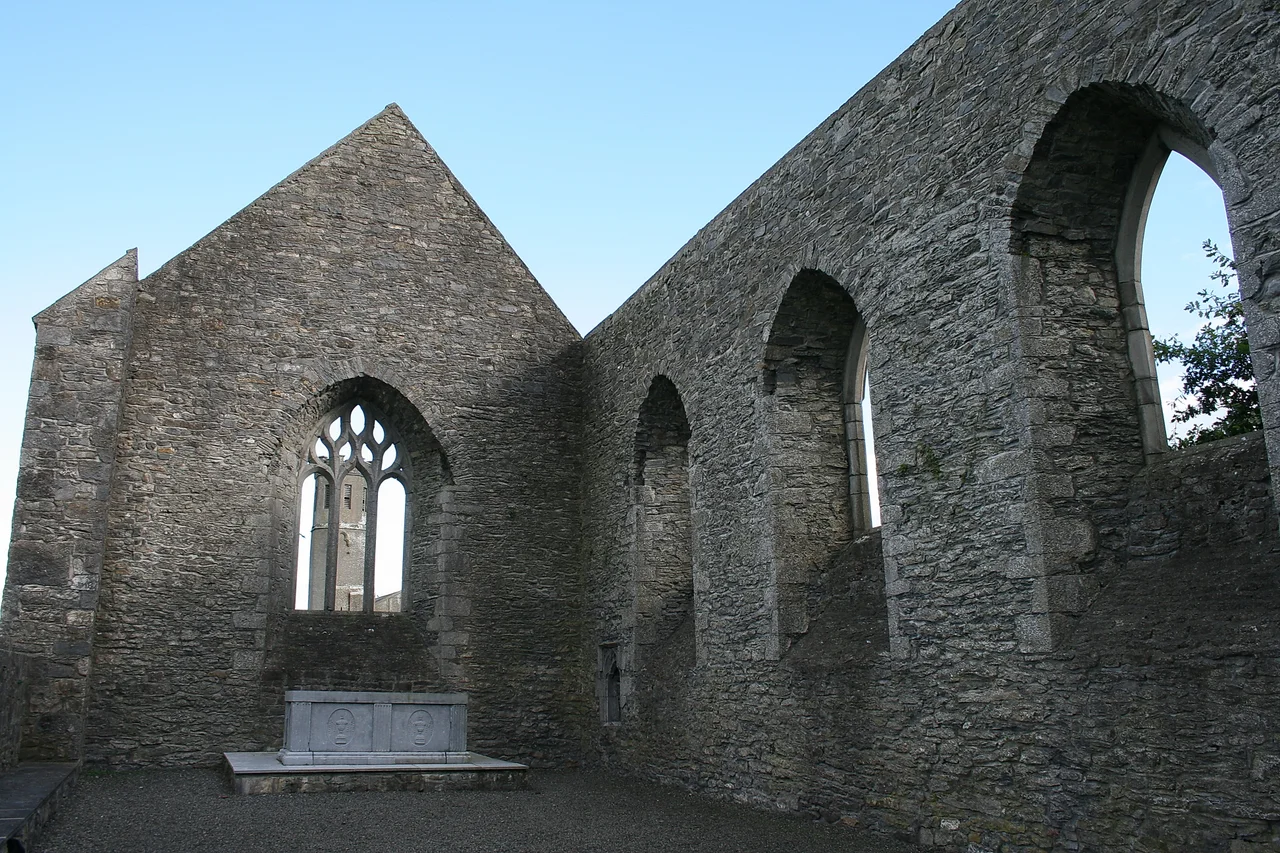

Aghaboe Abbey
The name means "little field of the cow" - Achadh-bou in old Irish, Campulus Bovis when Adomnan wrote about it in Latin in the seventh century. St. Canice founded his monastery here in the 500s, in the small kingdom of Osraige, and for a while the field of the cow held one of Ireland's most consequential intellectual exports. From this Laois pasture, a monk named Feargal walked across Europe and became the bishop who built Salzburg's cathedral. The cow-field made history. Then the world moved on, and the abbey burned twice, and what is left is a single ruin in a damp green field, with a beautifully carved three-light window in the east wall.
Canice and the Cow-Field
In the sixth century, Cainnech of Aghaboe - known in English as St. Canice - chose this spot in the Slieve Bloom foothills for his monastery. The kingdom of Osraige stretched from Slieveardagh to the Barrow, and Aghaboe became its principal religious house, eclipsing the older monastery of Seirkieran. Canice built a daughter house at Kilkenny, the kingdom's capital. The Annals of Inisfallen note the death of "Scandlán, grandson of Tadc, abbot of Achad Bo" in 782 - one of the few specific Aghaboe names that survives from the early centuries, when the abbey grew into a center of learning, commerce, and agriculture. When the Synod of Rathbreasail in 1111 divided Ireland into territorial dioceses, Aghaboe and Kilkenny were placed together in the Diocese of Ossory. The bishop's seat went to Kilkenny, where the abbey church became St. Canice's Cathedral. Aghaboe stayed a monastery.
The Monk Who Built Salzburg
Sometime in the eighth century, a monk named Feargal - also called Virgilius in Latin - left Aghaboe for the continent. He was a geometer and an astronomer, and he reportedly held the dangerous opinion that the earth was a sphere with people on the other side, a position that briefly got him in trouble with Pope Zachary. He kept his job. He became bishop of Salzburg, and there he built the cathedral that still bears his memory. He was canonized in 1233, almost five centuries after his death. The Salzburg-Aghaboe connection has not entirely faded: in 1984, Dr. Jakob Mayr, archbishop of Salzburg, made the pilgrimage to the cow-field where his most distant predecessor began. In 2001, the Austrian ambassador came too. A statue of Saint Vergilius stands at the Salzburg Cathedral. The little field has its place in continental memory.
Burned Twice
In 1234, the original monastery burned. Aghaboe was a possession of the Mac Giollaphadraigs - the lords of Upper Ossory, anglicized to Fitzpatrick - and the fire occurred during a Mac Giollaphadraig attack on a Norman fortification built right next to the abbey. The flames were probably accidental, but the result was the same. The site was rebuilt as an Augustinian priory. The ruin that still stands today, however, is older than that - or rather, younger. In 1382 Finghan MacGillapatrick, Lord of Upper Ossory, founded a Dominican friary on the site. That is the building whose east window still survives: three slender lights carved with the careful geometry of a wealthy late-medieval foundation. The friary lasted until 1540, when Henry VIII's Suppression closed it down. After that, the stones began the long slow weathering they are still undergoing.
A Place That Refuses to Disappear
The civil parish of Aghaboe and the Roman Catholic parish of Aghaboe both still carry the abbey's name, though they cover quite different areas of the surrounding Laois countryside. The local community conserved the priory church, and the east window's three lights still catch the morning sun. Members of the Fitzpatrick-Mac Giolla Phadraig Clan Society have made it a place of recurrent pilgrimage. In 1994, President Mary McAleese came - one of three presidential plaques now mounted in the nave. The motte beside the abbey, fourteen meters across at the summit, marks where the Norman tower once stood that may have caused the 1234 fire. The footprint of a thousand years sits in roughly an acre: Gaelic monastery, Norman fortification, Augustinian priory, Dominican friary, ruin, memorial, pilgrim destination. The cows still graze in the field, in case anyone wonders where the place got its name.
From the Air
Aghaboe Abbey sits at 52.92N, 7.51W in the gentle hill country of County Laois, in the rural midlands of Ireland. The Slieve Bloom Mountains rise to the northwest, a soft long ridge of moorland that marks the boundary between Laois and Offaly. Dublin (EIDW) is 90 km to the northeast; Shannon (EINN) is 95 km west. The abbey itself, just a single roofless chapel, is too small to see from cruising altitude. Look instead for the nearby town of Abbeyleix to the east, and the larger town of Portlaoise to the north - the modern county town that has absorbed most of the regional traffic. The R434 regional road links the village to the wider network.
Nearby Stories
- Borrisokane 2.8 km away
- Murder of Ashling Murphy 5.6 km away
- St Stanislaus College 7 km away
- Kilcooly Abbey 7.1 km away
- County Carlow 15 km away
- Doon, County Limerick 18 km away
- Kildare Cathedral 20 km away
- Clonard Abbey 21 km away