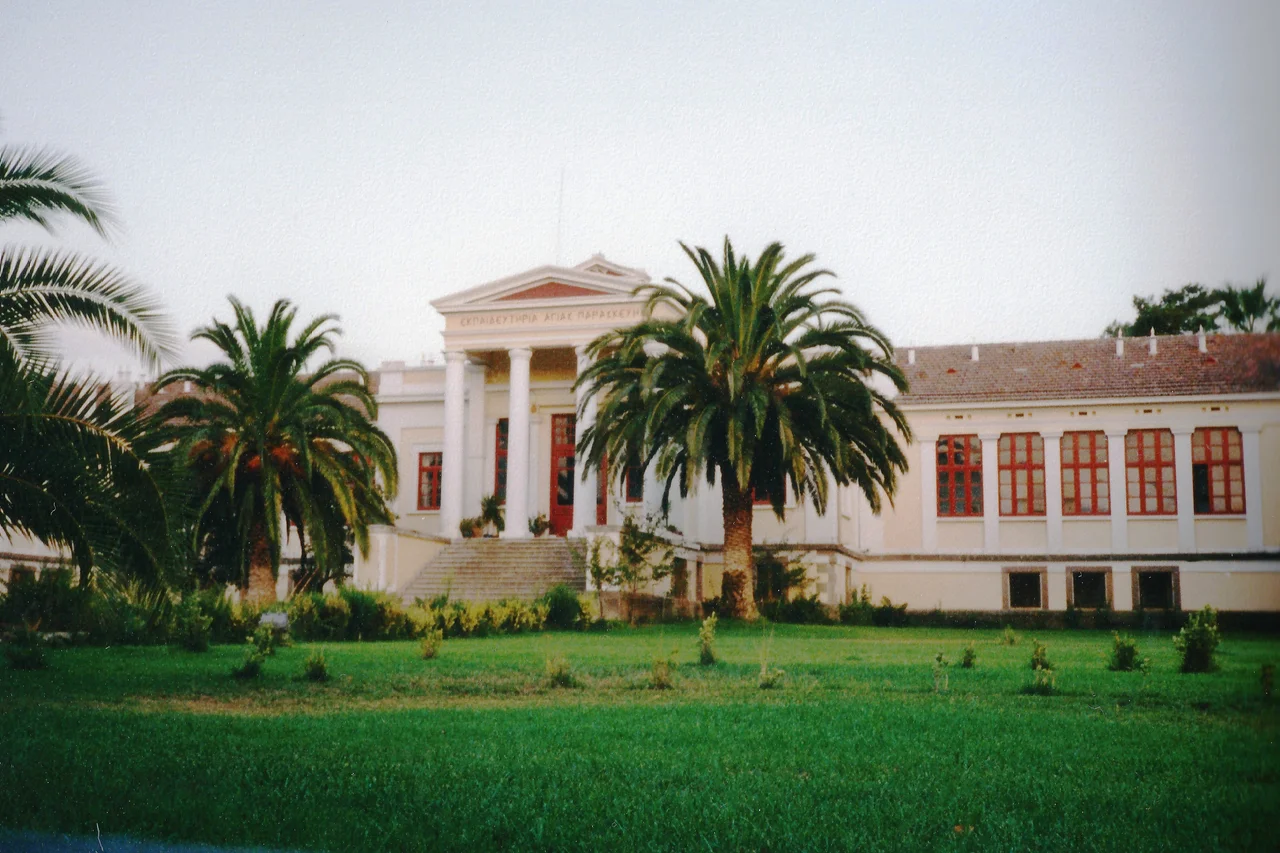

Agia Paraskevi, Lesbos
Once a year, the village of Agia Paraskevi does something most of Greece abandoned centuries ago. On the last weekend of June or the first of July, villagers lead a bull up to the chapel of Agios Charalambos in the pine forest above town, and there, in a rite that stretches back through Orthodox tradition to the ox-sacrifices of antiquity, the animal is offered and its meat boiled into a wheat-and-meat stew called kiskek to feed everyone who comes. Horses race, riders dance in the saddle, and music fills the square for four days. It is the most striking survival on an island full of old things, and it happens in a village that the rest of the year keeps quietly to itself.
Little Paris of the Aegean
Agia Paraskevi sits in the central part of Lesbos, on the northeast shore of Kalloni Bay, away from the beaches and the tour buses. Locals call it the Little Paris of the Aegean, mikro Parisi, and the name is not entirely a joke. The village grew wealthy enough to build grand things: stone mansions, an elegant agora, and a striking neoclassical school. Money for that school came from the town's own olive-oil press, and the architecture shows the layered occupations the island absorbed, Venetian and Roman influence among them. This is a rare kind of place on Lesbos, neither commercialized nor built for visitors. Villagers still gather at the tavernas along the main street to sit and talk, and while cars have long since taken over the work, people here once moved between the houses and fields on foot, by moped, or on horse, mule, and donkey.
The Bull Festival
The festival the village is known for honors Agios Charalambos, but its bones are far older than the saint. Scholars trace the bull sacrifice back to the Buphonia, the ancient ox-slaying that was part of the Dipolieia, a midsummer religious festival of classical Greece. On Lesbos the custom survives in only three places, of which Agia Paraskevi is the largest and most famous. The four days of celebration blend the sacred and the festive: the ritual offering of the bull, the long cooking of kiskek in great cauldrons, equestrian competitions and dances performed on horseback, and a village-square party with live music. People come from across the island and beyond, and the whole community is fed from the shared pot. It is a thread of continuity running, unbroken, from temple altars to a chapel in a pine wood.
A Cave, a Well, and Older Gods
The village takes its name from the Church of Agia Paraskevi, set inside a cave at one of the highest points of the town, where the cemetery also lies. The church was presumably raised over an older pagan temple, and a well still rises within the cave; drinking its water was said to bring the protection of the Virgin Mary. The deeper past surrounds the village. At nearby Klopedi stand the remains of the Aeolian temple of Napaios Apollo, and at Messa lie the ruins of a great Ionian temple from the late fourth or early third century BC, perhaps dedicated to Zeus, Hera, and Dionysos together. Not far off, at Halinados, the Early Christian basilica of St. George was restored by the medievalist scholar Anastasios Orlandos. Here the layers do not hide. Pagan temple, Christian cave-church, and a sacrifice that predates them both all share the same few hills.
From the Air
Agia Paraskevi lies inland in central Lesbos at 39.25°N, 26.27°E, on the northeast shore of Kalloni Bay. From the air, look for the large enclosed gulf of Kalloni to the southwest and the village set back from its head, with the pine-forested high ground above town where the chapel of Agios Charalambos sits. The nearest airport is Mytilene International (Odysseas Elytis), ICAO LGMT, roughly 35 km to the east-southeast. Best viewed in clear midday light when the bay's shallow waters and the surrounding olive country stand out.
Nearby Stories
- Antandrus 6.8 km away
- Agios Isidoros, Lesbos 19 km away
- Adramyttium 30 km away
- Troy 45 km away
- Destruction of Psara 51 km away
- St. Helena Church 72 km away
- Psara 82 km away
- Battle of Athos 85 km away