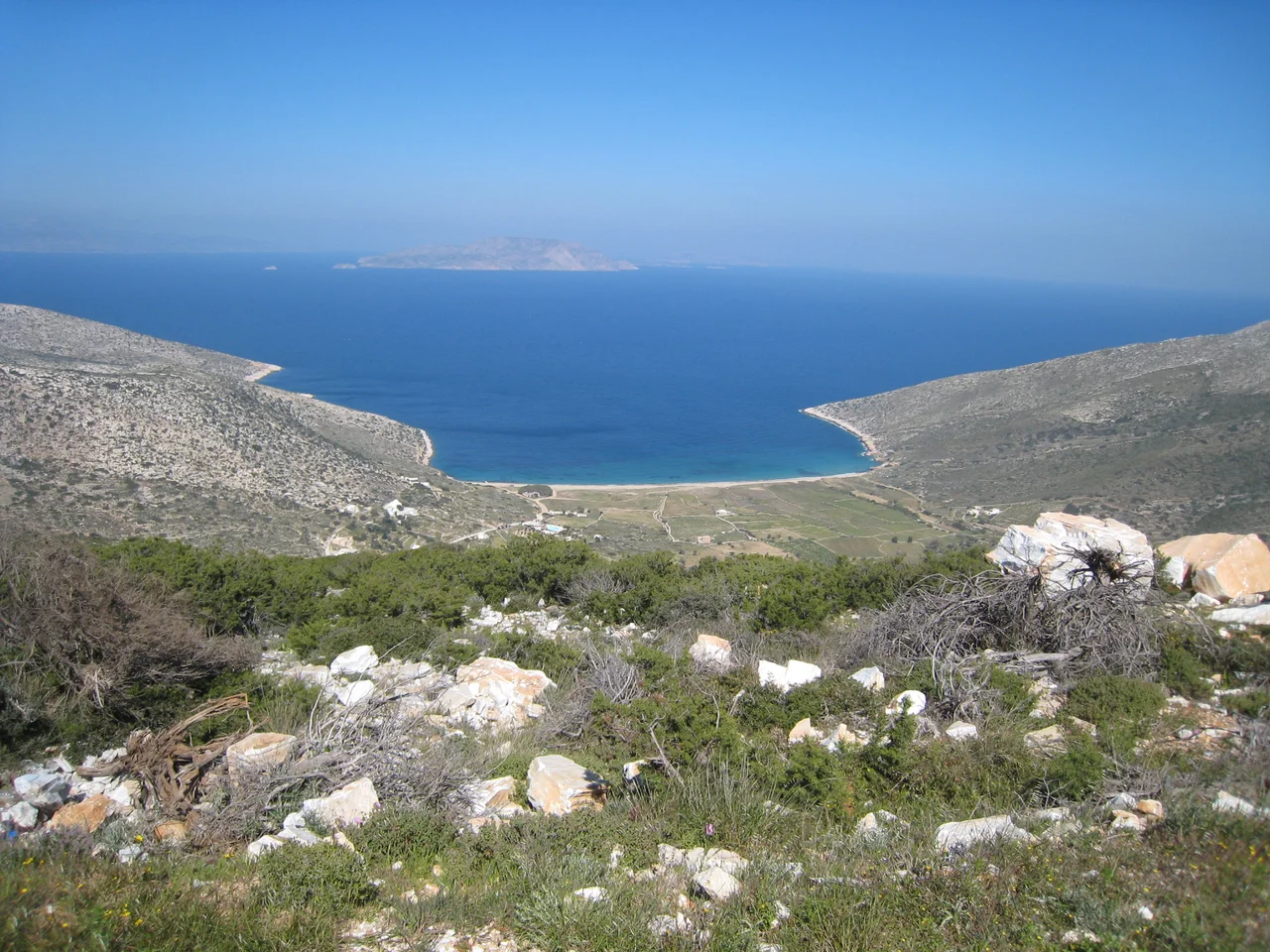

Agia Theodoti
Cross to the northeastern shore of Ios, away from the crowds and the all-night music of Chora, and the island goes still. Here, in the curve of its own gulf, sits Agia Theodoti - a seaside hamlet barely twenty meters above the water, named for the church that has stood watch over the bay for roughly five hundred years. For most of its history you could only reach it on foot or by donkey. The asphalt road did not arrive until 1998.
The Far Shore
Agia Theodoti lies about 10 kilometers northeast of Chora, the island's whitewashed capital, on the opposite coast from the harbour and the party beaches. For generations this distance meant isolation. Residents traveled the path to town on foot or with animals, and the basic infrastructure of modern life arrived late and slowly. Telephone service did not reach the settlement until 1967. The road was carved out in 1978, paid for privately, and only paved two decades after that. In the surrounding hills, iron mines once operated, a reminder that even remote corners of small islands were drawn into the wider economy. Then, beginning in the 1980s, the tide turned: tourism discovered the quiet bay, and the settlement began to grow.
A Church on Older Stones
The settlement takes its name and its identity from a single building. The church of Agia Theodoti was raised about five centuries ago directly on the ruins of an ancient temple - one sacred site built on the foundations of another, the way so many Greek churches inherited the holy ground of the gods who came before. Originally it served the worship needs of the island's Roman Catholic community, a legacy of the centuries when Latin and Frankish rulers held the Cyclades. The church carries a second name as well, Panagia to Genesio, marking the Nativity of the Virgin. Each year on the 8th of September the bay fills with the bustle of its festival - a single day when this hushed corner of Ios becomes the center of island life.
What the Land Remembers
Near the church lie the remnants of an ancient aqueduct, the practical infrastructure of people who lived here long before the donkey paths and the asphalt. Water has always been the scarce, precious thing on a Cycladic island of cliffs and dry summer wind, and the fragments of stone channel speak to the effort it once took to move it. Together with the temple beneath the church, the aqueduct makes Agia Theodoti a place where three layers stack quietly atop one another: an ancient sanctuary, a Catholic church of the island's Venetian centuries, and a modern beach village that woke up only a generation ago. Few visitors notice. The bay simply lies there, blue and patient, holding all of it at once.
From the Air
Agia Theodoti sits on the northeast coast of Ios at roughly 36.75°N, 25.32°E, set in the middle of the Gulf of Agia Theodoti at about 20 m elevation, some 10 km northeast of Chora. From the air, look for a sheltered bay with a sandy beach on the island's quieter, less-developed eastern side, opposite the harbour and Mylopotas. Recommended viewing altitude 2,500-4,000 ft to take in the gulf and surrounding hills. Nearest airports: Santorini (LGSR) to the south, Naxos (LGNX) to the north, and Paros (LGPA) to the northwest. Summer skies are clear with a strong northerly meltemi wind, which can make the eastern coast choppy.
Nearby Stories
- Battle of Amorgos 8.3 km away
- Panagia Chrysopigi 23 km away
- Miaouli Square 40 km away
- Astypalaia 42 km away
- Cave of the Apocalypse 53 km away
- Battle of Rhodes (1912) 110 km away
- Battle of Rethymno 138 km away