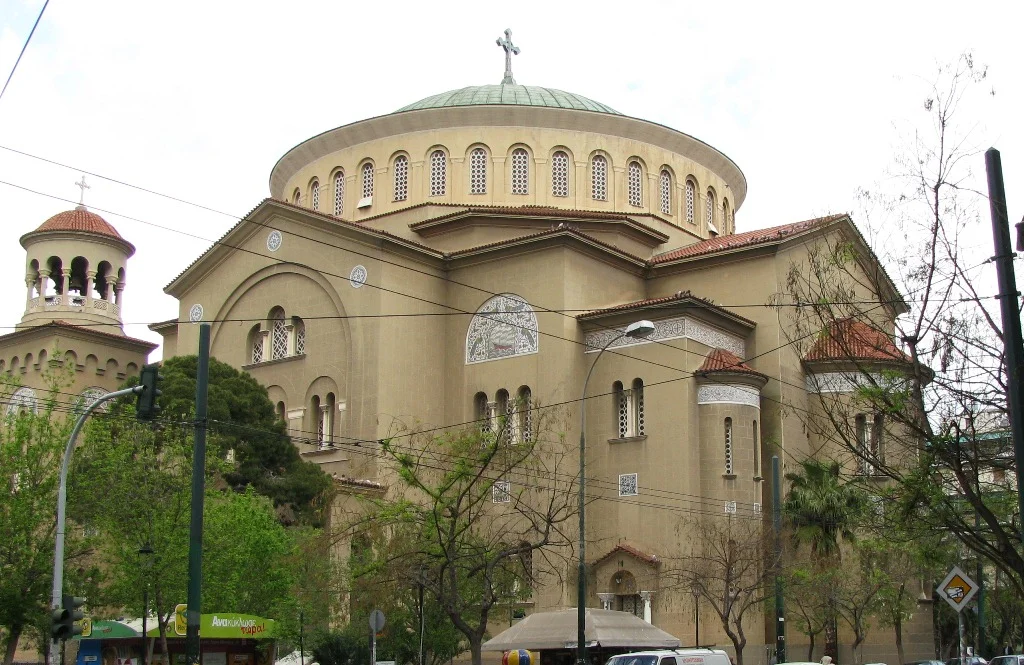

Agios Panteleimonas, Athens
The church came first, and it gave the neighborhood everything, including its name. Begun in the 1920s as one of the earliest reinforced-concrete buildings in Athens, the church of Agios Panteleimonas rose in stages, foundations and great dome first, then a long pause, then work resumed only after the Second World War. It was not finished until the 1970s. By then it was among the largest churches in the Balkans, an enormous landmark on Acharnon Avenue, and the streets that grew up in its shadow took the saint's name as their own. To stand in its square is to stand at the center of a working-class district northwest of the Athenian core, between Viktorias and Attikis squares.
The Great Church
Agios Panteleimonas, named for the healer-saint also called Saint Pantaleon, is sometimes called Agios Panteleimonas Acharnon for the avenue it overlooks. Its construction is a story of patience and interruption. When work began in the 1920s, builders poured concrete in a way still novel for Athens, and at first only the foundations and the vast central cupola took shape. Then the money or the will ran out and the site fell quiet for years. Construction resumed after the war and dragged on for decades more, the dome waiting all that time for the church beneath it to catch up. Completed at last in the 1970s, it stood as one of the biggest churches in the region, a monument finished half a century after it was started.
A Neighborhood in a Changing City
Like much of central Athens, Agios Panteleimonas changed shape as the city did. In the late 2000s, as Greece sat on one of Europe's main routes for people arriving from the Middle East and Africa, many newcomers settled in these dense central blocks. Many came without secure housing or work, drawn to cheap rooms in an old neighborhood near the rail lines and the city's heart. The arrivals were people in motion, often having traveled enormous distances under hard circumstances, looking for the same things anyone wants: a roof, a job, a measure of safety. The neighborhood they reached was already crowded and aging, and the pressures of poverty pressed on residents old and new alike.
Strain and Its Costs
The years that followed were hard ones, and they were felt by everyone who lived here. Longtime residents described rising crime and a sense of a familiar place slipping away; recent arrivals faced poverty, uncertain status, and growing hostility. In this climate, far-right organizations found an audience in the neighborhood, and Agios Panteleimonas became a flashpoint in Greece's wider arguments over migration during the crisis years. It is worth saying plainly that the human cost fell on people on every side of those arguments, the families who had lived here for generations and the migrants who had crossed half a world to reach a small Athenian square. The story of this place in those years is best told as one of strain and shared hardship, not of villains and victims.
Everyday Life Goes On
Underneath the headlines, the ordinary life of a city neighborhood continued. Children still played in the square beneath the great dome, shops opened and closed, the church bells still rang. Acharnon Avenue carried its traffic, and the saint's feast still drew the faithful. The district even fields a basketball club, Aetos B.C., that has competed in Greece's second division. Neighborhoods like this one absorb more than their share of a city's changes, and they keep going. Agios Panteleimonas remains what it has long been: a dense, lived-in piece of central Athens, defined as much by the enormous church at its heart as by the difficult decade that briefly made it famous.
From the Air
Agios Panteleimonas lies at 37.997° N, 23.727° E, in central Athens just northwest of the city core, between Viktorias and Attikis squares along Acharnon Avenue. The dominant landmark is the large domed church of Agios Panteleimonas itself, one of the biggest in the Balkans, set amid the dense low-rise blocks of the inner city. From the air the neighborhood reads as part of the tightly packed central Athens fabric, with the Acropolis and Lycabettus hill as orientation points to the south and east. A viewing altitude of 2,500–4,000 ft AGL over the city center gives context. Nearest airport is Athens International (LGAV), about 28 km east-southeast; central Athens visibility is good outside summer haze, though airspace over the city is busy and controlled.
Nearby Stories
- Great Sand Beach 5 km away
- Battle of Delium 7.7 km away
- Tower of Aliartos 9 km away
- HMHS Britannic 10 km away
- Saronic Gulf 15 km away
- Sousaki Volcano 17 km away
- Sanctuary of Apollo Maleatas 24 km away
- Skyros 66 km away