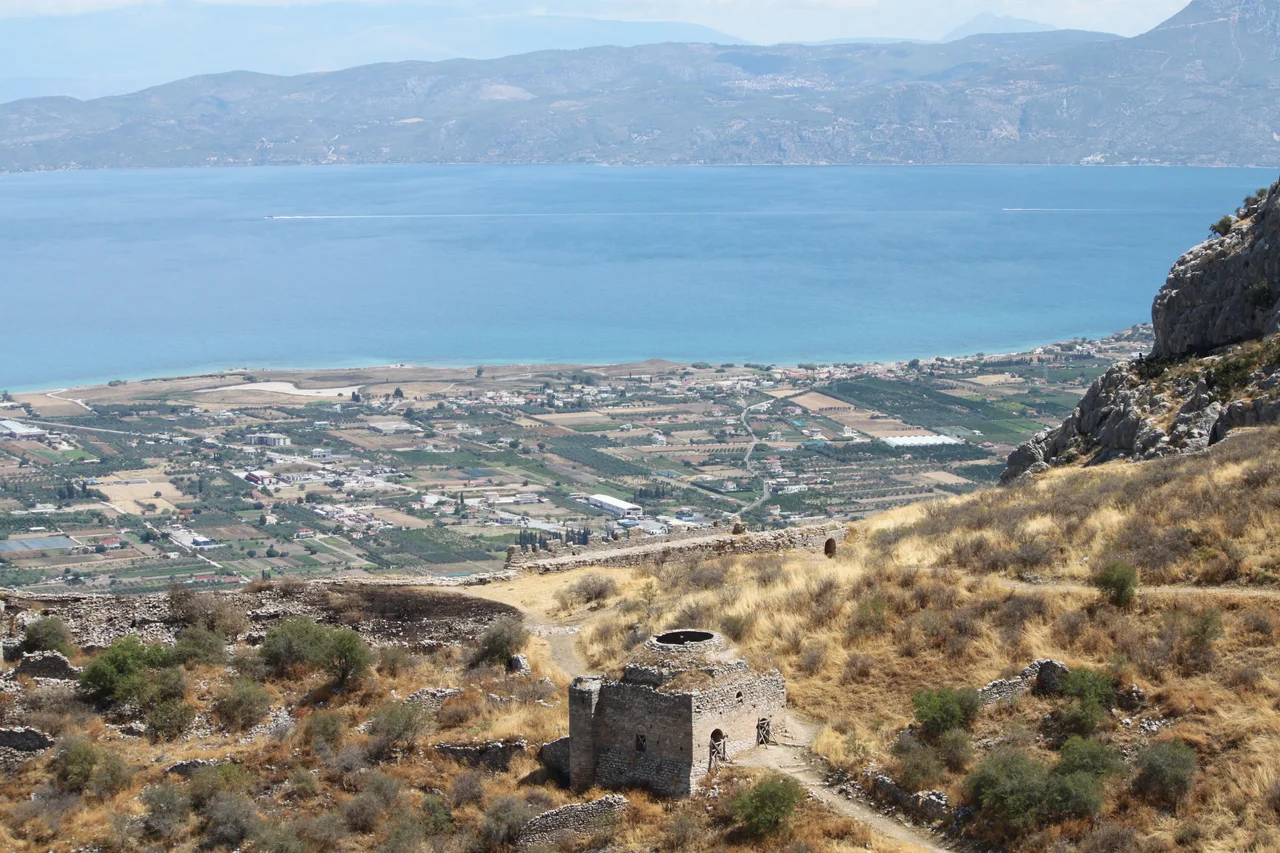

Ahmed III Mosque, Acrocorinth
On the walls of the Ahmed III Mosque, the lion of Saint Mark stares out from above the doorway — the emblem of the Republic of Venice, carved into stone that would become a Muslim place of prayer. That detail, more than anything else, captures what the Acrocorinth has always been: a place where one conqueror builds on top of another, each leaving traces the next cannot quite erase. The mosque sits near the summit of the great rock that has dominated Corinth for more than two millennia. It is small — barely 8.5 by 9.5 metres — and today it is largely in ruins, its cupola partially collapsed, its minaret missing its upper section. But it is still there, stubbornly present on a hill that has seen Greeks, Romans, Byzantines, Franks, Venetians, and Ottomans all claim it as their own.
A Fortress of Faiths
The Ottoman presence on the Acrocorinth began in 1458, when the forces of Sultan Mehmed II took Corinth. The citadel, already a formidable military stronghold, was adapted for the needs of its new garrison. Several mosques were established within the fortress walls. The Ottoman traveller Evliya Çelebi, who visited in 1668, recorded four buildings serving the Islamic religious life of the fortress community — a remarkably detailed snapshot of a working Ottoman garrison town perched on a rock above the Corinthian plain. One of these, probably dating from the 16th century, occupied the northern part of the citadel. Dendrochronological analysis of two oak timbers found in the wall masonry and minaret gave dates of 1489 and 1508, providing a rare fixed point in the building's murky early history. The mosque that stood there in 1668 did not survive the next chapter: when Venice seized the Peloponnese in 1687, it converted the building into a powder magazine — a practical desecration that risked, at any moment, turning the entire summit into rubble.
Built by Sultan Ahmed III
The Venetian period lasted until 1715, when Ottoman forces under Sultan Ahmed III reconquered the Peloponnese. Within a short time of retaking the fortress, Ahmed III commissioned a new mosque on the ruins of the earlier one — an act of both piety and political statement. The building that resulted has the simple, functional plan of the earliest Ottoman mosques in the Balkans: a square prayer hall surmounted by a large cupola on squinches, a mihrab set into the south wall in the Turkish Baroque style, and a minaret at the northwest corner preserving a spiral staircase in its base. The masonry is notably heterogeneous — limestone mixed with reused brick and spolia from earlier structures, the corners and minaret base more carefully finished than the rest. On the main north facade, the Venetian voussoirs above the door and the carved lion of Saint Mark were not removed. They simply became part of an Ottoman mosque, as if the building were making its own quiet commentary on the layered nature of this particular place.
Abandonment and the Weight of Time
The mosque was studied in 1936 by archaeologists Antoine Bon and Rhys Carpenter, who documented its architecture in detail. Some restoration work was completed in 2000, but the building has been largely abandoned and neglected since then. The cupola has been partially destroyed, the result of decades without maintenance. The minaret's upper section is gone. The prayer hall is open to the elements. What survives — the mihrab with its muqarnas niche and ornate double rectangular frame, the base of the minaret, sections of the exterior walls — does so through a combination of the structure's original robustness and simple inertia. It is a monument that nobody has quite decided what to do with. Greece's relationship with its Ottoman architectural heritage has historically been complicated, and the mosque on the Acrocorinth exemplifies that difficulty: too significant to demolish, too politically sensitive to fully restore, and too remote for casual visitors to reach without effort.
What the Ruins Tell
The Acrocorinth itself — the great limestone crag rising 575 metres above the plain — has been a military stronghold since at least the 7th century BC. The views from its summit take in the Corinthian Gulf to the north, the Saronic Gulf to the east, and the mountain ranges of the Peloponnese in every other direction. It is one of the most defensible natural positions in the ancient Mediterranean world, and every major power that passed through this region understood that. The Ahmed III Mosque is the last physical remnant of two and a half centuries of Ottoman occupation of the Acrocorinth. Its condition is a measure of how selectively the past is preserved — how some layers of history are celebrated while others are allowed to decay. Standing inside the roofless prayer hall, with the mihrab still visible in the south wall and the Venetian lion still carved above the door, you are standing inside the argument about what history is and who it belongs to.
From the Air
The Ahmed III Mosque lies at approximately 37.89°N, 22.87°E on the summit plateau of the Acrocorinth, the great rock rising above the modern city of Corinth in the northeastern Peloponnese. From the air, the Acrocorinth is unmistakable — a dramatic limestone massif rising steeply from the surrounding plain, visually distinct from the flat coastal strip along the Corinthian Gulf. The mosque is within the fortress walls at the summit. The nearest major airport is Athens International (LGAV / Eleftherios Venizelos), approximately 75 km to the east-northeast. Recommended viewing altitude: 3,000–5,000 feet AGL to appreciate the commanding position of the rock and its relationship to the ancient city below.
Nearby Stories
- Stymfalia 3 km away
- Sanctuary of Asclepius, Epidaurus 4.6 km away
- German Submarine U-133 (1941) 5.9 km away
- Battle of the Trench (1821) 6.7 km away
- 1981 Gulf of Corinth Earthquakes 12 km away
- Aigeira 13 km away
- Agios Thomas, Boeotia 14 km away
- Agios Georgios (island) 36 km away