.jpg)
Airborne Museum 'Hartenstein'
On the morning of 19 September 1944, Major-General Roy Urquhart walked back into the Hotel Hartenstein in Oosterbeek after spending two days trapped behind enemy lines, cut off from the division he was supposed to be commanding. He had landed near Arnhem with the British 1st Airborne two days earlier. Operation Market Garden was already coming apart. Of the roughly ten thousand men who jumped or glided in with him, only about two thousand would walk back out across the Rhine eight nights later. The hotel he returned to that morning, an elegant villa on a tree-lined road, was about to become the most desperately defended building in northern Europe. Today it holds their story, told as carefully as it can be told.
The House Before the Battle
The Hartenstein site has been continuously occupied since at least 1728, when an inn called Het Rode Hert, the Red Deer, stood at a busy crossroads on the Utrechtseweg in Oosterbeek. In 1779 a wealthy Gelderland attorney named J. van der Sluys bought the property, tore down the inn, and built a country mansion he named Hartenstein. The current building dates from 1865, with conservatories added in 1905. In 1942, two years into the German occupation, the Municipality of Renkum bought the villa and converted it into a hotel. Two years after that, it became a divisional headquarters under fire. The villa survived the battle in a state the photographs of the time barely soften: shattered windows, walls pocked by shrapnel, a building that had taken the war directly into its rooms.
Operation Market Garden
Field Marshal Bernard Montgomery's plan was to leap over the Siegfried Line by using airborne troops to seize a chain of bridges across the southern Netherlands, with armor racing up a single road to relieve them. The American 101st Airborne would take the bridges around Eindhoven. The American 82nd would take Nijmegen. The British 1st Airborne and a Polish parachute brigade would take Arnhem, the furthest of the bridges, the one on the Rhine itself. The first jumps came on 17 September 1944. The drop zones around Arnhem were too far from the bridge, the radios did not work as expected, and the German defenders included the refitting II SS Panzer Corps, whose presence Allied intelligence had badly underweighted. The British paratroopers walked into far heavier opposition than anyone had planned for. Operation Market Garden ended in failure on the morning of 26 September.
Nine Days in Oosterbeek
While Lieutenant-Colonel John Frost's battalion held the northern ramp of the Arnhem road bridge for four days, the bulk of the 1st Airborne was forced back into a shrinking pocket around Oosterbeek, with Urquhart's headquarters in the Hartenstein at its center. Roughly seven thousand British soldiers held a perimeter of just a few city blocks against German armor, infantry, and mortars for nine days. They drank water from the river when the mains failed. They ate what they could carry. The Dutch civilians who lived among them shared cellars with the wounded, fetched water, and buried the dead in their own gardens. When the order came on the night of 25 September to slip back across the Lower Rhine in small boats, only about 2,400 of the roughly 10,000 men who had jumped or glided in made it out. The rest were killed, wounded, or captured.
From Hotel to Museum
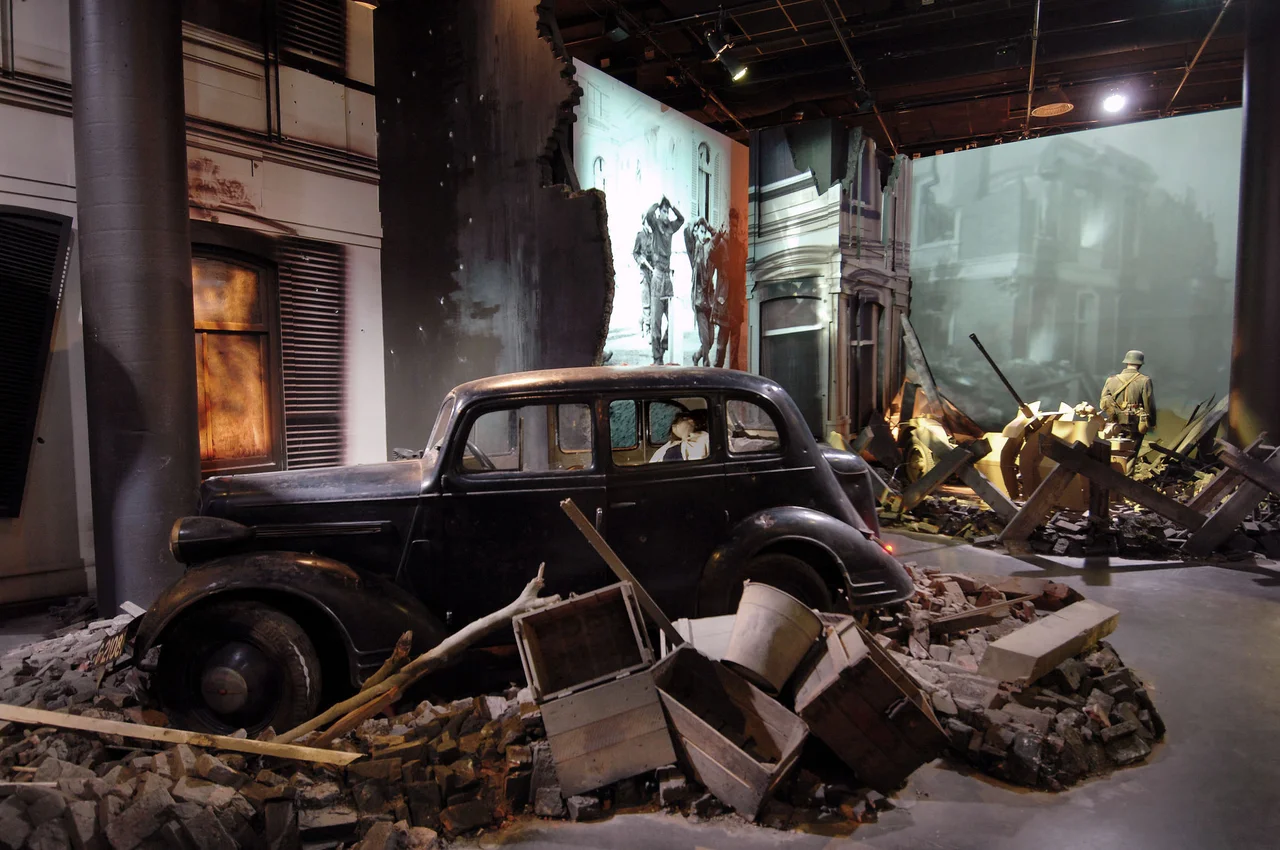
After the war the building briefly returned to being a hotel. By 1949 plans for an Airborne museum had begun at nearby Doorwerth Castle, but the collection quickly outgrew the space. In 1978 the Hartenstein itself was acquired and converted, and on 11 May 1978 Roy Urquhart returned one last time, by then a retired major-general in his seventies, to formally open the Airborne Museum. The collection includes uniforms, weapons, photographs, and films from the battle, with German and Dutch civilian perspectives alongside the Allied accounts. In 2008 the museum closed for renovation and reopened in September 2009, on the sixty-fifth anniversary of the battle, with a new basement-level Airborne Experience: an immersive walk through the nine days, told through dioramas. The exhibition went on to win the Gouden Reiger, the Dutch award for three-dimensional media interaction.
Across the Bridge in Arnhem
Since 2017 the museum has also operated a free information center on the Arnhem Rijnkade called Airborne at the Bridge, looking directly across the water at the structure now officially named the John Frost Bridge, after the colonel who held its northern ramp until his ammunition was gone. A 3D presentation walks visitors through the landings, the advance to the bridge, the British defeat, and the wave of Dutch civilian refugees forced out of Arnhem in the months that followed. The Airborne Cemetery at Oosterbeek lies a few minutes' walk from the museum, with the graves of roughly 1,750 Allied soldiers laid in straight ranks. Each September the Airborne March passes in front of the Hartenstein and the veterans, or their grandchildren, lay flowers. The villa has stood through three centuries of changing use. The nine days that gave it its name are the ones the museum exists to keep from being forgotten.
From the Air
The Airborne Museum sits at 51.99°N, 5.83°E on the Utrechtseweg in Oosterbeek, roughly 5 km west of central Arnhem and just north of the Lower Rhine. Recommended viewing altitude 1,500 to 2,500 feet AGL to take in the river, the John Frost Bridge in Arnhem 7 km east, the Polish 1st Independent Parachute Brigade landing zones near Driel on the southern bank, and the wooded ridges where most of the fighting took place. Nearest airports: Niederrhein/Weeze (EDLV) approximately 45 km east; Eindhoven (EHEH) about 70 km southwest. Best visibility late spring through early autumn; September commemorative events bring extra activity to the area.
Nearby Stories
- Herzogenbusch Concentration Camp 1.8 km away
- Gooi 4.8 km away
- Volkel Air Base 6.9 km away
- Achterhoek 8.3 km away
- Sportpark Berg & Bos 8.8 km away
- Vetera 9 km away
- Beverweerd Castle 10 km away
- Sallandse Heuvelrug National Park 15 km away