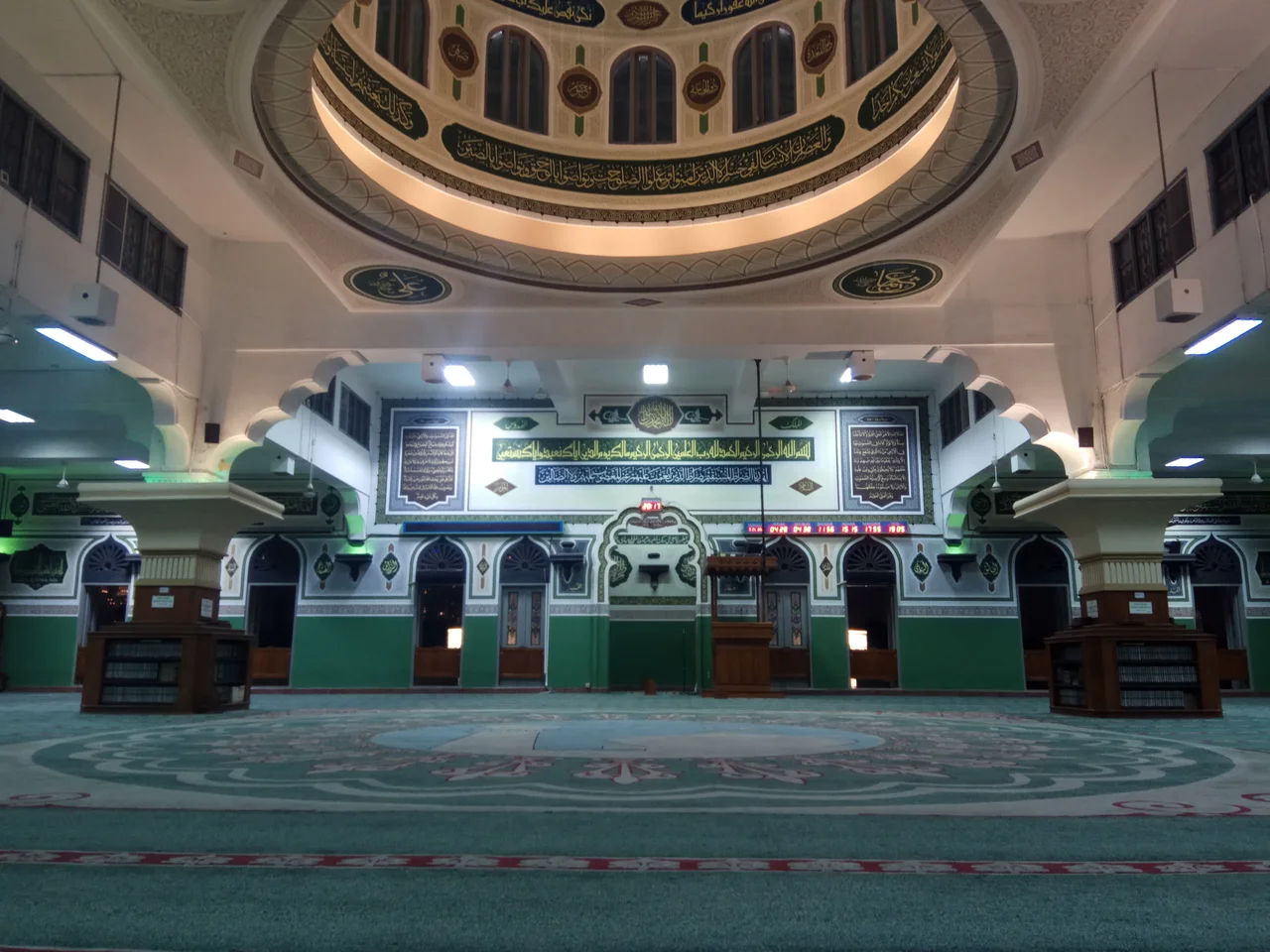

The Mosque That Built a School
Build the mosque first, Hamka said. The school can wait. It was 1952, and fourteen members of the Masyumi Party had just founded the Islamic Dormitory School Foundation with the goal of establishing both a mosque and a school in Kebayoran Baru, Jakarta's newest planned suburb. The mayor had donated four hectares of land. The Ministry of Religious Affairs had scraped together a modest construction fund. The question was what to build first. Hamka -- one of Indonesia's most influential Islamic scholars, a prolific author, political activist, and future Chief Imam -- had a practical answer: build the mosque, but fill it with offices, meeting rooms, and classroom space so that education could begin before the school walls went up. It was a decision that would define Al-Azhar Great Mosque for the next seven decades.
From Suburb to Sanctuary
Kebayoran Baru was barely a decade old when construction of the mosque commenced on November 19, 1953. Planned by Dutch urban designers in the 1940s as a garden suburb south of Jakarta's colonial core, the neighborhood was still filling in -- wide boulevards lined with modest houses, government workers settling into a district that felt more like a provincial town than a piece of the capital. Into this quiet grid came a mosque that would take five years to complete. When it was inaugurated in 1958, it was the largest mosque in Jakarta, crowned with a white onion dome in the Middle Eastern tradition and anchored by a single minaret. Its official name was Masjid Agung Kebayoran -- the Kebayoran Great Mosque. It would not keep that name for long.
A Name from Cairo
In 1960, Mahmud Shaltut, the Grand Imam of al-Azhar University in Cairo, visited Jakarta. Al-Azhar is one of the oldest and most prestigious centers of Islamic learning in the world, founded in 970 AD. When Shaltut toured the Kebayoran mosque, he proposed that it take the name of his institution -- a gesture that linked this young Jakarta mosque to a thousand years of Islamic scholarship. The mosque's leadership accepted, and the Kebayoran Great Mosque became the Al-Azhar Great Mosque. Shaltut went further, formally recognizing Hamka as Imam Besar, Chief Imam, of the renamed institution. For Hamka, the title was more than ceremonial. He saw Indonesian society drifting in directions that alarmed him -- the growing influence of communism, the erosion of Islamic values in public life -- and believed that the antidote was education, not confrontation. Al-Azhar would become a center for dakwah, the propagation of faith, and for the modern intellectual revival he believed Indonesian Muslims needed.
Through the Crisis
That mission was tested almost immediately. In 1965, following the 30 September Movement -- a still-debated series of events in which six army generals were killed, triggering a political upheaval that toppled President Sukarno and ushered in Suharto's New Order -- Al-Azhar Great Mosque became a rallying point for anti-communist sentiment among Jakarta's Muslims. The mosque's role during this period was neither neutral nor incidental. It positioned itself at the center of a political storm that would reshape Indonesia for the next three decades. The violence that accompanied the transition killed hundreds of thousands of people across the archipelago, a catastrophe whose scale and moral complexity Indonesia continues to reckon with. Al-Azhar emerged from the crisis with its institutional identity intact and its educational mission accelerated.
Classrooms in Every Direction
A kindergarten opened in the mosque complex in 1967, the first brick in what would become an educational empire. Over the following decades, Al-Azhar expanded its schools across Jakarta and eventually across Indonesia, offering curricula that combined Islamic religious instruction with secular subjects -- science, mathematics, languages. The approach was distinctly modern, reflecting Hamka's original vision of a mosque that was not just a place of prayer but a hub of intellectual life. The complex grew to include an Islamic library, lecture and seminar halls, a health clinic, and dormitories. In 2000, the educational project reached its institutional peak with the founding of Al-Azhar University Indonesia, located near the mosque. The trajectory from Hamka's 1952 suggestion -- build the mosque first, with plenty of office space -- to a full university half a century later has a logic that feels almost inevitable in retrospect, though nothing about it was guaranteed at the time.
Heritage and Horizon
On August 19, 1993, Al-Azhar Great Mosque was designated both a Jakarta heritage site and a national cultural heritage property. The recognition honored not just the building's architecture -- the white onion dome, the single minaret, the Middle Eastern-influenced design that was groundbreaking for Indonesian mosques of the 1950s -- but its role in shaping how Indonesian Islam engaged with modernity. Al-Azhar was among the first mosques in the country to integrate social services, educational programs, and community facilities into the mosque complex itself. That model has since been adopted across Indonesia, but Al-Azhar pioneered it. Today the mosque sits in a Kebayoran Baru that has matured from a sleepy government suburb into one of South Jakarta's most desirable residential districts, its wide streets now shaded by decades-old trees. The Istiqlal Mosque, completed in 1978, long ago surpassed Al-Azhar in size. But Hamka's mosque was never built to be the biggest. It was built to be the most useful.
From the Air
Located at 6.23S, 106.80E in the Kebayoran Baru district of South Jakarta. The mosque's white onion dome and single minaret are visible from low altitude amid the residential grid of Kebayoran Baru, one of Jakarta's planned garden suburbs. Nearest major airport is Soekarno-Hatta International (WIII), approximately 25 km northwest. Halim Perdanakusuma Airport (WIHH) lies roughly 14 km east-southeast. The mosque complex sits along Jalan Sisingamangaraja, a major north-south arterial road.
Nearby Stories
- The King's Footprints in the River 2.8 km away
- Rawagede Massacre 6.4 km away
- The Cruiser That Wouldn't Stop Fighting 14 km away
- Four Minutes Over the Java Sea 14 km away
- The Scholar's Mosque 21 km away
- Through the Cidepong Hills 37 km away
- Ujung Kulon National Park 97 km away
- The Islands That Vanished from Sight 352 km away