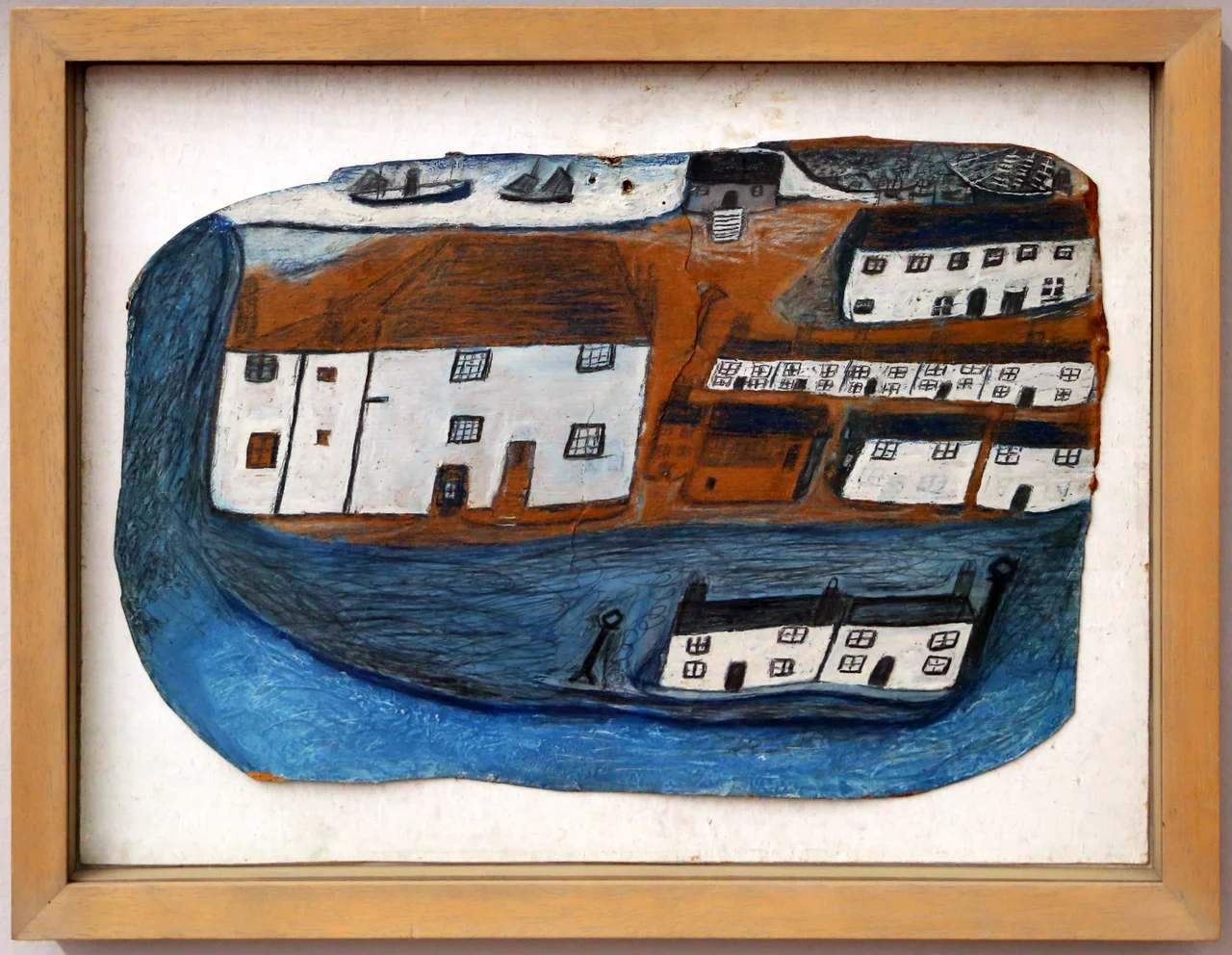

Alfred Wallis
He started painting at seventy. His wife had died three years earlier, and Alfred Wallis began covering scraps of cardboard torn from packing boxes with the only paint he could easily get hold of in his St Ives marine stores shop, household ship's paint in a handful of colours. He had no training. He had never tried to be an artist before. What he had was sixty years of staring at the sea, a sailor's memory full of vessels that no longer existed, and a stubborn certainty that what he saw mattered. Then, one summer afternoon in August 1928, two young painters wandering down Back Road West glanced through his open door and saw something that would help change the direction of British art.
A Sailor's Long Apprenticeship
Wallis was born in Devonport in 1855, the son of a Cornish father from Penzance and a mother from the Isles of Scilly. He went to sea as a child. In August 1876 he sailed to Batteau Harbour on the wild coast of Labrador, working several months as a ship's cook on a deep-sea schooner. Back in Cornwall he switched to local fishing, then to running marine stores in St Ives, dealing in rope, paint, sailcloth and the endless small hardware a working harbour devours. The shop and his fisherman's life put him among the men who knew the headlands by smell and the swell by feel. When Wallis later painted St Ives Bay, Newlyn, Mount's Bay, the schooners running before a gale, he was not inventing pictures from imagination. He was setting down a working life.
The Discovery on Back Road West
The two young painters were Ben Nicholson and Christopher Wood, in St Ives on a day trip in August 1928. They stopped at Wallis's door because they saw little painted boards nailed up inside. What they recognised was a kind of seeing that the avant-garde was struggling to reach by theory: perspective ignored, scale dictated by importance rather than optics, a child's directness wedded to a sailor's expertise. Nicholson later wrote that Wallis's art was "something that has grown out of the Cornish seas and earth and which will endure." Through Nicholson and Wood, the work reached Jim Ede in London, the future founder of Kettle's Yard, who began collecting and promoting it. By the 1930s Wallis was being discussed by the most progressive painters and critics in Britain. None of which seems to have interested Wallis very much. He kept painting as he always had.
Materials of Necessity, Choices of Conviction
Wallis had almost no money. Cardboard ripped from grocer's boxes was free, and he cut it to irregular shapes that became part of the composition - a triangular fragment for a sail, a long strip for a coastline. He insisted on Peacock and Buchan's ships' paint, bought from Burrell's hardware shop in the Digey, and used a strict palette of greys, blacks, browns, a particular dirty white. Modern conservators examining the work have concluded these were not desperate substitutes but deliberate choices. The cardboard's tone showed through as sea or sky. The ship's enamel gave the surface a wet, marine sheen no artist's oil could match. He painted from memory because, as he put it in a letter to Jim Ede, his subjects were "what use To Bee out of my own memery what we may never see again." The world of sail and steam was disappearing. He was painting it before it vanished entirely.
Influence in Only One Direction
St Ives in the 1930s became one of the most consequential places in twentieth-century British art. Nicholson and his wife Barbara Hepworth would settle here. Naum Gabo would arrive as a wartime refugee. Patrick Heron, Peter Lanyon, Terry Frost and the post-war generation would build their careers in the same square mile of granite and light. Wallis sat at the centre of this current and seemed entirely untouched by it. The traffic ran one way. The young modernists studied him, bought his work for shillings, and absorbed his unschooled rigour into their own painting. He did not learn anything from them in return, and didn't appear to want to. He continued painting the ships and harbours he remembered until poverty and isolation forced him into the Madron workhouse, where he died on 29 August 1942 at the age of 87.
The Tile Mosaic and the Long Afterlife
Wallis is buried in Barnoon Cemetery on the hill above Porthmeor Beach. His grave, designed by the potter Bernard Leach, is covered with a tile mosaic showing a tiny figure climbing a lighthouse - half memorial, half final painting. From there you can look down on the Tate St Ives, opened in 1993, which holds his work in its permanent collection alongside the modernists who first saw him. The Telegraph called him "the fisherman who stunned the art world," which is the kind of headline Wallis himself would have shrugged at. He sold his paintings, when he sold them at all, for a few shillings each. Today they hang in the Tate, Kettle's Yard, the Pier Arts Centre in Orkney, and museums around the world. The cardboard outlasted him. The memory outlasted the ships.
From the Air
Centred on the Back Road West / Barnoon area of St Ives at 50.21 N, 5.48 W, less than half a mile west of the Tate St Ives. Approach VFR from the north over St Ives Bay, with Godrevy Lighthouse visible to the east-northeast. Nearest airport is Land's End (EGHC) 8 nm south-west; Newquay (EGHQ) lies 22 nm north-east. Best light for spotting the granite-and-slate roofscape Wallis painted is early morning or late afternoon, when the Atlantic light hits Porthmeor Beach side-on.
Nearby Stories
- Wadebridge 8.1 km away
- Caerhays Castle 8.1 km away
- Sevenstones Lightship 16 km away
- Battle off Lizard Point 20 km away
- MV Cita 22 km away
- Carnewas and Bedruthan Steps 30 km away
- 1979 Fastnet Race 71 km away
- HMS Affray 108 km away