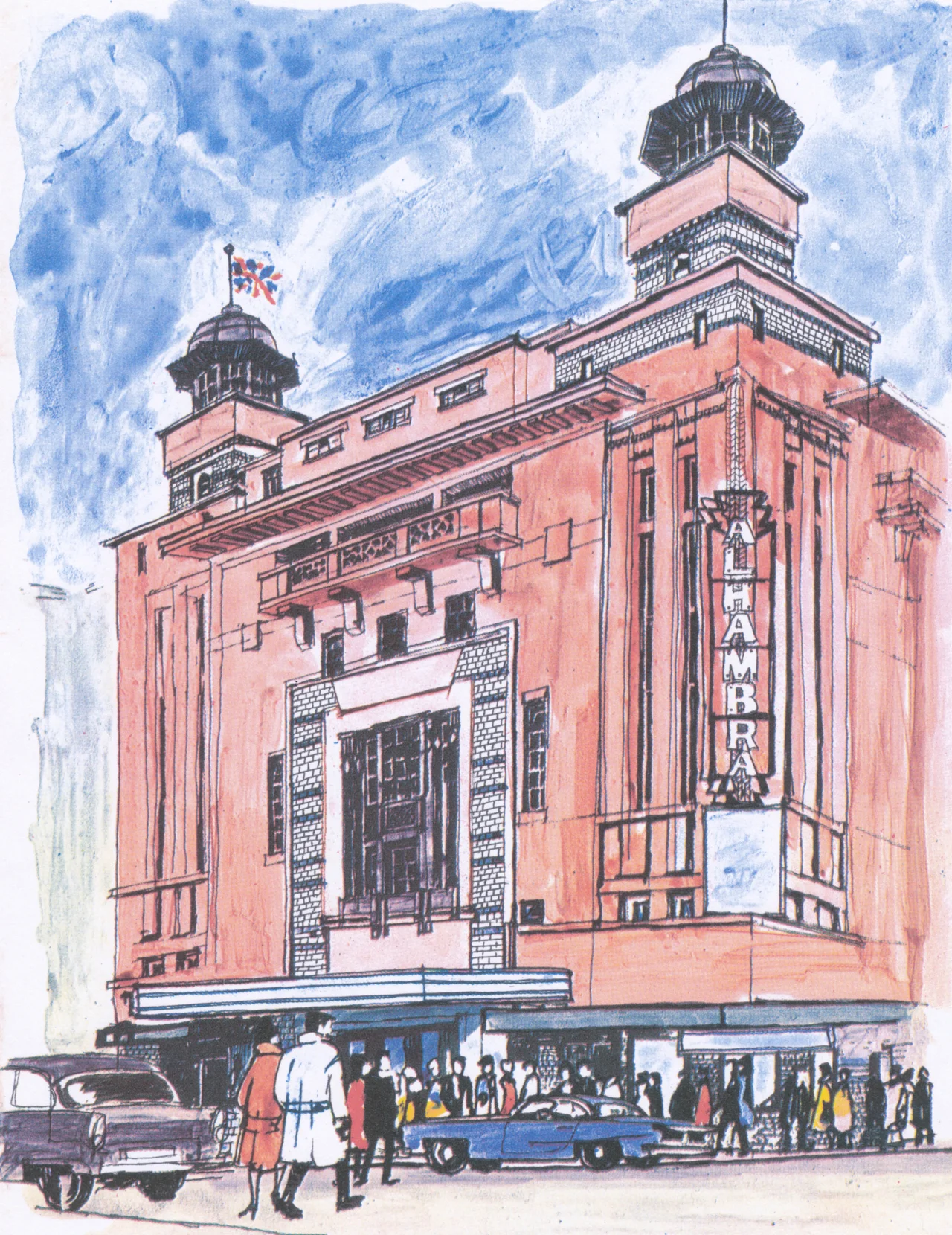

Alhambra Theatre Glasgow
Marlene Dietrich came to Glasgow in November 1966 to say goodbye. Her Farewell engagement at the Alhambra ran from 7 to 11 November, the German-American star in the twilight of a career that had spanned Weimar Berlin, wartime cabaret for Allied troops and Hollywood stardom - though she would continue touring until a fall on stage in Sydney in 1975 finally ended her performing life. She performed in a Wellington Street theatre with twin oriental domes and a colonnade of deep eaves, built in 1910 to evoke the Moorish palace it was named after. Two and a half years after Dietrich's farewell, the Alhambra hosted its own. Cilla Black closed the venue on 24 May 1969. The building came down in 1971.
Built for Variety
The Alhambra opened on 19 December 1910 at the corner of Waterloo Street and Wellington Street in Glasgow, under the direction of Sir Alfred Butt. It was acknowledged as one of the best-equipped theatres in Britain, planned to accommodate 2,800 people. The architect was Sir John James Burnet, who gave it what contemporary accounts describe as a cubic design with a colonnade of deep eaves, topped with twin oriental domes. Its exterior was red brick banded with black and panels of white-glazed tile toward the top. Inside, the canopies carried sparing Louis XVI decoration. The site had previously been occupied by the Waterloo Rooms, which had themselves been the Wellington Street Church before that. The name was deliberately exotic - a nod to the Moorish palace in Granada, marketed for evenings of escape from the Scottish autumn.
The A1 Theatre
Throughout its history the Alhambra was classed as a No 1 theatre - also known as an A1 theatre - meaning it sat at the very top tier of British variety venues. By the 1960s only fourteen such theatres remained in Britain. Glasgow Alhambra Ltd owned the venue through most of its life. In the 1920s it formed an association with Moss Empires, who bought a twenty percent shareholding. The opening night featured French chanteuse Yvette Guilbert. Variety became the venue's bread and butter, drawing performers from America, Australia and continental Europe. Pantomimes followed, produced by Wylie-Tate. Scottish performers Harry Lauder, Will Fyffe, Alec Finlay and Harry Gordon became regular fixtures, alongside revues and musical plays featuring Cicely Courtneidge, Jack Buchanan, Evelyn Laye, Jessie Matthews and Ivor Novello.
Ballet, Plays and the Starlight Room
In 1941 the Alhambra hosted the debut of the International Ballet, newly formed by Mona Inglesby. That same year the Wilson Barrett Company began its long summer residency at the theatre, going on to produce over 450 plays across fourteen years of twelve-week summer seasons - the largest repertory company Scotland has seen. In 1953 the theatre joined the Howard and Wyndham Ltd company, which had recently sold the Theatre Royal to Roy Thomson, founder of Scottish Television. The Alhambra had a revolving stage, and from 1961 it was doubled in size to become the Starlight Room for the Five-Past-Eight summer shows. The Half-Past-Eight and Five-Past-Eight revues, produced by Dick Hurran, and the Wish for Jamie pantomimes produced by Freddie Carpenter, defined the venue's mid-century identity. Rikki Fulton, Jimmy Logan, Stanley Baxter, Fay Lenore, Eve Boswell, Kenneth McKellar, Max Bygraves and Frankie Vaughan all performed there.
The Bluebells and Dietrich
In 1962 and 1963 the Bluebell Girls of Paris, the legendary precision dance troupe based at Le Lido, made their first British appearances at the Alhambra. They returned for two consecutive summers, drawing crowds who otherwise would have needed to travel to the Champs-Elysees to see them. Marlene Dietrich's Farewell engagement from 7 to 11 November 1966 - billed as a farewell, though she would tour for nearly another decade - fell in the same era in which she was filmed for her famous concert documentary. The Alhambra had become, by then, a place where audiences could still touch the glamour of a vanishing variety era. The Bluebell Girls had brought the Lido north. Dietrich had brought Hollywood. For a stretch of nights, Glasgow was on the international variety map.
The Final Curtain
Cilla Black closed the Alhambra on 24 May 1969. Howard and Wyndham had been selling off its theatres for years, and audience attendance, though still healthy, could not compete with television and changing tastes. The building came down in 1971. The site is now occupied by an office block called Alhambra House - a name that preserves the venue's memory without preserving its purpose. Glasgow has continued to lose its grand variety houses through the decades since, and the Alhambra's demolition marked a wider shift in how British cities thought about their entertainment heritage. The Moorish twin domes that had topped Wellington Street for sixty years vanished into rubble. The Marlene Dietrich Farewell played here. So did Cilla Black's. The Alhambra's own farewell came with the wrecking ball.
From the Air
The former Alhambra site sits at 55.86°N, 4.26°W in central Glasgow, at the corner of Waterloo Street and Wellington Street. Recommended viewing altitude 2,500-3,500 feet over the city centre. The site is now occupied by Alhambra House office block. Nearest airports: Glasgow (EGPF) about 6 nm west and Glasgow Prestwick (EGPK) about 28 nm southwest. The River Clyde runs south of the site, with Central Station and the M8 motorway corridor providing visible landmarks for navigation through the Glasgow city centre.
Nearby Stories
- Mauchline 3.6 km away
- Shotts 4.2 km away
- HMS Ulysses (1917) 7.7 km away
- Rothesay Castle 8.8 km away
- Inchcailloch 10 km away
- Strachur 14 km away
- Battle of Dollar 16 km away
- Crawford Castle 16 km away