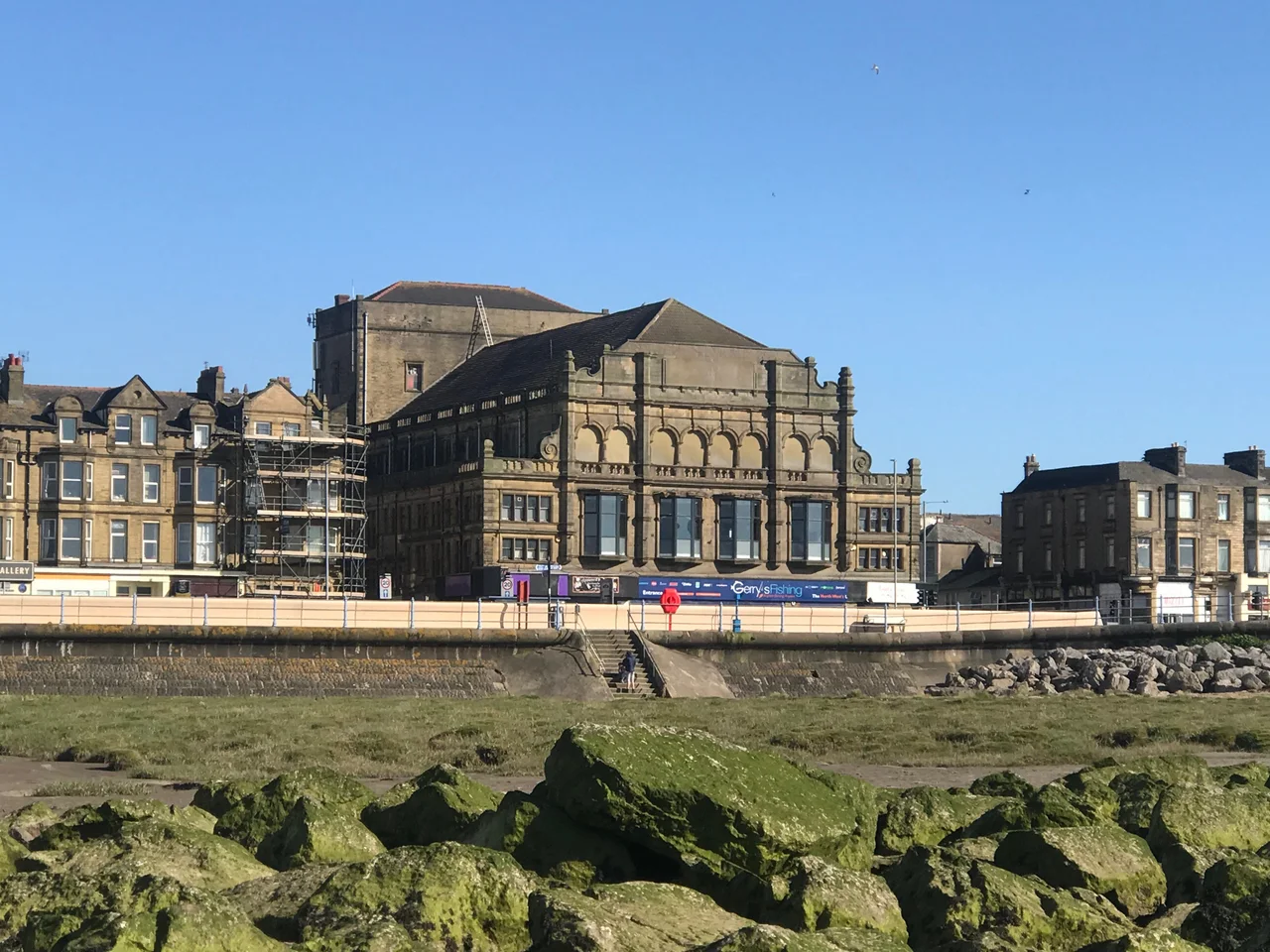

Alhambra Theatre, Morecambe
A magician walked onto the Alhambra's stage on the 4th of April 1901, the night the curtain first went up. His name was Chung Ling Soo, and he was about to become one of the most famous illusionists of the early twentieth century — a man whose entire identity, it later turned out, was its own trick. The audience filling the West End promenade theatre that opening evening did not yet know any of this. They knew only that Morecambe had a grand new venue, named after the Moorish palace in Granada though styled nothing like it, and that the seaside resort meant to take itself seriously.
A Local Project, Built for the West End
Everything about the Alhambra Palace was local. Two developers, John Gardner and John Scott, conceived it. The young architect Herbert Howarth designed it. The builder John Edmondson — responsible for most of Morecambe's great buildings, including the Park Hotel up Regent Road — put it together and wired in the electric lighting. They built it on the site of the old West End Market, which they demolished to make room, and they kept the market function alive by designing the ground floor as a covered market space. Only the original market sign survived the demolition, moved to the back wall above the new market's rear entrance. The whole development was an attempt to rescue the failing 1877 Summer Gardens, whose 30 acres had proved too far from the sea to draw a crowd. The Alhambra anchored the seafront end of that rescue.
Olivier, Variety, and the Astoria
For seventy years the Alhambra adapted to whatever the times asked of it. By 1910 it was licensed as a cinema and showed films between live revues. In the 1920s it became the Astoria Super Cinema. When the Second World War came, the building was requisitioned for the war effort and closed as a cinema until 1946. The most famous afternoon in its history arrived in 1960, when Laurence Olivier shot scenes for The Entertainer, the John Osborne film about a fading music-hall comic that has come to feel like a eulogy for the whole British seaside variety tradition. The film was practically a Morecambe story already — Morecambe-born actress Thora Hird co-starred, and the bay's faded grandeur stood in for every English resort whose moment had passed.
Fire, Carleton, Northern Soul
In 1970 a projector caught fire in the upper tiers. The entire wood structure of the interior collapsed inward, though the fly tower's open space saved the rest of the building. The walls held. The fire took the elaborate Dutch gable and the distinctive sun-burner turret from the roof, both gone forever. Inside, basic remodelling produced a vast black-box room with multi-bars, ideal for dancing, and the Alhambra reopened in 1973 as The Inn on the Bay, then renamed itself The Carleton Club. For a while it was one of the great Northern soul clubs of the north-west, ceiling-to-floor windows looking out at Morecambe Bay while DJs spun obscure American 45s. The suspended ceilings of that era still conceal the cavernous original balcony space above. When Morecambe's economy collapsed in the 1980s and 1990s, the Carleton went with it. By 2016 it had finally closed.
Volunteers and a Slow Return
The same year it closed, a local developer named Ian Bond rescued it. The street-level shops were brought back to life — the central market space already housed Gerry's Fishing, the region's largest angling store — and the upstairs became an entertainment, conference and community venue with capacity up to 1,100. Renamed the Alhambra once more, it now runs on volunteers. In 2019 the Morecambe Alhambra Theatre Trust was created as a charitable company alongside the established Friends of the Alhambra. The venue has slotted itself into the slow Morecambe revival that includes the restored Midland Hotel, the renovated Morecambe Winter Gardens, the 2019 promenade wave-deflection wall, and the planned £80 million Eden Project Morecambe. Morecambe Punk Festival, the steampunk A Splendid Day Out, goth nights called Corrosion, Morecambe Fringe, and a Hawkwind Easter festival have all found a home here. The Other National Theatre and the UK Centre of the International Theatre Institute are based at the Alhambra. A building that has been market, theatre, cinema, soul club, and event space is now several things at once again.
From the Air
Located at 54.07°N, 2.88°W on the West End promenade in Morecambe, Lancashire. Nearest airport is Blackpool International (EGNH), about 32 km south across the bay. Manchester (EGCC) lies 95 km southeast. From the air the Alhambra sits along the elegant Victorian curve of Morecambe's seafront, between the Midland Hotel art deco landmark to the north and the open expanse of Morecambe Bay sands stretching west.
Nearby Stories
- Grizedale Hall 3.4 km away
- Lytham St Annes 5.2 km away
- Hawes Junction Rail Crash 9.1 km away
- Helmshore Mills Textile Museum 14 km away
- Sawley Abbey 17 km away
- Egremont Castle 18 km away
- Egremont, Cumbria 48 km away
- Llandudno 56 km away