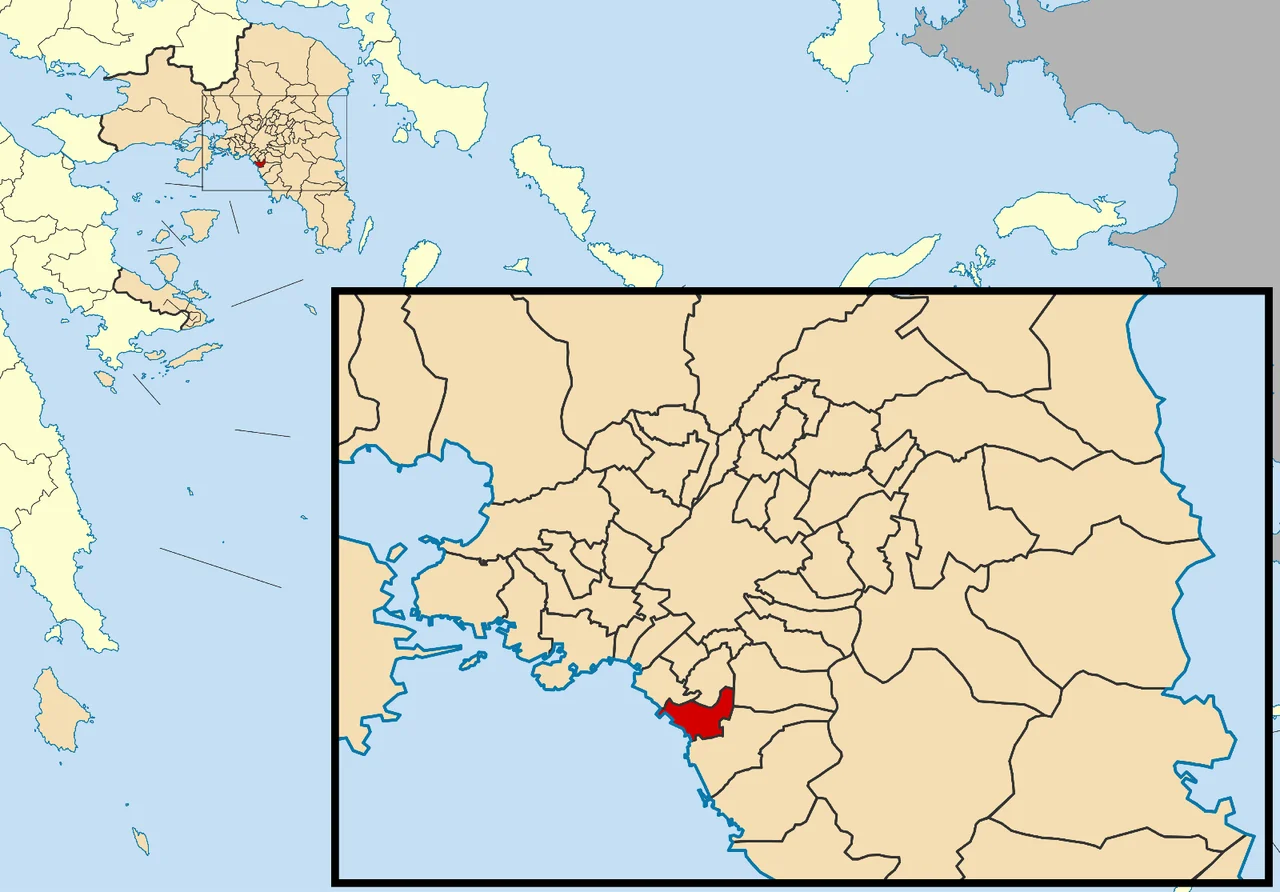

Alimos
Thucydides, who wrote the most rigorous history of ancient warfare ever produced, grew up somewhere along this coast. The shoreline of Alimos — anciently called Halimous — is where the father of scientific history watched the sea and formed the habits of mind that would make him essential reading two and a half millennia later. Today the same coastline is lined with beach clubs and marina berths, and the bust of Thucydides serves as the official emblem of the municipality. The local high school is named after him: Thoukydideio. It is a remarkable thing, to name your school after a man who wrote that the strong do what they will and the weak suffer what they must — and to mean it as a compliment.
An Ancient Deme on the Shore
In classical antiquity, Halimous was one of the demes of Attica — the civic subdivisions of the Athenian city-state. It was a fishing community on the outskirts of Athens, near enough to participate in Athenian political life, far enough from the Acropolis to maintain a distinct coastal identity. Nearby, the area of Ano Kalamaki was known as Euonymeia, a separate settlement that became the urban deme of Euonymos in the classical period. Archaeologists have found the ruins of a rectangular amphitheater there — a design described as quite unusual in the ancient world — on what is now Archaiou Theatrou Street. A short distance away lies a Neolithic site, meaning humans were living along this shoreline long before Athens existed as a political entity. The landscape has been continuously inhabited for perhaps five thousand years.
Thucydides the Halimousian
The most significant person ever born in Alimos is known to history by a geographic epithet: Thucydides the Halimousian, or in Greek, Θουκυδίδης ο Αλιμούσιος. He was born in Halimous, probably in the 5th century BCE, and wrote the History of the Peloponnesian War — an account of the 27-year conflict between Athens and Sparta that remains a foundation text of political philosophy and historical method. Thucydides was the first historian to systematically distinguish between reliable evidence and rumor, to interview participants, and to analyze causation rather than simply narrate events. That a man of such analytical rigor came from a small fishing deme on the Saronic Gulf is the kind of biographical fact that seems almost too apt. The coastline teaches patience and observation. The sea does not lie.
From Ottoman Estate to Modern Municipality
The area that became modern Alimos passed through centuries of shifts. During and after Ottoman rule, the coast was part of the broad landed estates that stretched across southern Attica. The settlement of Kalamaki was part of the community of Brachami until 1927, when it separated into a distinct community. The municipality of Alimos was formally founded in 1968, merging Kalamaki with adjacent territory to create the current municipal boundaries. The population includes descendants of refugees from Kalkan, in what is now Turkey, who arrived during the Greek genocide of the early 20th century — families who brought their Anatolian memories to a Greek shore and built new lives in the southern suburbs of Athens.
The Riviera Shore
Alimos today is a coastal suburb of roughly 43,000 residents, situated 8 kilometers south of central Athens along the Athens Riviera. The municipality has the largest marina in Greece, Alimos Marina, with over 1,100 permanent berths drawing boats from across the Aegean. Several beaches along Poseidonos Avenue — the coastal road running the length of the suburb — are accessible by both metro and tram, the latter connecting the western shore directly to central Athens. Just south of Alimos lies the Hellinikon Olympic Complex, built on the grounds of the former Ellinikon International Airport for the 2004 Summer Olympics. The former airport runways have become athletic facilities, an extraordinary recycling of Cold War-era infrastructure. The Byzantine Sport Centre in Alimos is home to A.O. Tataula and A.S. Pera, two table tennis clubs with roots in Constantinople that settled here in 1973 and have accumulated multiple Greek Table Tennis Championship honors.
From the Air
Alimos sits at approximately 37.91°N, 23.72°E along the Saronic Gulf coast, 8 km south of central Athens. Approaching from LGAV (Athens International Airport, Eleftherios Venizelos), the coast road of Poseidonos Avenue is clearly visible hugging the shoreline. A viewing altitude of 1,500–2,500 feet reveals Alimos Marina — one of Greece's largest — as a distinctive rectangular harbor on the shore. The Hellinikon Olympic Complex is visible immediately to the south, its wide tarmac aprons and athletic facilities unmistakable from the air. The Saronic Gulf extends westward toward Salamis Island, visible on clear days.
Nearby Stories
- Parnitha 3.4 km away
- Kea (island) 7.3 km away
- Sanctuary of Apollo Maleatas 11 km away
- Sousaki Volcano 12 km away
- Battle of Leuctra 14 km away
- Great Sand Beach 18 km away
- Agios Georgios (island) 23 km away
- Skyros 84 km away