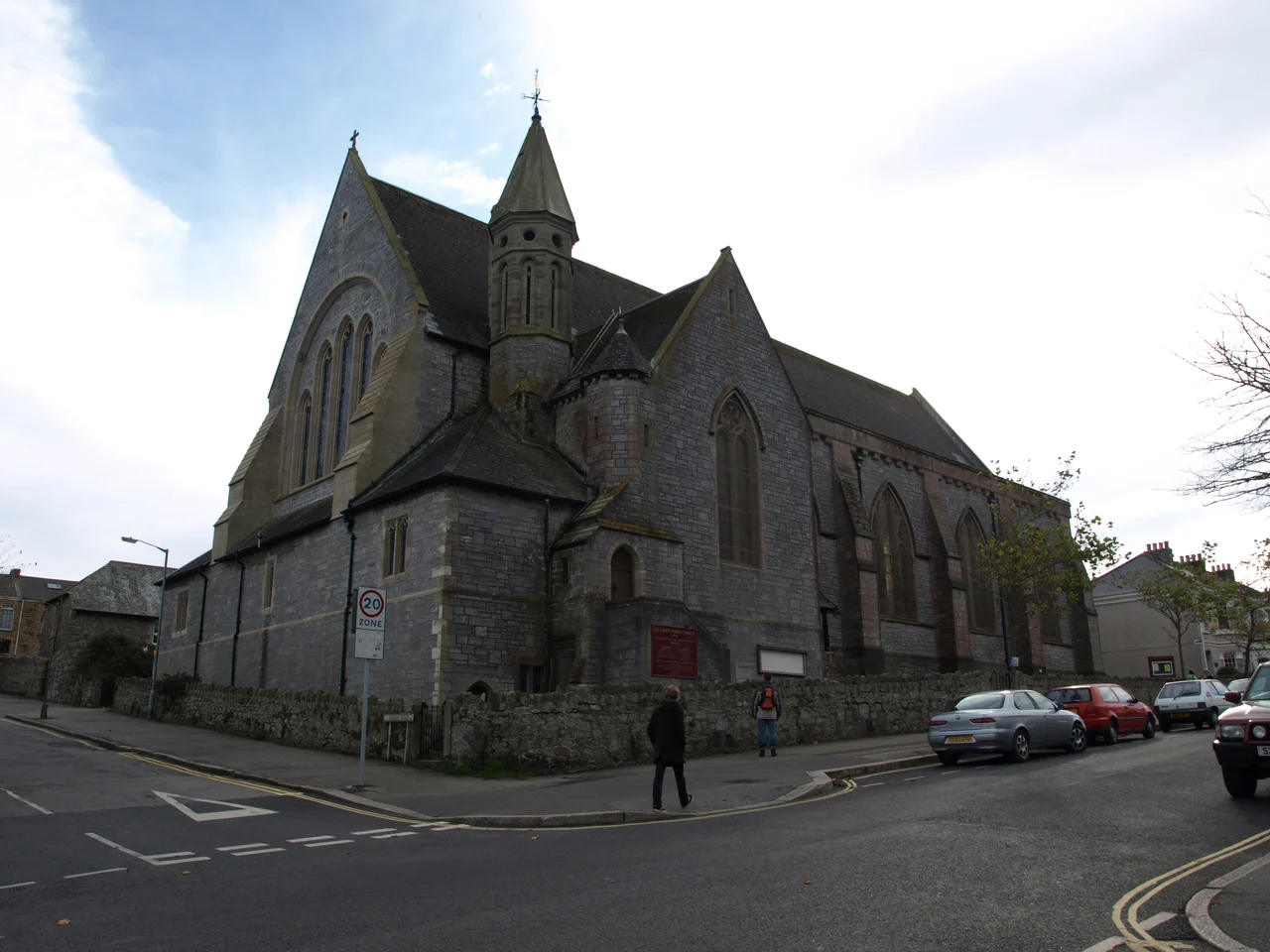

All Saints' Church, Falmouth
In 1887 the future King Edward VII, then still Prince of Wales and Duke of Cornwall, laid a foundation stone at the edge of Falmouth. Three years later, on 17 April 1890, a parish church rose from it - the design of John Dando Sedding, one of the more inventive architects of the late Gothic Revival. The consecration itself made a small piece of ecclesiastical curiosity: George Wilkinson, the Bishop of Truro, was too ill to officiate, so Herbert Bree, Bishop of Barbados, stepped in. A Cornish church was consecrated by the bishop of a Caribbean island.
Sedding and Then Sedding
John Dando Sedding designed All Saints in the Gothic Revival style with narrow aisles and a great east window of five lancets. He also designed many of its fittings: the oak choir stalls carved by Trask and Co., and the Devon marble font. The interior is dense with the careful detail Sedding was known for - he was an architect who believed buildings should be felt at close range as well as seen from a distance. Sedding died in 1891, the year after the church opened. The work continued. His nephew Edmund Harold Sedding stepped into his uncle's role. In 1895 Edmund designed the alabaster and marble pulpit, executed by J. and E. Goad of the Plymouth Phoenix Steam Marble Works. In 1908 he drew the elaborate reredos for All Saints, carved by Harry Hems of Exeter rather than the usual Pinwill workshop. Pinwill woodcarving still appears elsewhere in the church, however - the Sedding family worked with the Pinwill sisters of Plymouth on many Cornish churches, and the relationships pile up across decades like sediment.
Hele and Co., Plymouth, 1894
The organ was installed in 1894 by Hele and Co. of Plymouth at a cost of £750. A contemporary article in the Royal Cornwall Gazette praised the oak case 'enhanced by fine carving, adding much to the beauty of the chancel' and went further - the instrument was, the writer claimed, second only to the great organ at Truro Cathedral. The verdict has been repeated by many notable organists in the century and a quarter since. Henry Speechly and Sons of London cleaned and overhauled the organ in 1926, adding the Choir stops, the soundboard, additional reeds on the Swell, an 8-foot reed on the Great, a 16-foot reed on the Pedal, and an electric blower to replace the hand-pumping arrangement. Successive generations of organists have inherited an instrument that grew, layer by layer, alongside the building.
Roger Yates and the Willis Sound
In 1950 the organ came under the hands of Roger Yates of Michaelstow, who had trained with Henry Willis III of the famous Willis organ-building dynasty. Yates' work at All Saints is regarded today as some of the finest in Cornwall. He cleaned the pipework, added a Swell Tremolo and a Pedal 4-foot Nachthorn, and installed a pneumatic relay that let the Pedal Quint be derived from the Bourdon and Bass Flute ranks. The detail that organ enthusiasts remember, however, is what Yates did with the voicing. Rather than tune the instrument to his own preferred sound, Yates voiced it to the acoustic of the church itself - opening up the Great Diapason Chorus, pushing the pipework to its Willis limit, and using the bright Willis fifteenth to compensate for the missing Great Mixture. The Twelfth and Fifteenth drawn together produce a brilliance that makes the chorus sound as if a mixture were present. The Swell reeds were blended and voiced, it is believed, in pursuit of the great Father Willis sound from Truro Cathedral itself. Yates also rebuilt the organ at Newquay Parish Church, which was lost to fire in 1993, and the organ at Kilkhampton. Of his surviving Cornish work, All Saints is the masterpiece. In 2015 the instrument was placed in the care of Henry Willis and Sons, who took over the tuning contract. They suspected, with affection, that Yates had tuned the instrument to the mysterious 'Willis Scale.'
A Quiet Cornish Parish
Beyond the organ, All Saints is the kind of parish church that English Anglicanism does well. The vicars' list runs unbroken from Thomas Taylor in 1890 to Bill Stuart-White, who arrived in May 2018. Canon Clifford William George Wood served for nearly forty years - 1924 to 1963 - one of those long incumbencies that quietly shape a town's religious life. The organists' list is shorter than the vicars' but stretches just as far: W. J. Shoosmith began in 1890, Claire Cooper took over in 1903, and the line continued through the twentieth century to Daniel Shermon, who arrived in 2014. The church is Grade II*-listed, Anglo-Catholic in tradition, and active. A foundation laid by an English king, a church built by a Gothic Revival master and finished by his nephew, and an organ voiced to a Cornish acoustic by a Willis-trained craftsman - All Saints is a smaller story than Truro Cathedral, but it is built on the same materials, the same craftsmanship, and the same patient century-after-century attention.
From the Air
All Saints' Church, Falmouth is at 50.1512 degrees north, 5.07661 degrees west, in central Falmouth on the south Cornish coast. The town sits on a large natural harbour at the mouth of the Carrick Roads. From the air look for the church's distinctive Gothic Revival profile in the dense urban grid west of the harbour. Nearest commercial airport is Newquay (EGHQ), 50 km north. RNAS Culdrose (EGDR, military) is 11 km south. Falmouth harbour is one of the deepest natural anchorages in the world; expect significant maritime activity below and possible Royal Navy traffic in the Roads. Best viewed 1,500 to 3,000 feet.
Nearby Stories
- Morvah 2.9 km away
- Carnewas and Bedruthan Steps 6.1 km away
- Liskeard 7.5 km away
- Battle off Lizard Point 14 km away
- Polperro 17 km away
- MV Cita 47 km away
- HMS Affray 86 km away
- 1979 Fastnet Race 96 km away