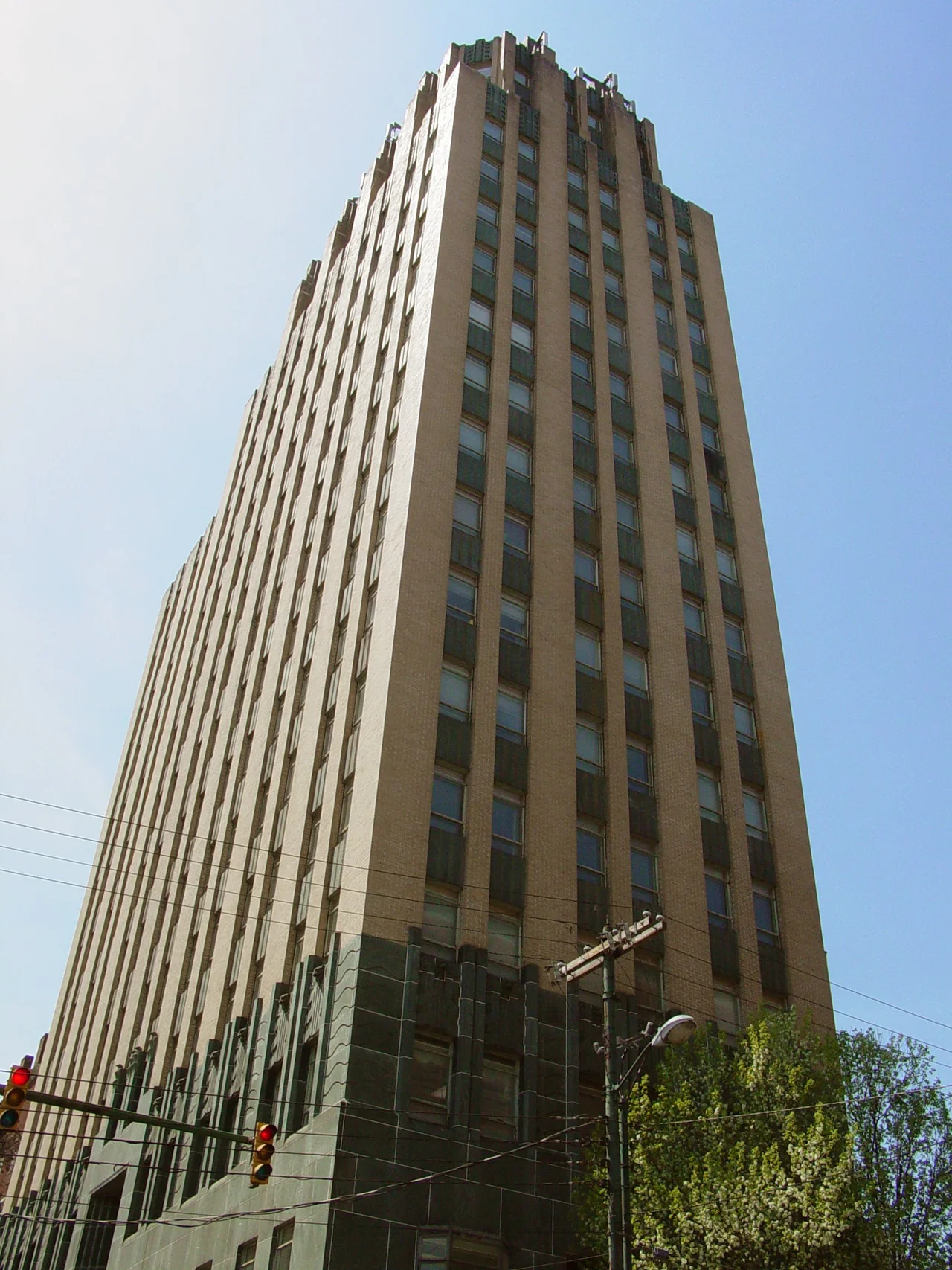

Allied Arts Building
Construction started in 1929. Think about that date. The stock market collapsed in October of that year, the Depression closed in over the next two winters, and yet by 1931 the developers of the Allied Arts Building in downtown Lynchburg had finished a seventeen-story Art Deco tower of yellow brick and greenstone — forty feet wide, a hundred thirty-two feet deep, narrow as a domino and twice as tall as anything else in the city. It would remain the tallest building in Lynchburg until 1972. It was conceived in a more optimistic year and completed in a much harder one, and you can still read both moods in its setback profile and stepped crown.
A Tower for a Tobacco Town
Lynchburg in the late 1920s was a prosperous Virginia city built on tobacco processing, rail, and small manufacturing — the kind of place that had survived Reconstruction by leaning into industry. A seventeen-story office tower at 725 Church Street was a statement of confidence. The architects, Stanhope S. Johnson and Addison Staples, were Lynchburg's best-known firm of the era; Johnson had been turning out elegant Colonial Revival houses and commercial buildings around the region for years. For the Allied Arts they went modern. The steel frame allowed them to push higher than masonry alone would have permitted, and the cladding of yellow brick punched with vertical strips of greenstone gave the tower a luminous warmth at sunset.
Reading the Setbacks
The Allied Arts is unmistakably Art Deco, the style that emerged from the 1925 Paris Exposition Internationale des Arts Décoratifs and dominated American skyscraper design from about 1928 through 1935. You see it in the stepped setbacks toward the top, in the chevron and zigzag patterns picked out in contrasting brick, in the verticality emphasized by spandrels that pull the eye up rather than across. The overall massing closely echoes the Central National Bank in Richmond, also built around 1929, a sister design from the same regional school of architectural thinking. Forty feet wide, the building reads almost as a tower of pure geometry — too narrow to be confused with anything around it, too tall to be anything but a landmark.
Forty Years on Top
From 1931 until 1972, the Allied Arts was the tallest building in Lynchburg. That is a long reign for an office building. The Bank of the James Building finally took the title in 1972, and decades later Liberty University's Freedom Tower would push above both — but for forty years, when residents of the seven hills looked toward downtown, the Allied Arts was the building that stood up against the sky. It became a working address: offices for lawyers and accountants, doctors and insurance agents, the kind of professional tenancy that filled American midsize downtowns through the twentieth century. Tucked inside the Court House Hill-Downtown Historic District, it was listed on the National Register in 1985.
A Second Life
Like a lot of mid-twentieth-century office towers in cities Lynchburg's size, the Allied Arts lost tenants as professional firms drifted to suburban parks. For a stretch it sat partly empty, its lobby a museum piece, its setbacks a pigeon roost. The current chapter is residential — the building is being remodeled into apartments, a conversion that takes advantage of those narrow forty-foot floor plates that office tenants no longer want but city dwellers happily will. The same vertical proportions that once stamped the skyline of a tobacco town are now framing kitchen windows and bedrooms. The light at the top is still the same yellow brick light at sunset.
From the Air
Located in downtown Lynchburg at 725 Church Street, approximately 37.4144 N, 79.1442 W. Seventeen stories, about 200 feet tall, yellow brick with greenstone accents and an Art Deco stepped crown. One of the most recognizable buildings in downtown from any altitude up to roughly 5,000 feet AGL. Nearest airport: Lynchburg Regional (KLYH), 5 nm south-southwest.
Nearby Stories
- Appomattox-Buckingham State Forest 4.8 km away
- Hollins University 12 km away
- Franklin County, Virginia 13 km away
- Buena Vista, Virginia 15 km away
- Smith Mountain Lake 24 km away
- Alleghany County, Virginia 26 km away
- Murder of Hannah Graham 36 km away
- Staunton River State Park 44 km away