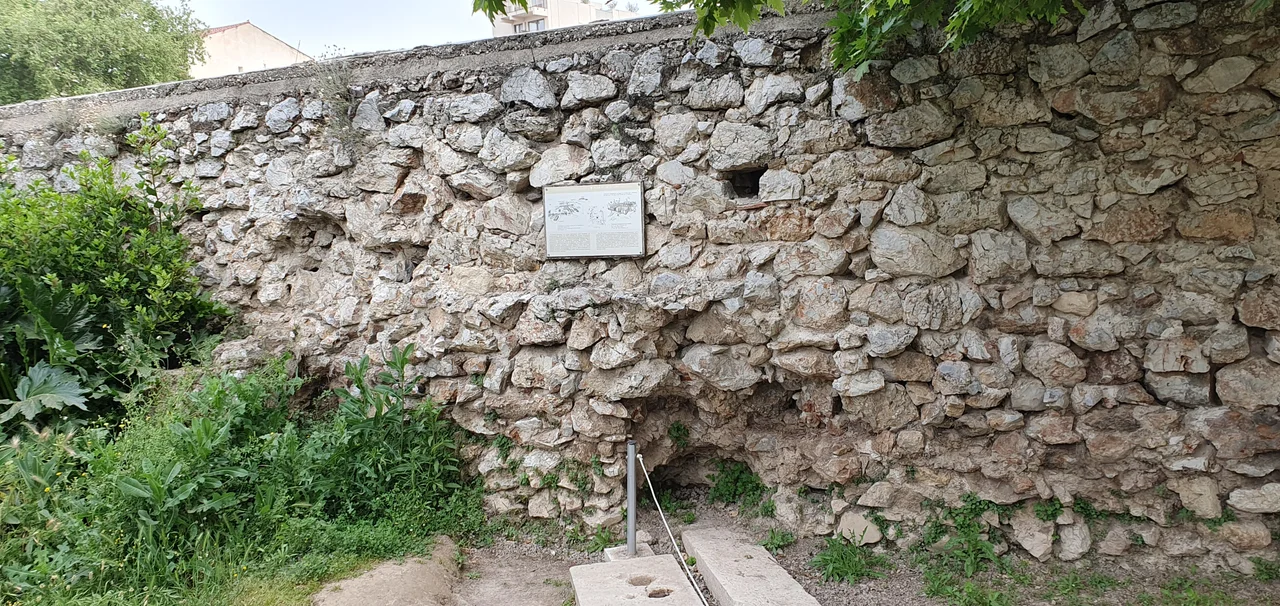

Altar of the Twelve Gods
Every map needs an origin, a place where the measuring begins. For ancient Athens that place was a roughly square marble enclosure in the corner of the Agora, dedicated to the twelve great gods of Olympus. Distances across the Greek world were reckoned from here. When a milestone near the Acropolis gate announced that the harbor lay forty-five stades away, it meant forty-five stades from this altar. Pindar called Athens's agora the city's "navel," and he may have meant this very spot - the point from which a whole civilization took its bearings.
Point Zero
A tyrant's grandson set it up. In 522 or 521 BC, during his year as archon, Pisistratus the Younger - grandson of the famous tyrant Pisistratus - dedicated the Altar of the Twelve Gods in the Agora. The historian Thucydides recorded the act, noting that later Athenians extended one side of the altar and in doing so buried the original dedicatory inscription. Within a century the altar had become Athens's official zero point. Herodotus, writing around 440 BC, measured the distance from the altar to the temple of Olympian Zeus at Pisa (near Olympia) to give his readers a sense of scale in faraway Egypt. The twelve gods themselves were almost certainly the Olympians of the Parthenon frieze - Zeus, Hera, Athena, Apollo, and the rest - though even in antiquity their exact roster was debated.
Sanctuary and Refuge
The altar was more than a surveyor's benchmark. It was sacred ground, and sacred ground in Greece meant safety. A person who sat at the altar as a suppliant placed themselves under the protection of the gods, and to drag them away was sacrilege. In 519 BC, when envoys from Plataea came to Athens seeking an ally against Thebes, they sat at this altar while the Athenians sacrificed, and so bound the two cities together. Decades later, when the sculptor Phidias and his circle faced accusations over public funds, some of his assistants are thought to have taken refuge here. The altar caught the desperate and the cornered - generals fleeing execution, men with nowhere left to turn. It was where the city's most powerful and its most frightened occupied the same few square meters of marble.
Buried Beneath the Trains
For centuries the altar's location was lost. Then in 1891, workers digging the line for the Athens-Piraeus electric railway struck two stretches of ancient wall. In 1934 the American School of Classical Studies, excavating the Agora, uncovered the enclosure's southwest corner - and an inscribed marble base reading "Leagros, son of Glaukon, dedicated this to the Twelve Gods." The identification was sealed. But there was a catch that still defines the site: the railway had been laid directly over it. By the 1990s nearly nine-tenths of the altar lay buried beneath the tracks, only one corner exposed to daylight.
A Modern Standoff
In 2011 the trains paused. With the tracks lifted for maintenance, archaeologists briefly uncovered more of the altar than anyone alive had seen, and a remarkable confrontation followed. Scholars and a group reviving ancient Greek polytheism filed legal injunctions to stop the rails being relaid over the sanctuary. The court weighed the heritage of the twelve gods against the daily needs of commuters - and ruled for the commuters. In August 2011 the altar was covered again, and the trains returned. It is a fitting modern fate for the original point zero: the place from which Athens once measured the world now measures nothing, waiting in the dark beneath the wheels of a working city.
From the Air
The Altar of the Twelve Gods lies in the northwest corner of the Ancient Agora of Athens, at roughly 37.9758° N, 23.7228° E, beneath the Athens-Piraeus railway line just north of the main archaeological area. The Acropolis rises immediately to the southeast - the clearest landmark for orientation, with the Agora spread below its northwest slope. Athens International Airport (LGAV) is about 33 km to the east. Visibility over the Athens basin is typically excellent in clear weather.
Nearby Stories
- Great Sand Beach 5 km away
- Battle of Delium 7.7 km away
- Tower of Aliartos 9 km away
- HMHS Britannic 10 km away
- Saronic Gulf 15 km away
- Sousaki Volcano 17 km away
- Sanctuary of Apollo Maleatas 24 km away
- Skyros 66 km away