.jpg)
American Shakespeare Center
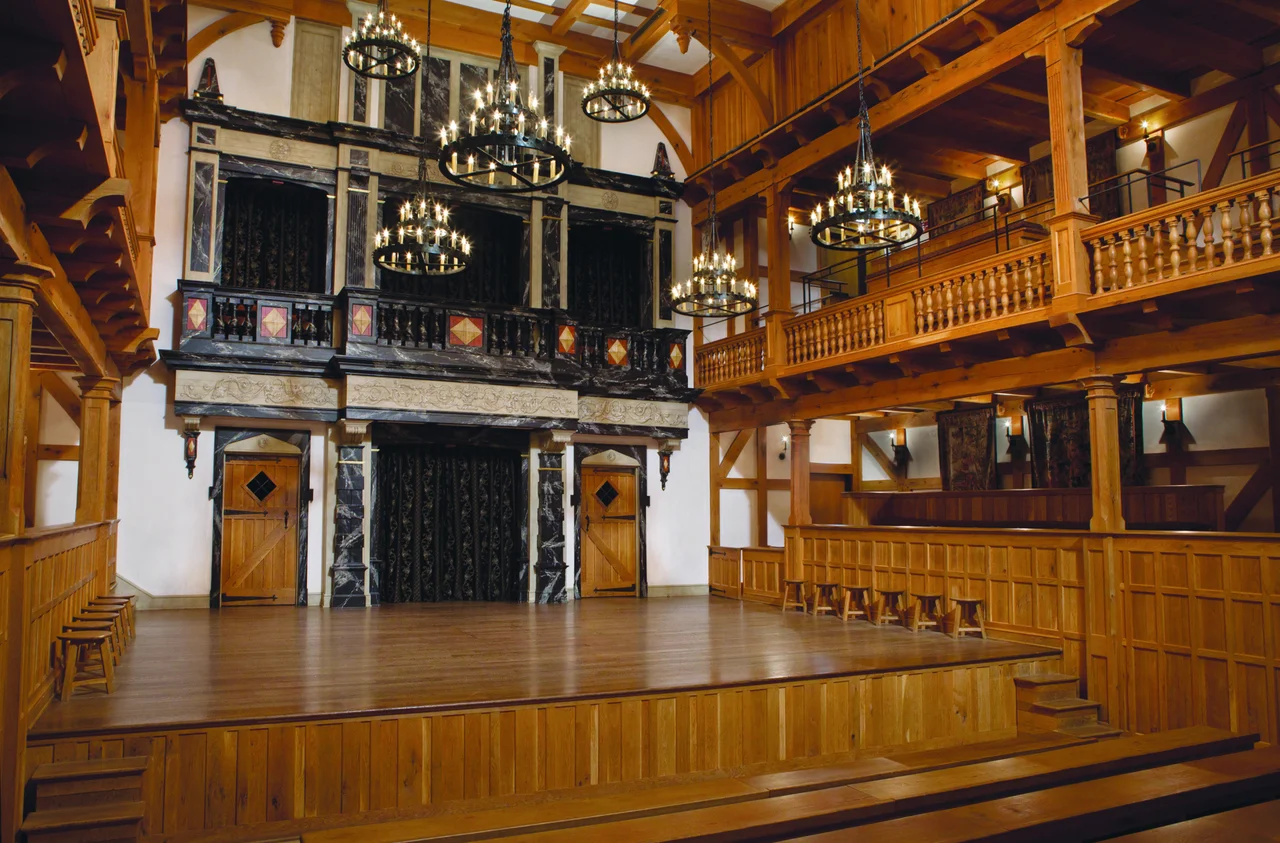
Walk into the Blackfriars Playhouse in Staunton and the first surprise is the light. There is no dimming when the show starts. The house never goes dark. Actors and audience share the same chandeliers, the same plain candle-yellow glow that English playgoers knew in 1608. Then comes the second surprise. There is no curtain, no offstage. Actors sit on benches at the edges of the stage between scenes, in costume, watching the play with you. By the end of the first act you understand why the American Shakespeare Center spent $3.7 million to build a playhouse that worked this way: it changes how the plays land. Lines that read flat on the page suddenly snap when an actor delivers them looking directly at a member of the audience three feet away.
From a Touring Truck to a World First
The company started in 1988 as the Shenandoah Shakespeare EXPRESS, founded by James Madison University professor Ralph Alan Cohen and director Jim Warren. Their first show was Richard III, performed fourteen times in rural Virginia by a young ensemble drawn from JMU students and alumni. The two-hour version they staged challenged a Shakespearean orthodoxy: that the plays needed lavish productions and grand theaters. SSE's first principle was the opposite. Strip the productions down, put them on the road, and let the language do the work. Within five years they were touring the Folger Shakespeare Library in Washington, London, Edinburgh. By the late 1990s they had played in nearly every U.S. state and several countries. They needed a home.
Building Blackfriars
The original Blackfriars Theatre stood in London from 1596 until it was demolished in 1655 - the indoor counterpart to the Globe, where Shakespeare's company spent its winters. No reliable plans survive. To rebuild it in Staunton, architect Tom McLaughlin worked from plans of other 17th-century theatres, stage directions in the plays themselves, and theatre historian Irwin Smith's research that suggested the dimensions: roughly 50 by 70 feet. Construction began in 2000, with the timber sourced by Virginia firm Dreaming Creek. The playhouse opened in September 2001 - the same month Shakespeare's Globe was experimenting with its first indoor candlelit performances in London. (Globe's Sam Wanamaker Playhouse, which shares many features with the Blackfriars, would open thirteen years later, in 2014.) The Staunton building remains the first modern re-creation of Shakespeare's indoor theatre in the world.
Doing It Like the King's Men
The American Shakespeare Center commits to what scholars call Original Practices. Universal lighting - audiences and actors share illumination throughout. Doubling - actors play multiple roles. Cross-gender casting. Minimal sets and props. No interval between scenes; the action flows. Music plays before and during productions, often performed by the actors themselves. The 2005 Actors' Renaissance Season took the experiment further: actors self-direct, self-design, and rehearse only briefly, recovering some of the conditions under which Shakespeare's own company worked. The result feels surprisingly close to a rock concert at times - electric, intimate, communal. Audiences sit on stools onstage if they want; gallant stools, the company calls them. Lines come out into the room. Laughter is loud. The plays were built to work this way.
More Than Shakespeare
The ASC produces eight to nine shows a year, with seasons that include Shakespeare's contemporaries - Ben Jonson, Christopher Marlowe, Beaumont and Fletcher - alongside more modern work, like a staged Pride and Prejudice or a comic Dracula. In 2017, the center launched Shakespeare's New Contemporaries, an international playwriting commission that asks living writers to create new plays in conversation with specific works in the canon. Recent ASC productions have included new responses to The Winter's Tale, Othello, Cymbeline, and Twelfth Night. The center also partners with Mary Baldwin University on a unique graduate program in Shakespeare and Performance, training the actors, directors, and scholars who will carry the practice forward. In a brick playhouse on Market Street in Staunton, a 16th-century theatrical idea is still being figured out, one show at a time.
From the Air
Located at 38.1495N, 79.0705W on Market Street in downtown Staunton, Virginia, in the Shenandoah Valley. The Blackfriars Playhouse is a small brick structure not easy to pick out from altitude; downtown Staunton's grid is the broader visual landmark. Recommended viewing altitude is 3,500 to 5,500 feet for downtown Staunton in context with the surrounding valley. Nearest airport is Shenandoah Valley Regional (KSHD) about 4 nm north; Charlottesville-Albemarle (KCHO) is 30 nm east. Watch for valley haze in summer.
Nearby Stories
- Rockingham County 4.8 km away
- Shenandoah: The Skyline Drive Through America's Oldest Mountains 5.6 km away
- 2023 Virginia Cessna Citation Crash 16 km away
- Highland County, Virginia 16 km away
- Montpelier 20 km away
- Fork Union Military Academy 26 km away
- Battle of Greenbrier River 28 km away
- Alleghany County, Virginia 53 km away