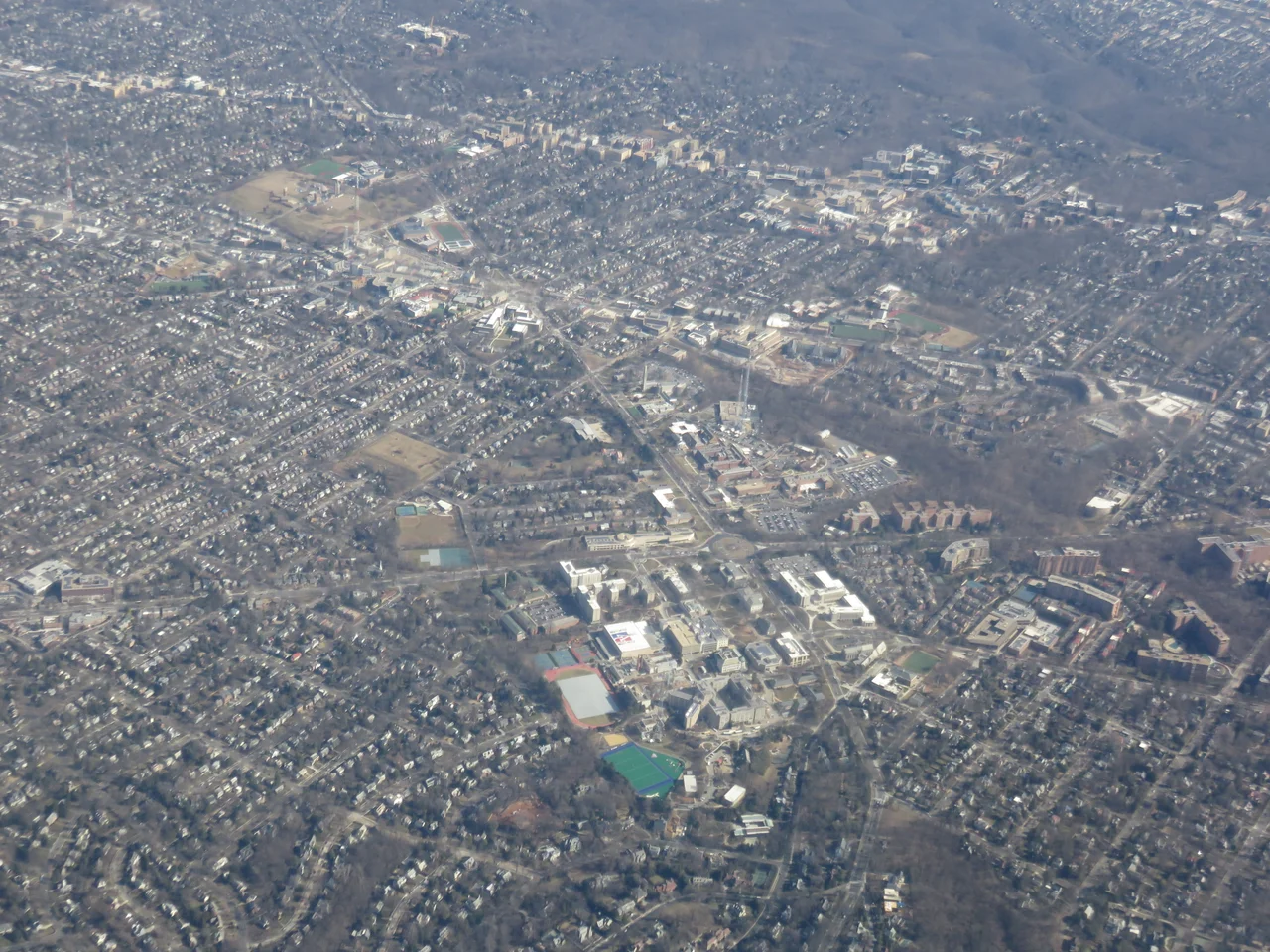

American University
On June 10, 1963, John F. Kennedy stood at a commencement lectern at American University and proposed peace with the Soviet Union. He had been President for less than two and a half years. The Cuban Missile Crisis was eight months in the past. The speech he delivered that morning - calling for a comprehensive nuclear test ban treaty and a fundamental reconsideration of the Cold War - was one of the most significant of his presidency. It came to be known simply as the American University Speech. He was assassinated five months later. The treaty he proposed was signed within months. The campus where he stood still teaches international relations as if it were the family business. American University has been, since its founding, an idea about what the United States could be in the world - and a sometimes awkward host to what the United States actually was.
The Methodist Idea
American University was chartered by an Act of Congress, approved on February 24, 1893, almost entirely because of the persistence of one man - John Fletcher Hurst, Methodist bishop, abolitionist, and scholar, who wanted a national Methodist university in the capital that would educate public servants and diplomats. Hurst chose the site himself: rural farmland on the heights of Northwest Washington at Ward Circle, where Massachusetts Avenue meets Nebraska. He spent thirty years raising money for it. Ground broke in 1902. The university opened in 1914 with 28 students, almost all of them graduate students - Hurst had wanted the founding generation to be advanced scholars. The first commencement was held in June 1915. Undergraduate education arrived in 1925 with the founding of the College of Liberal Arts, which is now the College of Arts and Sciences. Today AU is officially affiliated with the United Methodist Church but is fully nonsectarian; religion is not a criterion for admission, employment, or coursework. Bishop Hurst would recognize the mission. He might not recognize the campus.
Camp American University
In 1917, with the United States newly entered into the First World War, the U.S. military took over a large portion of the AU campus and divided it into two installations. Camp Leach housed advanced research on camouflage. Camp American University - on the same hilltop where students now walk to class - became the birthplace of the United States chemical weapons program. The Army's Chemical Warfare Service tested mustard gas, lewisite, and other chemical agents on the grounds, and at the end of the war, the experimental ordnance was buried in pits on what is now the residential Spring Valley neighborhood. The university and the Army both assumed the pits would never be disturbed. In 1993 a construction crew laying utilities in a Spring Valley backyard unearthed an artillery shell. Subsequent investigation found over 200 mustard-gas shells, along with quantities of arsenic-based chemicals, buried beneath the campus and the surrounding neighborhood. The Army Corps of Engineers has been excavating and remediating the area for more than thirty years. Additional contaminated material was located as recently as June 2024.
The American University Speech
On June 10, 1963, John F. Kennedy delivered the commencement address on the AU quadrangle. The speech, written largely by Theodore Sorensen with input from Kennedy himself, broke from Cold War convention in several specific ways. Kennedy called for an end to what he called the prevailing American view that war with the Soviet Union was inevitable. He called the Soviet people who they were: the same human beings who had lost 27 million dead in the Second World War, and who, like Americans, were sick of nuclear fear. He announced that the United States would unilaterally suspend atmospheric nuclear testing. He proposed an immediate negotiation for a comprehensive nuclear test ban treaty. The Soviet press, almost uniquely, reprinted the speech in full in Pravda. Within six weeks, U.S., Soviet, and British negotiators had agreed on the Limited Nuclear Test Ban Treaty, which prohibited atmospheric, underwater, and outer-space nuclear testing. The Senate ratified it on September 24, 1963. It was the first arms control agreement of the Cold War. Kennedy was killed in Dallas eight weeks later. The American University Speech is engraved on a stone marker on the quadrangle.
Eight Schools and a Radio Station
American University today consists of eight schools and colleges, including the School of International Service, the School of Public Affairs, the Washington College of Law - the first law school in the United States founded by women, in 1896, and absorbed by AU in 1949 - and the Kogod School of Business. The main campus on Massachusetts Avenue covers 84 acres and is designated as an arboretum by the American Public Gardens Association. The original campus master plan was drafted by Frederick Law Olmsted, the architect of Central Park, though much of his vision was scaled back for cost reasons. The student body of more than 13,000 represents all 50 states and 141 countries. Roughly one in five students is international. AU is one of the top three feeder schools to the U.S. State Department, alongside Georgetown and George Washington, and routinely ranks first nationally in producing Peace Corps volunteers. The university also owns WAMU 88.5 FM, the flagship NPR affiliate in Washington and the longtime home of The Diane Rehm Show and 1A. In 2018 American became the first carbon-neutral university in the United States. In 2020 it divested its endowment from fossil fuels. Bishop Hurst would not recognize the carbon accounting. He would recognize what the university was trying to do.
From the Air
American University sits at 38.94 degrees N, 77.09 degrees W on Ward Circle in northwest Washington, D.C., at the intersection of Massachusetts and Nebraska Avenues. The main campus elevation is about 350 feet above sea level. This is all inside Class B airspace and the Washington Special Flight Rules Area. Reagan National (KDCA) is 6 miles south. Andrews JBA (KADW) is 9 miles southeast. Coordinate with Potomac TRACON before any low operations. Watch for P-56A over the White House two miles south.
Nearby Stories
- Gunston Hall 1.1 km away
- 2023 Baltimore Shooting 4.9 km away
- Battle of Middleburg 6.6 km away
- Crownsville Hospital Center 10 km away
- Battle of Loudoun Heights 13 km away
- First Battle of Rappahannock Station 20 km away
- Howard County, Maryland 21 km away
- Harriet Tubman Underground Railroad 50 km away