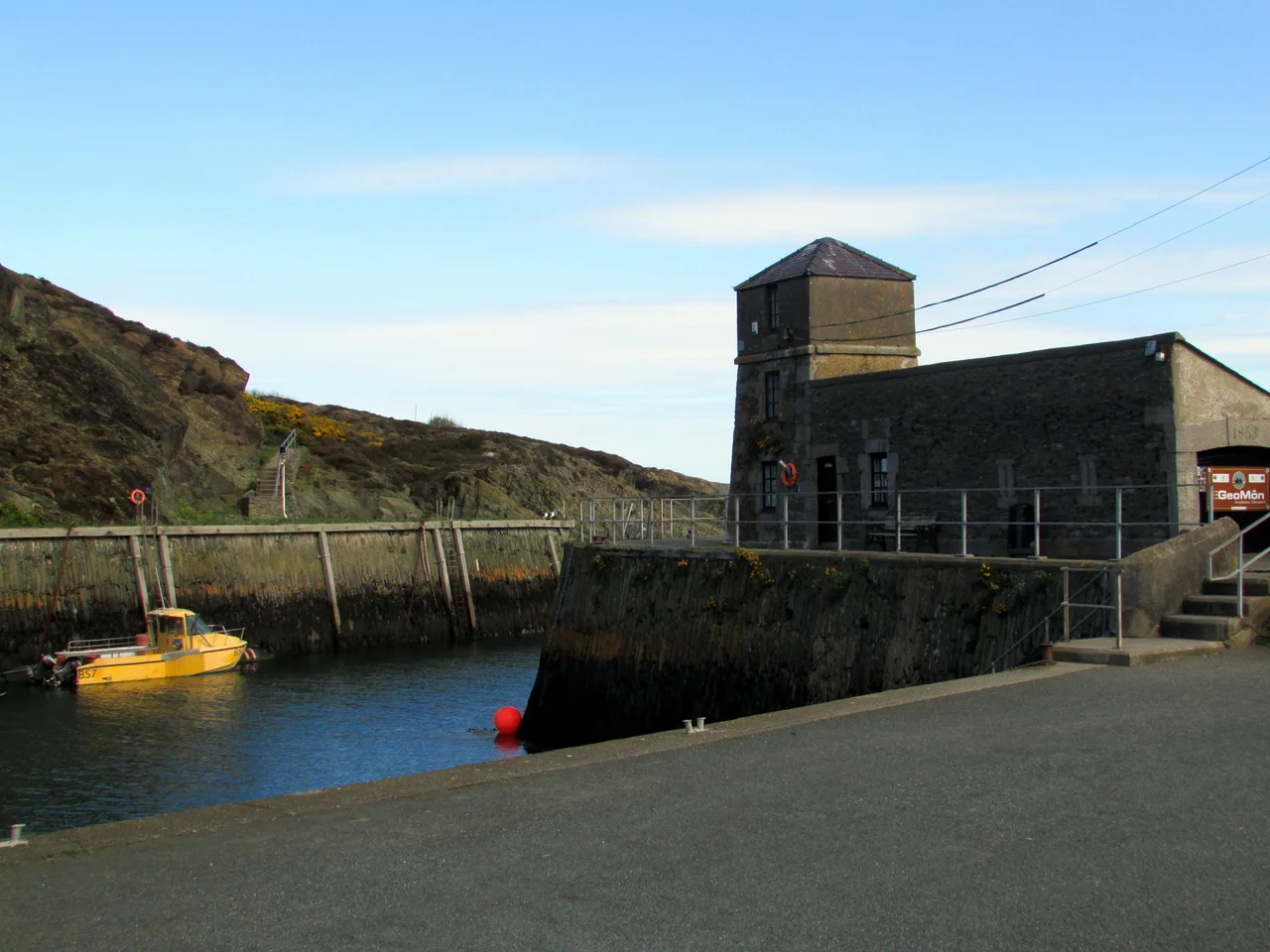

Amlwch Lighthouse
Four lighthouses have stood on this short stretch of pier since the late 18th century. The one visitors see today is the youngest - a stocky square tower built in 1853 from beautifully cut ashlar masonry, with a later lantern bolted on top. Only 4.6 metres of original stone survives at the base, weathered and battered by 170 winters of Irish Sea spray. It looks too small to matter. It mattered enormously. In its day, this tiny light guided more copper ore out of Wales than any other harbour in Europe.
The Copper Trade That Built It
A mile and a half inland from Amlwch's harbour stands Parys Mountain, where in 1768 a vein of copper was uncovered that briefly made Anglesey the largest copper producer in the world. The ore had to leave by sea, and the only harbour close enough was the narrow rocky cleft at Porth Amlwch - a slit of water barely wide enough for a single vessel to enter. By the 1790s the harbour was choked with ships waiting to load. An Act of Parliament in 1793 authorised the first two piers, and on top of those piers went two octagonal houses with lanterns poking through their roofs: the first lighthouses, described in a contemporary mariners' guide as 'small white houses displaying lights at night.' The volume of traffic was extraordinary for the size of the harbour.
Each Tower Replaced By Need
In 1816 the harbour was extended again, this time with a 46-metre outer pier to give vessels more shelter from north-easterly gales. A new light went up on the pier head the following year, raised 8.5 metres above the high-water mark. That tower was replaced by the present one in 1853, and the current lantern came later still. The pattern says something about how hard the sea worked on this pier - few small harbour lights have been rebuilt four times in seventy years. Each replacement had to be tougher than the last, and the 1853 tower, with its battered profile and finely cut stone, was built to outlast everything that came before. So far it has.
What Remains Today
Copper production at Parys Mountain peaked in the 1780s and was already in steep decline by the mid-19th century. By the time the present lighthouse was built, the harbour was finding new work in shipbuilding and ship repair, with one of the largest dry docks in northwest Wales tucked just inside the inner basin. The dry dock survives as part of Amlwch's restored heritage harbour. The lighthouse stands at the end of the outer pier, weathered but still recognisably the same square tower that 19th-century captains aimed for through the dark. Trinity House records list it as a Grade II listed structure. Few small lighthouses anywhere in Britain can claim to have served so global a trade from so small a footprint.
From the Air
Amlwch Lighthouse sits at 53.42°N, 4.33°W on the outer pier of Amlwch harbour, a narrow rocky inlet on the north coast of Anglesey. From cruising altitude it is invisible, but the harbour notch and the copper-stained tracks descending from Parys Mountain to the south are unmistakable landmarks. Nearest airports: Anglesey/Valley (EGOV) 14 nm west, Caernarfon (EGCK) 19 nm south. The whole north Anglesey coastline often suffers from low cloud pushed off the Irish Sea by westerly fronts; on a clear day the Isle of Man is visible some 40 nm to the north.
Nearby Stories
- Llandudno Lifeboat Station 3.8 km away
- Glynllifon 6.1 km away
- German submarine U-1024 9.4 km away
- Irish Sea Bridge 11 km away
- Ysbyty Ifan 12 km away
- Irish Sea 18 km away
- Celtic Array 18 km away
- Birkdale Palace Hotel 56 km away