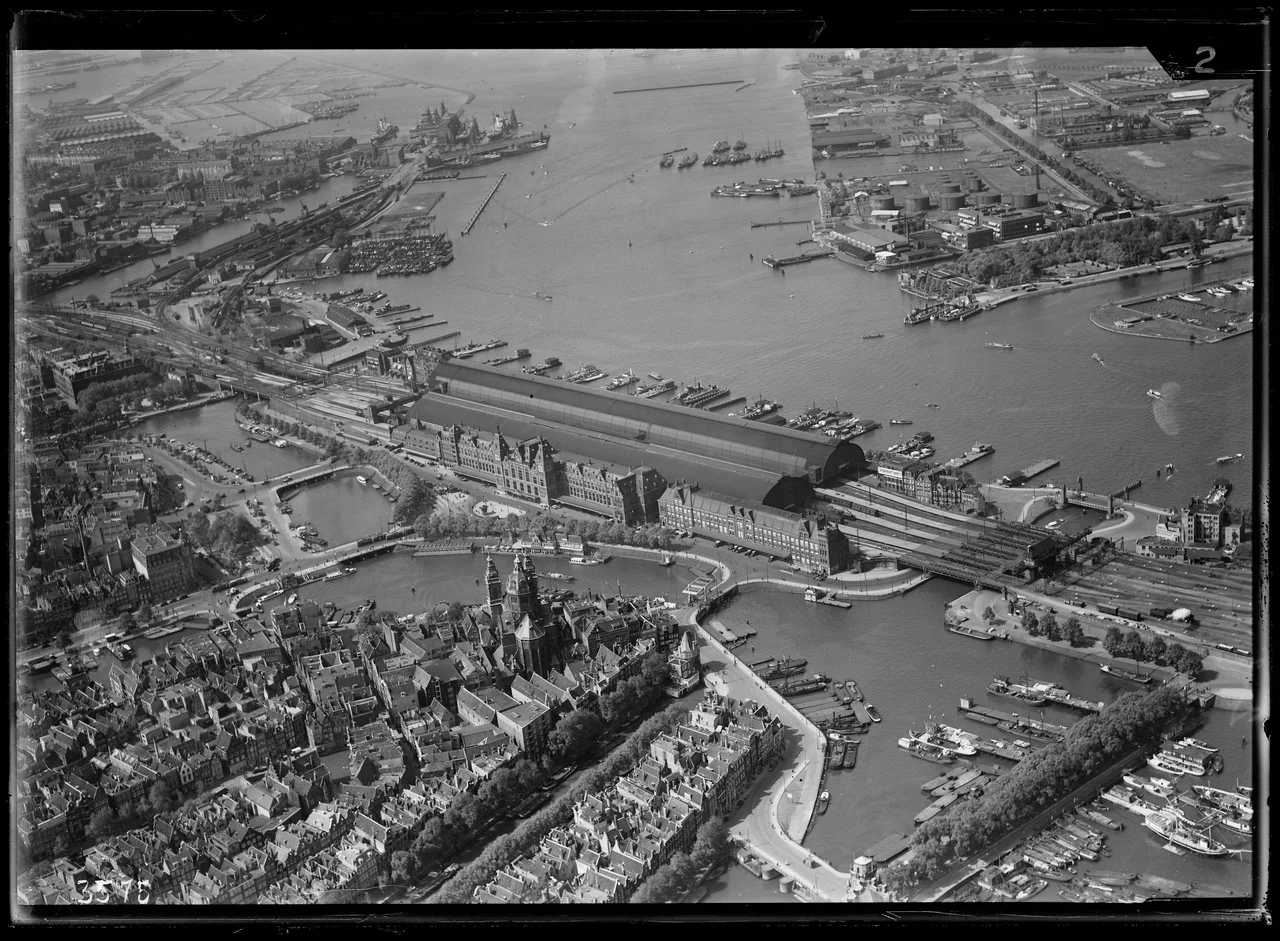

Amsterdam Centraal Station
The first thing Pierre Cuypers had to build was the ground. The site he was given in 1882 had no ground. It was open water, the Open Havenfront, the inland edge of the IJ, and the city of Amsterdam had decided that this was where its main railway station would stand. Engineers dredged sand from the dunes near Velsen, which had piled up usefully from the excavation of the new North Sea Canal, and shaped it into three artificial islands. Then they drove 8,687 wooden piles down through the silt to firm clay below, the same forest of piles that holds up most of central Amsterdam. On that floating foundation, Cuypers built a cathedral. It happens to be a railway station, and it happens to be one of the most-visited buildings in the Netherlands.
The Architect of Two Cathedrals
Cuypers was already famous in 1882. He had spent the previous six years designing the Rijksmuseum across town, a Gothic-Renaissance pile bristling with sculpted niches and red brick that was meant to glorify Dutch art, Dutch trade, and Dutch empire. The board of the railways wanted the station to do the same thing for transit. He gave them what they asked for. The front facade reads more like a Loire Valley chateau than a depot, with towers, gables, and decorative panels celebrating the colonial economy that paid for it. Contemporaries called it a cathedral of the railways and meant it as a compliment. Cuypers, in characteristic Dutch fashion, focused most of his attention on the ornament and left the structural calculations to railway engineers.
Forty Meters of Cast Iron
The roof was someone else's job entirely. While Cuypers fussed over decoration, a civil engineer named L. J. Eijmer at the private Staatsspoorwegen designed the great train shed: 50 curved trusses spanning almost 45 meters, fabricated by Andrew Handyside and Company of Derby, England, and shipped to Amsterdam in pieces. When the assembled roof rose into place it was one of the largest cast-iron spans in Europe. Cuypers did contribute the decorative ironwork at the gable ends, ornamental crests that flutter in the smoke of long-vanished steam engines. The station was officially opened on 15 October 1889. The city charged 25 cents admission and tens of thousands paid it just to walk inside in the first two days.
The City Turned Its Back on the Water
Amsterdam in 1889 was still essentially a port. Ships docked at the Damrak, only a few hundred meters away, and unloaded spices, timber, and tobacco. The station's construction physically cut the city off from its harbor for the first time in seven centuries. The decision was contentious then and remains so in some quarters. Critics argued that the city had been a waterfront town since the 13th century and should remain one. Supporters pointed out that ships were getting bigger, the IJ was getting busier with industrial traffic, and rail was the future. The future won. Within a few decades, canals running into the city center were filled in to make room for tram lines and roads. Amsterdam stopped facing north toward the water and started facing south toward Europe.
Fifteen Tracks and Two Trains Per Platform
Centraal handles 192,000 passengers a day, second in the Netherlands only to Utrecht Centraal. Fifteen tracks fan out from the platform throat, eleven of them with platforms, arranged as four island platforms, one side platform, and a two-track bay. The longest platforms run 695 meters, the second-longest in the country, which lets each platform serve two trains at once: one stops at the A-side, the other at the B-side, with scissors crossings in the middle so trains can swap ends. Three Amsterdam Metro lines terminate here, a fourth, Line 52, passes through on the north-south route that finally opened in 2018 after more than two decades of construction. The station building, the metro hall, and the surrounding plaza have been a near-continuous construction site since 1997.
Seven Thousand Bikes Under the Water
On 26 January 2023 the city opened the strangest of its recent additions: a 7,000-space bicycle garage built directly under the water of the Open Havenfront, between the station and the Prins Hendrikkade. Engineers pumped the water out, excavated a vast pit, poured the concrete shell, and then let the water back in over the roof. The entrance opens off the central metro hall, the ceiling is the harbor floor, and above the garage tour boats now tie up at jetties that did not exist a decade ago. A second underwater facility opened a month later on the IJ side of the station, holding another 4,000 bikes. Together they constitute the densest bicycle storage anywhere on Earth, which is appropriate, because the country that invented modern cycling has finally found a use for the part of its city that has always been below sea level.
From the Air
Amsterdam Centraal sits at 52.379 N, 4.900 E, on the southern shore of the IJ in central Amsterdam. From the air the building reads as a long Neo-Renaissance bar fronting the water, with the great curved train shed behind it and the medieval canal ring radiating south. Nearest airport is Schiphol (EHAM), 15 km southwest. Recommended viewing altitude 1,500-3,000 feet to make out the platforms and the bicycle parking complex; the IJ ferries crossing to Noord and the A'DAM Tower on the opposite shore aid orientation.
Nearby Stories
- Polanen Castle 1.6 km away
- Gouda 2.6 km away
- Princess Amalia Wind Farm 3.5 km away
- The Green Cathedral 4.2 km away
- Egmond Abbey 7.1 km away
- Dorestad 7.7 km away
- Hollandse Kust Zuid Offshore Wind Farm 11 km away
- Enkhuizen 16 km away