
Ancient Mediterranean Religions
Stand in the Athenian Agora and you are standing in a vanished religious machine. The ancient Mediterranean ran not on private faith but on public performance - on sacrifice, procession, festival, and vow. The British classicist Mary Beard summed up the whole system in a phrase: it was about "doing rather than believing." For more than a thousand years, from the Bronze Age palaces to the rise of Christianity, the peoples around this sea localized the divine in specific places, things, and people. Athens, more than almost anywhere, still lets you read that older logic in stone.
A Religion You Could Walk Through
Greek religion was a religion of the city - what scholars call "polis religion" - and Athens wore it on the ground. The sacred year was a calendar of festivals, and the festivals were routes through the streets. The Panathenaia, established in 566 BC, sent a great procession winding up the Panathenaic Way from the Agora to the Acropolis to dress the statue of Athena. The City Dionysia filled the slope below the Acropolis with choruses and tragedy. At the Altar of the Twelve Gods, the symbolic center of Athens, distances were measured and suppliants found refuge. None of this required a creed. It required showing up, walking the route, making the offering. The Roman jurists later gave the underlying bargain a name - do ut des, "I give so that you may give" - and it fit the Greeks just as well.
The Translatable Gods
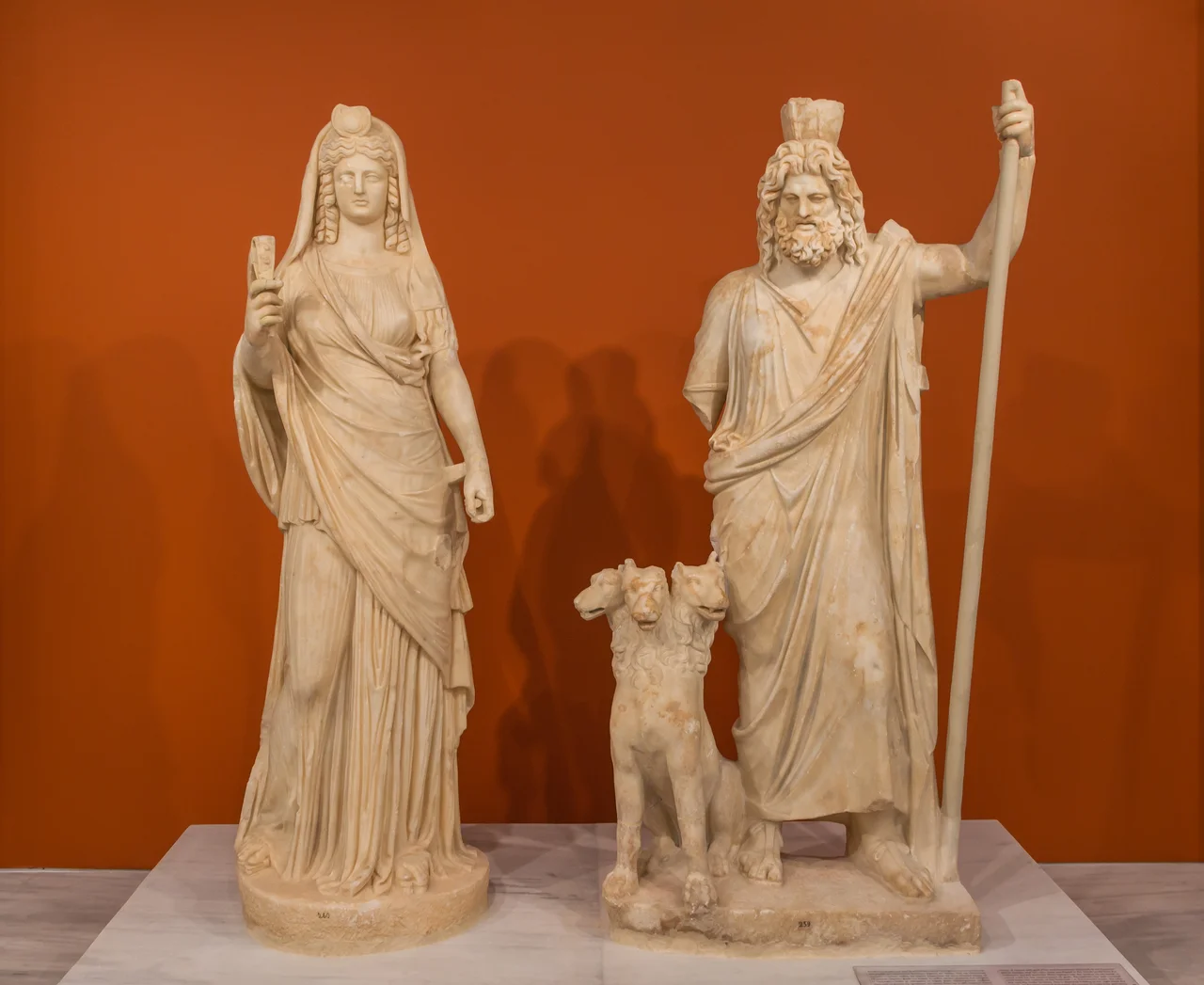
What made the Mediterranean a single religious world, rather than a thousand sealed ones, was its astonishing openness. The Egyptologist Jan Assmann called it "the translatability of gods" - the ancient habit of recognizing one people's divinity in another's, of equating Athena with this goddess and Zeus with that one across borders and languages. A merchant arriving in Athens from Egypt or the Levant did not find a closed temple system but a porous one, ready to absorb. Foreign cults took root in the city, and Athenian ideas traveled out along the same trade routes. The same gods, in different costumes, turned up port after port around the sea.
Stone That Still Speaks
Athens preserves the physical residue of all this with unusual richness. The Parthenon frieze gives us the canonical twelve Olympians in marble. The Acropolis sanctuaries - the great precinct of Athena - held forests of dedicated statues, the korai and kouroi that worshippers offered to the goddess, many of them later toppled by Persian invaders and reverently buried by the Athenians themselves. The Theater of Dionysus, where drama was an act of worship, still carries inscriptions assigning reserved seats to priests. To walk these slopes is to move through the hardware of a working religion - not ruins of belief, but the apparatus of practice, frozen mid-ritual.
When the Sacred Year Ended
Nothing about this world was permanent. From the fourth and fifth centuries AD, new laws, new patrons, and new leaders reshaped the religious landscape across the empire. Some sanctuaries closed; others were rebuilt as churches or simply repurposed; the old civic festivals faded as Christianity became dominant. Historians still argue over how fast it happened - whether the ancient cults died quickly or lingered for generations among stubborn local elites. But the change was real, and Athens lived through it. The temples that had ordered a thousand years of processions fell quiet. What survives now is a city you can still walk like an ancient calendar - the routes, the altars, the sanctuaries - reading a religion that asked not what you believed, but what you were willing to do.
From the Air
This story is anchored to ancient Athens, centered on the Agora and Acropolis at roughly 37.97° N, 23.73° E. The Acropolis rock with the Parthenon is the unmistakable landmark, with the Ancient Agora on its northwest slope and the Theater of Dionysus on the south. Athens International Airport (LGAV) lies about 33 km to the east. The Attic basin is typically clear and brightly lit in summer, ideal for picking out the marble monuments against the surrounding city.
Nearby Stories
- Great Sand Beach 5 km away
- Battle of Delium 7.7 km away
- Tower of Aliartos 9 km away
- HMHS Britannic 10 km away
- Saronic Gulf 15 km away
- Sousaki Volcano 17 km away
- Sanctuary of Apollo Maleatas 24 km away
- Skyros 66 km away