.jpg)
Ancient Theatre of Epidaurus
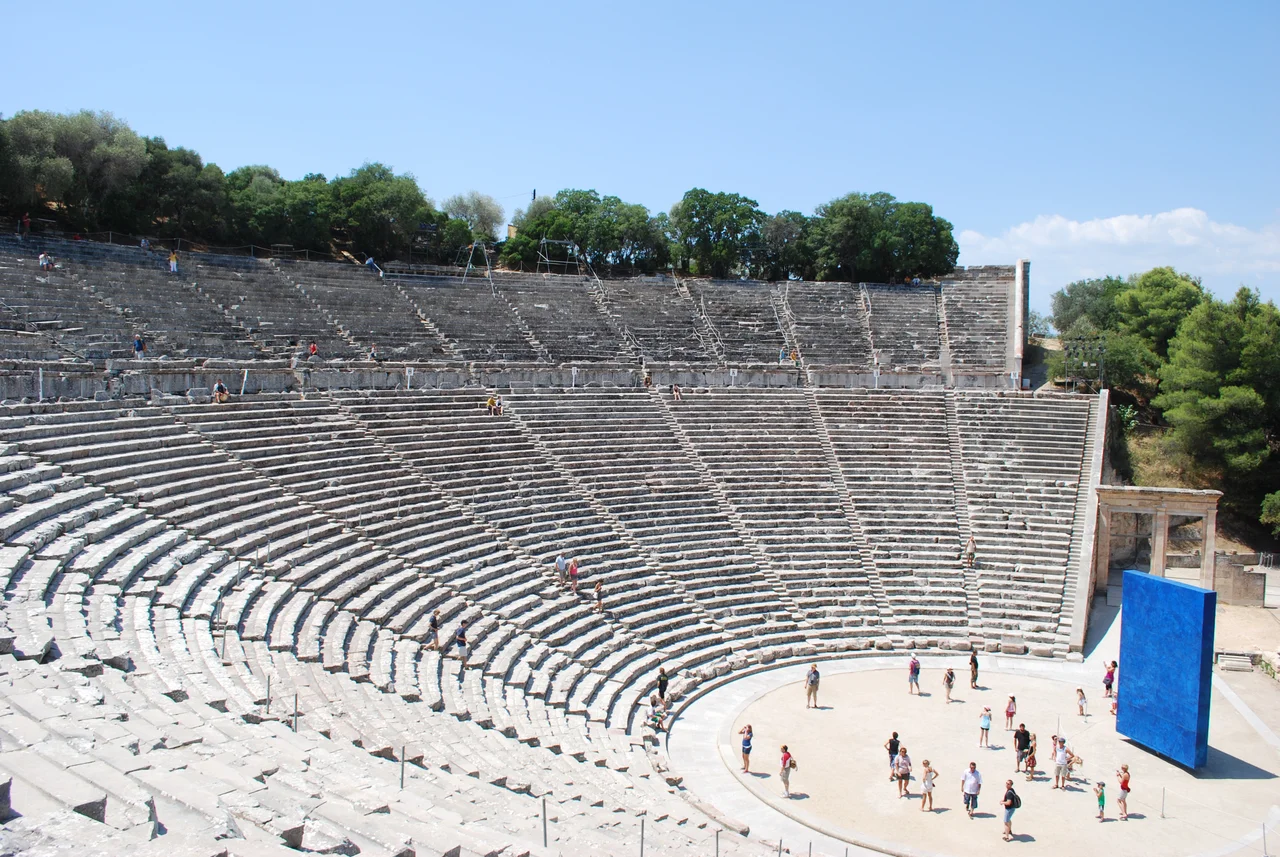
Drop a coin on the circular stone at the center of the orchestra. From any of the 14,000 seats — from the front row pressed against the stage to the topmost tier carved into the hillside — you will hear it. The acoustics of the Ancient Theatre of Epidaurus have astonished visitors for more than two millennia, and they continue to astonish today. Built around 340–300 BC and attributed to the architect Polykleitos the Younger, the theatre sits on the western slopes of Cynortion Mountain in the Argolid, part of the healing sanctuary of Asclepius. It was inscribed on the UNESCO World Heritage List in 1988. Every summer, it still fills with audiences.
A Theatre Built for Healing
The theatre was not originally conceived as entertainment in the modern sense. It was an instrument of medicine. Epidaurus was the most celebrated healing sanctuary of the classical Greek world — the place where the sick came from across the Mediterranean to be cured by the god Asclepius. They slept in the enkoimeteria, a great hall where divine dreams were believed to reveal the path to recovery. Drama was part of the treatment. The ancient Greeks understood, or at least theorized, that watching tragic and comic plays had positive effects on mental and physical health — a precursor to what we might now call therapeutic catharsis.
At maximum capacity, the theatre held between 13,000 and 14,000 spectators. Music, singing, and dramatic competitions were woven into the religious calendar of the sanctuary. A performance here was an act of worship as much as entertainment, and its setting — open to the sky above Cynortion Mountain, with a green hillside visible beyond the stage — was understood as integral to the experience. Greek theatres, unlike Roman ones, did not obscure that backdrop. The landscape was part of the show.
The Geometry of Perfect Sound
The acoustics of Epidaurus are not accidental. The design of the auditorium is based on three marking centers — an unusual mathematical approach that allowed the architects to achieve both optimal sound projection and clear sightlines across the curved seating. The auditorium divides into two sections: a lower tier of 34 rows and an upper tier of 21 rows added during Roman times, separated by a horizontal walkway 1.82 meters wide. The lower tier is divided into 12 wedge-shaped sections; the upper into 22. The circular orchestra at the center has a diameter of 20 meters, with a stone plate at its heart that marks the base of the altar.
Research into the theatre's acoustics has confirmed that sound travels remarkably well throughout the seating, though scholars note that perfect intelligibility — especially of the spoken word — requires good vocal projection rather than passive transmission. Greek actors were trained to project precisely this way. The limestone seats may also play a role: they act as natural high-pass filters, absorbing low-frequency background noise like wind and crowds while allowing the higher frequencies of the human voice to carry. The system works because every part was considered together.
Buried and Rediscovered
Unlike many ancient structures that were quarried for building material or converted to other uses, the theatre at Epidaurus survived largely because it was buried. Centuries of soil and vegetation accumulated over its stone seats, hiding the structure from plunderers. The first systematic excavation began in 1881, directed by the archaeologist Panayis Kavvadias on behalf of the Archaeological Society. What emerged was almost entirely intact — the seating, the orchestra, the entrances. The stage building, the skene, was more fragmentary, but the auditorium itself required relatively little restoration.
Subsequent restorations by Kavvadias in 1907, by A. Orlandos between 1954 and 1963, and by the Preservation Committee for Epidaurus Monuments from 1988 to 2016 have brought the theatre back to something very close to its original form. The two vaulted entrance gates have been restored. The skene remains partial. But from the uppermost seats, looking down at the orchestra and out toward the green hills, the theatre looks much as Pausanias described it when he praised its symmetry and beauty in the second century AD.
Maria Callas and the Living Stage
The theatre fell silent for centuries after antiquity. Its modern life began in 1938, when Sophocles's tragedy Electra was performed here for the first time since ancient times, directed by Dimitris Rontiris and starring Katina Paxinou and Eleni Papadaki. The experiment was interrupted by World War II. Performances resumed in 1954 and were established as an annual event in 1955 — the Epidaurus Festival, which continues today through the summer months.
In 1960 and 1961, the soprano Maria Callas performed at Epidaurus, singing Norma and Médée in what became among the most celebrated operatic events of the twentieth century. The idea that a voice trained for concert halls and opera houses could fill this open-air space of 14,000 seats — without amplification, under the stars, in an ancient sanctuary — was at once theatrical and entirely Greek. The theatre does not merely host performances. It absorbs them into its long memory.
From the Air
The Ancient Theatre of Epidaurus is located at coordinates 37.5961°N, 23.0792°E, on the western slopes of Cynortion Mountain in the Argolid. From the air, the theatre's characteristic semicircular seating carved into the hillside is clearly visible, especially in low-angle morning or evening light. The sanctuary complex sits in a broad valley accessible from the east. The nearest major airport is Athens International (LGAV), approximately 100 km to the northwest. A viewing altitude of 3,000–5,000 feet gives a clear orientation to the site's position in the valley. Summer brings clear skies and excellent visibility throughout the region.
Nearby Stories
- German Submarine U-133 (1941) 5.1 km away
- Battle of the Trench (1821) 5.4 km away
- Battle of Settepozzi 6.7 km away
- Stymphalus (Arcadia) 8.2 km away
- Kechries 11 km away
- Battle of Sellasia 13 km away
- Saronic Gulf 19 km away
- SS Heraklion 68 km away