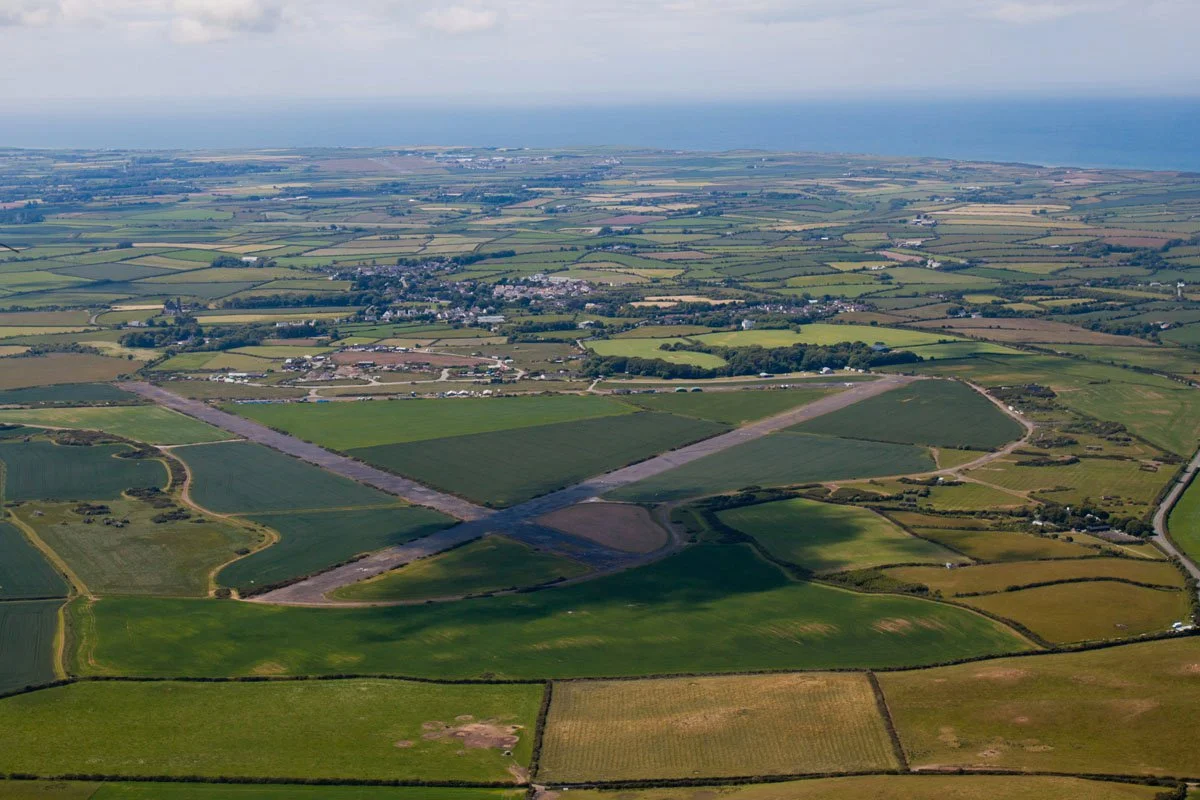

Andreas, Isle of Man
On a stone slab in the parish church of Andreas, a Christian cross occupies the central space - and beside it, Odin is being devoured by the wolf Fenrir at the end of all things. The slab is called Thorwald's Cross. It was carved sometime in the early medieval period when the people of the Isle of Man were both Christian and Norse, and saw no need to pick a side. There are eleven such carved cross-slabs in St Andrew's Church now, gathered from the surrounding fields and farms. They are among the most striking witnesses anywhere to the religious negotiations of a people caught between two cosmologies.
The Northern Plain
Andreas - or Kirk Andreas in its older form - sits about five kilometres from Ramsey, the island's second town, in the centre of the Manx northern plain at an altitude of roughly 20 metres. The parish takes in part of the sandy lands called the Curragh, and to the north it rises into low rounded hills lying between Port Cranstal and Blue Head. Administratively the parish belongs to the sheading of Ayre, one of the six ancient Manx divisions. Just east of the village lies the now little-used airfield of RAF Andreas. For much of the village's history this was farming country, and the rhythm of life was agricultural. In recent decades many residents commute daily to Ramsey or Douglas instead, served by Bus Vannin routes and an on-demand service.
Saint Andrew's Stones
Both village and parish take their name from Saint Andrew, the brother of Peter who became the patron saint of much of northern Europe. Evidence of human settlement here reaches back well before Christianity arrived: the Bronze Age Ballavarry Burial Mound stands a short distance from the village. The parish church almost certainly occupies the site of an earlier keeill, the small Celtic chapels that were the first Christian buildings on the island. The current building, St Andrew's Church, dates from 1802 and was built with stone from Sulby Glen. A 120-foot bell tower was added in 1869 but reduced in height during the Second World War - the tower would have been a navigation aid for German bombers and for friendly aircraft alike, and its height was clipped accordingly. It has never been restored. The eleven carved cross-slabs displayed inside the church record the layered story of Manx religion: Celtic Christian, Norse-pagan, Norse-Christian, all overlaid on the same hand-cut stone.
Bell Tower, Rectory, Chapel
The old rectory in Andreas was for centuries the most significant residential building in the village. William Blundell's A History of the Isle of Man, written between 1648 and 1656, mentions the rectory during the time of Bishop Samuel Rutter; it is now a registered building. Also in the parish is St Jude's Chapel, built in 1869 in a Romanesque style with a square tower. By 2005, St Jude's was at risk of demolition. The Friends of St Jude's took on the upkeep of the chapel that March and successfully campaigned to save it. It is now used for occasional services - weddings, funerals, and christenings - which is more or less what a small country chapel was always for. The Andreas school logo carries three symbols: a Viking-era cross-slab, a Viking ship based on the local ship burial at Knock y Doonee, and the Manx three-legged arms.
Football Under Floodlights
Andreas Primary School takes pupils from age four to eleven, drawn from a wide catchment by government-sponsored bus and equipped with a breakfast club. The original school was built in 1903; the current building dates primarily from 1977. After year six, pupils move on to Queen Elizabeth II High School in Peel or Ramsey Grammar School in Ramsey. The parish hall, built in 1939, hosts a youth club, the Women's Institute, parties, exhibitions, and games of badminton and bowls. The Grosvenor, the village's one pub and restaurant, closed temporarily in late 2019 and has since reopened. Ayre United, the local football club founded in 1967, plays in the Isle of Man Football League at Andreas Playing Fields. Their clubhouse was built up from an old RAF building brought across from Jurby airfield - a small piece of wartime infrastructure given a sporting second life. They were the first club on the island to install floodlights, and they took the Manx FA Cup in the 2002-03 season.
From the Air
Andreas village sits at 54.367°N, 4.444°W in the centre of the flat Manx northern plain, at an elevation of approximately 20 metres. The former RAF Andreas airfield (closed to scheduled traffic) lies about 1 kilometre east. Ronaldsway Airport (EGNS) is approximately 23 nautical miles south. Ramsey lies about 5 kilometres east-southeast. Best viewed at 1,500-3,000 feet AGL; the level northern plain offers excellent visibility, and the church spire at St Andrew's is a useful landmark from the air. Watch for general aviation operations at the former airfield.
Nearby Stories
- Kirkmaiden 3.2 km away
- Isle of Whithorn 4.1 km away
- Santon Railway Station 13 km away
- Solway Firth 16 km away
- St Bees Lighthouse 19 km away
- Portavogie 34 km away
- Walney Island 40 km away
- German submarine U-1024 55 km away