_July_2013.jpg)
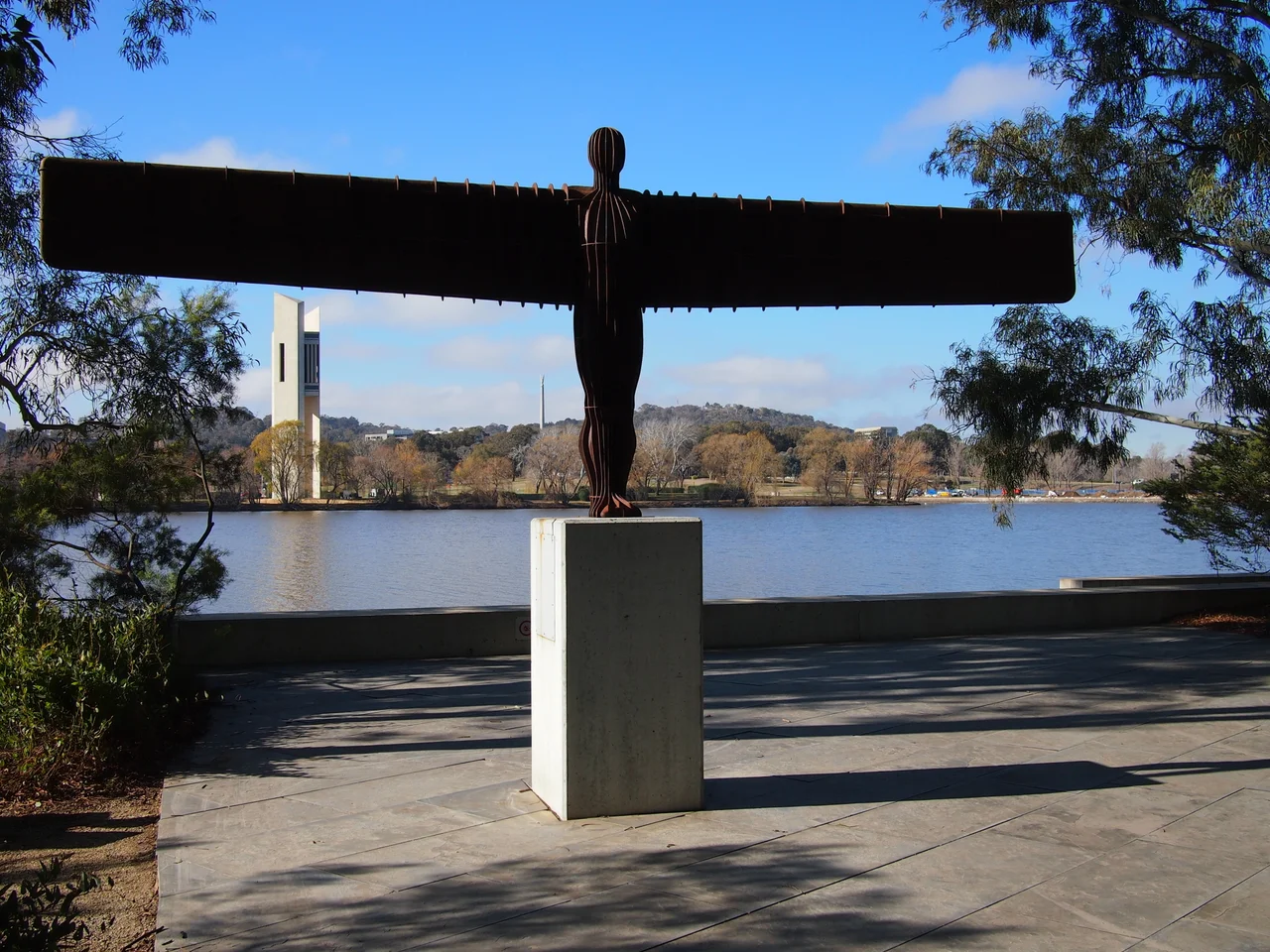
Angel of the North
Antony Gormley initially turned the commission down. He didn't do roundabout art, he told Gateshead Council. Then he visited the proposed site - a low knoll near the A1, built up from the spoil of the demolished Team Colliery - and changed his mind. It reminded him, he said, of a megalithic burial chamber. He took the job. On the morning of 15 February 1998, after an overnight road convoy from Hartlepool, the body of the Angel was lowered into place. The first 50-tonne wing was attached at 11 am. The second went on at 4 pm. Crowds of thousands stood in the cold to watch, and more than 20 television crews recorded what would become, by most measures, the best-known piece of public art ever made in Britain.
A Body Cast in COR-TEN
Like much of Gormley's work, the Angel is shaped from a cast of his own body, scaled up to mythic dimensions. It stands 20 metres tall. The wingspan is 54 metres - wider than a Boeing 757, a comparison the Gateshead tourist materials enjoy repeating. The whole thing weighs 208 tonnes, with the body alone weighing 100 and each wing another 50. The COR-TEN weathering steel gives the surface its deep oxidised brown - Gormley had originally wanted to call the work The Iron Angel of the North. The wings are angled 3.5 degrees forward, deliberately, to create what the sculptor describes as a sense of embrace. The vertical ribs running down body and wings are an external skeleton, designed to direct wind toward the foundations. They allow the Angel to stand through gusts of over 100 mph.
Twenty Metres Down to the Rock
Most of what holds the Angel up is invisible. Twenty-metre concrete foundations, containing 600 tonnes of concrete, anchor the figure to the bedrock 70 feet below the knoll. The old Team Colliery workings - mined from the 1720s until the 1960s - had to be stabilised first, with 100 tonnes of grout pumped into the disused shafts. Hartlepool Steel Fabrications built the body and wings in a shed labelled 'Hartlepool Erections Group,' a name Gormley visited weekly during construction. The total budget reached £800,000: £584,000 from Arts Council England, £150,000 from the European Regional Development Fund, £45,000 from Northern Arts, the rest from private sponsors. The planning committee had approved the scheme 15 to 5 in 1995. The full council had ratified it 41 to 14. Not everyone was convinced. The lone Conservative councillor called it 'ugly and intrusive.'
Mining the Symbolism
Gormley has spoken often about why an angel for this place. Beneath the sculpture, miners worked in darkness for centuries. Above it, in the light, stands a figure that celebrates that labour without literally depicting it. 'Men worked beneath the surface in the dark,' he wrote. 'Now, in the light, there is a celebration of this industry.' The Angel doesn't commemorate any single person - which has freed visitors to attach their own meanings. Some see millennial optimism. Some see the miners. Some see religious devotion. Some, including a few critics, saw fascist monumentalism: the Gateshead Post once drew a comparison to a 1930s Nazi statue, and an art critic likened the form to communist totalitarian sculpture. Vote Leave projected its logo onto the Angel during the 2016 Brexit campaign, prompting an angry letter from Gormley's solicitors.
Thirty-Three Million Eyes
Roughly 33 million people see the Angel every year. The figure is so often cited that it has become part of the work itself. Most of them are inside vehicles - around 90,000 a day pass on the A1 and A167 - or aboard East Coast Main Line trains, which run 600 metres to the west. The sculpture sits facing south, looking down at northbound traffic entering Tyneside. From the top of the knoll, the design brief specified, the views command 100 degrees of horizon up to four kilometres in each direction, with Durham Cathedral just visible. Visitors are encouraged to touch the steel, sit at the feet, walk under the wings. Accessibility is built in. A scale maquette sold at Christie's in 2011 fetched £3.4 million. Another, valued at £1 million on Antiques Roadshow, remains the most expensive item ever appraised on the programme. The Angel itself, of course, is priceless. It is also, deliberately, designed to last more than a hundred years.
From the Air
54.914N, 1.589W. The Angel of the North stands on a hill at Low Eighton in Lamesley Parish, immediately east of the A1 just south of Gateshead. From the air, the wings catch sunlight against the surrounding green of the Tyne and Wear Lowlands. Best viewed at 1,500-3,000 ft AGL. Nearest airport: Newcastle International (EGNT), 11 nm to the north. The Team Valley industrial estate lies just north, the East Coast Main Line 600m west.
Nearby Stories
- Cresswell Lifeboat Station 5.2 km away
- Auckland Castle 5.7 km away
- Battle of Otterburn 7.1 km away
- Saltburn Pier 11 km away
- Hadrian's Wall Path 11 km away
- Battle of Stainmore 18 km away
- Saltburn-by-the-Sea 39 km away
- Alexander L. Kielland (Platform) 296 km away