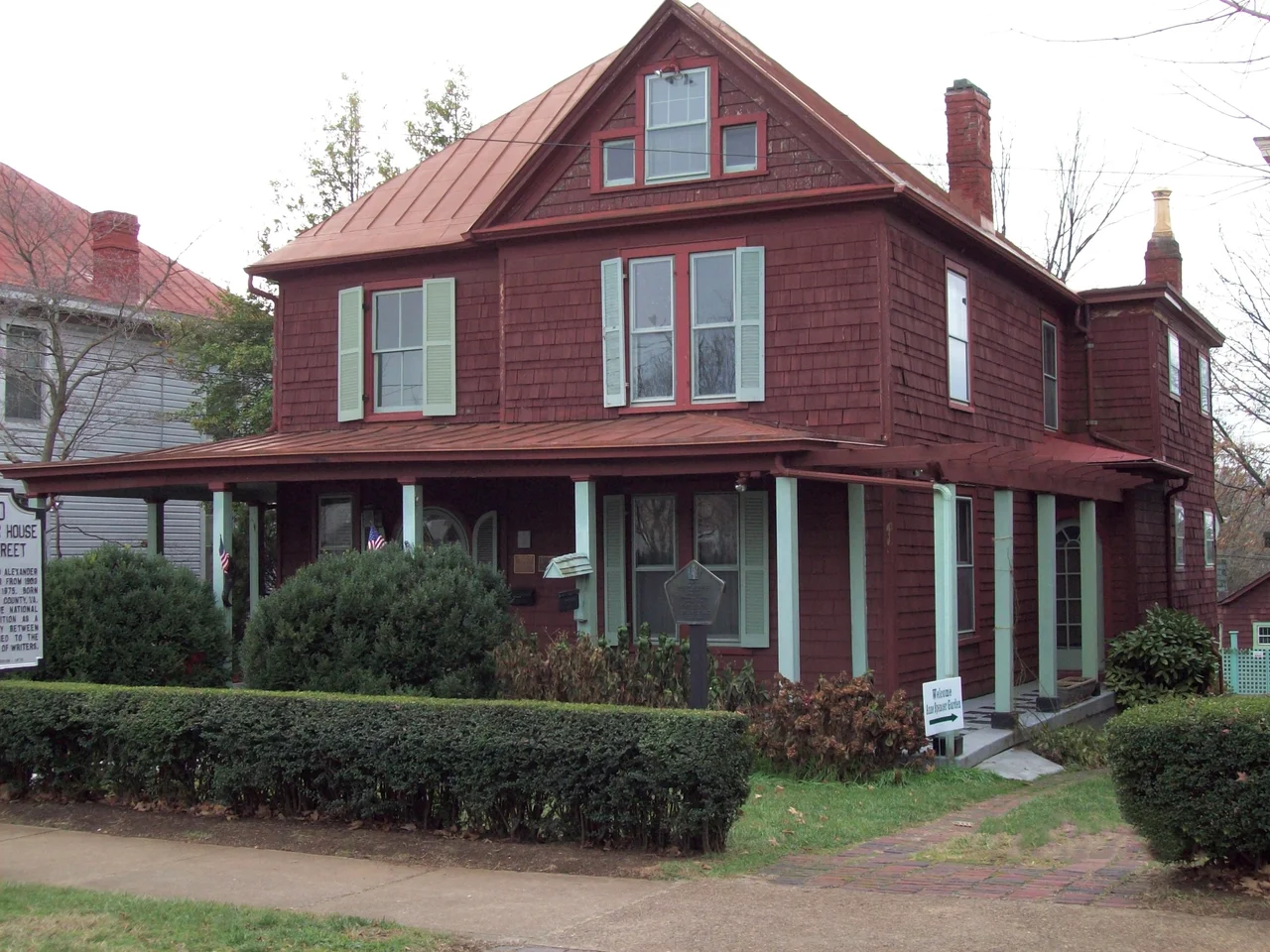

Anne Spencer House
Anne Spencer wrote her poems in a one-room cottage at the back of her garden. She called it Edankraal — a private word built from "Edward," her husband's name, her own "Anne," and the Afrikaans word kraal, for enclosure. The garden is what survives most vividly today: a long, narrow strip behind the Pierce Street house in Lynchburg, laid out by Edward Spencer in beds and arbors, planted thick with the irises and tea roses and trumpet vines Anne loved. Marian Anderson sang there once, after segregated Lynchburg hotels would not house her. Langston Hughes walked the paths. Thurgood Marshall and Martin Luther King Jr. and James Weldon Johnson and George Washington Carver and W. E. B. Du Bois all came through this gate. The poet lived in this house from 1903 until her death in 1975, and her garden was the unofficial Black intellectual salon of the upper South.
A Poet First, Always
Anne Spencer was born Annie Bethel Bannister in 1882, the daughter of formerly enslaved parents in Henry County, Virginia. She moved to Lynchburg as a young woman, married Edward Spencer in 1901, and from the early 1920s onward published poems that James Weldon Johnson collected into his anthology The Book of American Negro Poetry. Her verse is dense, garden-rooted, and unsentimental — closer to the Imagists than to the Harlem cabarets — and it earned her a place as the first Virginian and the first African American woman whose work appeared in the Norton Anthology of Modern Poetry (1973). She was a librarian by trade at Lynchburg's all-Black Dunbar High School. She was also a relentless civil rights organizer, the kind who knew which judges were honest and which were not, and she did most of her writing in pieces, on scraps, between visits.
Edward Built It Twice
The Pierce Street house went up in 1903, a two-story shingle residence in a modified Queen Anne style — hip-roofed on one side, gable on the other, with a two-bay facade carefully balanced. Edward Spencer designed and built it himself, and then over the next several decades he rebuilt and modified it as the family grew. He was a relentless recycler. When Guggenheimer's Department Store downtown threw out copper from a window display, Edward used the sheets to face the dining room wainscot. When the all-Black Harrison Movie Theater on Fifth Street took down its bright red leather padded doors, Edward installed them in the kitchen. He carved a phone booth into a corner under the stairs. He turned the third floor into what the family called Edward's man cave, with a pool table and a half bath, and later opened it up as a dormitory for the grandchildren. The house is, in a real sense, a family memoir built into walls.
Edankraal and the Garden
Behind the house Edward laid out a long garden with paths, pergolas, a small pond, and a fountain centered on a cast figure that Anne loved. At the back of the garden he built her a single-room writing studio. She named it Edankraal. She wrote there for fifty years, with the garden visible through the windows in every season. When friends came — and they came often — the garden became a gathering place where conversation could happen out of the reach of Jim Crow Lynchburg. Marian Anderson stayed in the house after a 1934 concert when the city's hotels refused to give her a room. James Weldon Johnson sat in the garden helping the Spencers organize Lynchburg's NAACP chapter. Langston Hughes, Thurgood Marshall, George Washington Carver, W. E. B. Du Bois, and Martin Luther King Jr. all came through. The garden was, for decades, one of the most important Black political and literary spaces in Virginia.
Museum, Garden, and Living Archive
After Anne Spencer's death in 1975, the family preserved the house intact and opened it to the public in 1977. The garden was restored in the 1980s with the help of horticulturists and members of the family who remembered exactly which beds held which bulbs. In July 2022 the National Trust for Historic Preservation's African American Cultural Heritage Action Fund awarded the museum a grant to hire its first full-time executive director, a milestone for a small house museum that has been run largely by volunteers for decades. Today you can walk the same paths Marian Anderson walked, see the small writing cottage Anne disappeared into when she needed a poem, and read the lines she scratched on the walls of Edankraal in pencil, where they remain visible under glass.
From the Air
Located at 1313 Pierce Street in Lynchburg's Pierce Street Historic District, approximately 37.4036 N, 79.1522 W. A modest residential block of late nineteenth- and early twentieth-century houses on a hill above downtown. From the air, look for the gridded streets between Fifth Street and Park Avenue. Nearest airport: Lynchburg Regional (KLYH), 4 nm south-southwest.
Nearby Stories
- Appomattox-Buckingham State Forest 4.8 km away
- Hollins University 12 km away
- Franklin County, Virginia 13 km away
- Buena Vista, Virginia 15 km away
- Smith Mountain Lake 24 km away
- Alleghany County, Virginia 26 km away
- Murder of Hannah Graham 36 km away
- Staunton River State Park 44 km away