
The Wire That Carried a Nation's Voice
On August 17, 1945, a young journalist named Adam Malik obtained a freshly signed proclamation of Indonesian independence and dictated it by telephone to his colleagues at a news agency office in Jakarta. The resulting bulletin slipped past Japanese military censors and raced across the Domei newswire network before anyone could stop it. By the time occupation authorities tried to retract the dispatch, a courier had already delivered it to a radio station under the agency's name. That news agency was Antara — and the proclamation it smuggled into the world would change the course of Southeast Asian history.
Born from a Dutch Blind Spot
Antara was founded on December 13, 1937, in Batavia — the colonial capital that would later become Jakarta. The Dutch East Indies already had a news agency: Aneta, established by Dominique Willem Berretty. But Aneta was a Dutch enterprise that rarely covered local Indonesian news, and two independence activists grew tired of the silence. Soemanang Soerjowinoto, a journalist at the Tjahaja Timoer newspaper, and Albert Manoempak Sipahoetar, who worked for a Dutch advertising firm, decided to build something of their own. They met at Soemanang's residence with the author Armijn Pane and a young political activist from Medan named Adam Malik — barely twenty years old and already wanted by Dutch authorities. Soemanang named the agency after Perantaraan, a weekly magazine he had founded in Bogor. Its first bulletin, reporting its own existence, ran in two nationalist newspapers the following day.
Swallowed and Reborn
When Japanese forces invaded the Indies in 1942, Antara was renamed Yashima and absorbed into the empire's Domei Tsushin network. But absorption brought infrastructure. Domei opened offices across Java, and Indonesian journalists gained access to equipment and distribution channels they had never possessed. When Japan's grip weakened in August 1945, Malik and his colleagues exploited every advantage. The independence proclamation they smuggled onto Domei's wire reached audiences far beyond Indonesia. Weeks later, when Japan surrendered to the Allies, Antara's staff seized Domei's local offices and reopened under their own name on September 3. One of the agency's first acts as a free organization was establishing an overseas bureau in Singapore — unfunded by the new government, housed in a modest building in Raffles Place — with the explicit goal of breaking the Dutch monopoly on news about Indonesia.
The State's Mouthpiece
Independence brought new pressures. In 1962, President Sukarno reorganized Antara as the National News Agency Institute, placing it directly under presidential control and merging it with three other news services. The president could now appoint its managing director and editor-in-chief. As Sukarno pursued leftist policies, conservative outlets accused Antara of partisan reporting. After the abortive 1965 coup attempt blamed on the Communist Party, nearly a third of Antara's editorial staff were dismissed, and many journalists sympathetic to the party were killed in the subsequent anti-communist purge. Under Suharto, the agency became a tool of state messaging. Independent outlets would only publish politically sensitive stories if Antara had reported them first — a survival strategy in a system where publishing licenses could be revoked and publications shuttered at any time.
A Monopoly That Endures
When Suharto resigned in 1998, the number of authorized publications surged from 289 to over 2,000 in sixteen months. Antara attempted to reinvent itself as an independent voice, though allegations of continued government bias persisted. In 2007, the agency was finally separated from presidential control and reorganized as a statutory corporation. Yet one artifact of the old order remains: a 1972 decree still grants Antara the exclusive right to distribute news material from foreign agencies within Indonesia. This effective monopoly provides the largest share of the agency's revenue. Some officials have called for its end, but scholars at Queensland University of Technology have warned that revoking it would undermine Antara's entire operating structure. By 2002, government subsidies had fallen to just one percent of the agency's costs — a remarkable distance from an organization that once existed to amplify the state's voice.
Revolution on the Wire
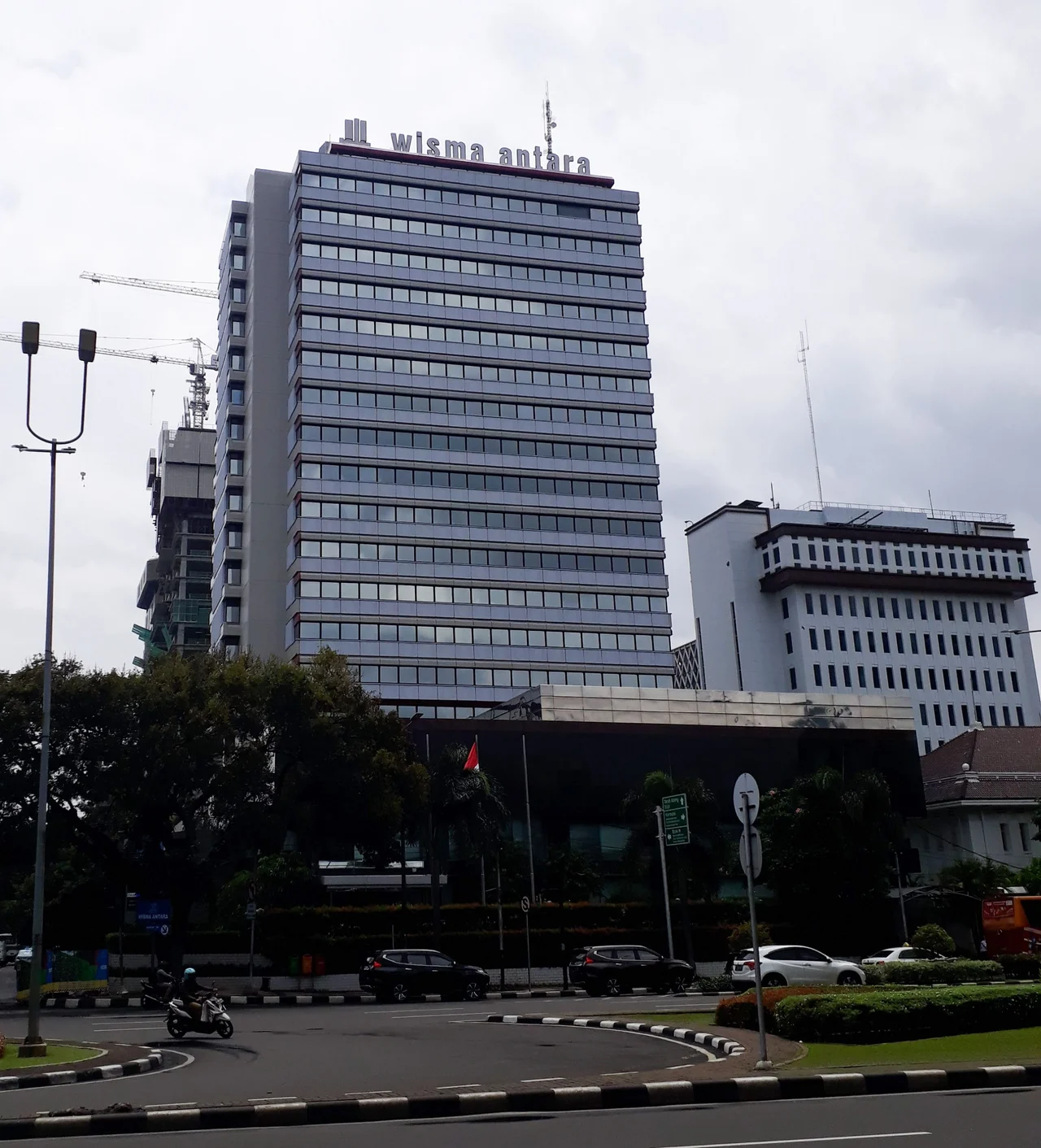
Antara's legacy is inseparable from Indonesia's struggle for nationhood. President Yudhoyono, speaking on the agency's 69th anniversary, said it had made "immense contributions in documenting the nation's struggle during the period of revolution." Scholars have argued that journalists and guerrilla soldiers played equally important roles in winning the Indonesian National Revolution — that Antara's war of propaganda for international recognition was as decisive as any military campaign. The agency's headquarters stood for decades in Wisma Antara in Central Jakarta, a building it occupied from 1981 until 2023. Today, media scholars debate whether decades of government entanglement can ever truly be unwound. But the dispatch that Adam Malik dictated by telephone on an August morning in 1945 — the one that slipped past the censors and carried a proclamation of independence across the world — remains the single most consequential act of journalism in Indonesian history.
From the Air
Antara's historical headquarters stood at Wisma Antara in Central Jakarta, at approximately 6.18°S, 106.82°E. The area sits in the dense urban core of Jakarta, near Merdeka Square and the National Monument. Nearest major airport: Soekarno-Hatta International Airport (WIII/CGK), approximately 20 km northwest. Halim Perdanakusuma Airport (WIHH) is closer, about 12 km southeast. From cruising altitude, Jakarta's sprawling metropolitan area is unmistakable along the northern coast of Java.
Nearby Stories
- The King's Footprints in the River 2.8 km away
- Rawagede Massacre 6.4 km away
- The Cruiser That Wouldn't Stop Fighting 14 km away
- Four Minutes Over the Java Sea 14 km away
- The Scholar's Mosque 21 km away
- Through the Cidepong Hills 37 km away
- Ujung Kulon National Park 97 km away
- The Islands That Vanished from Sight 352 km away