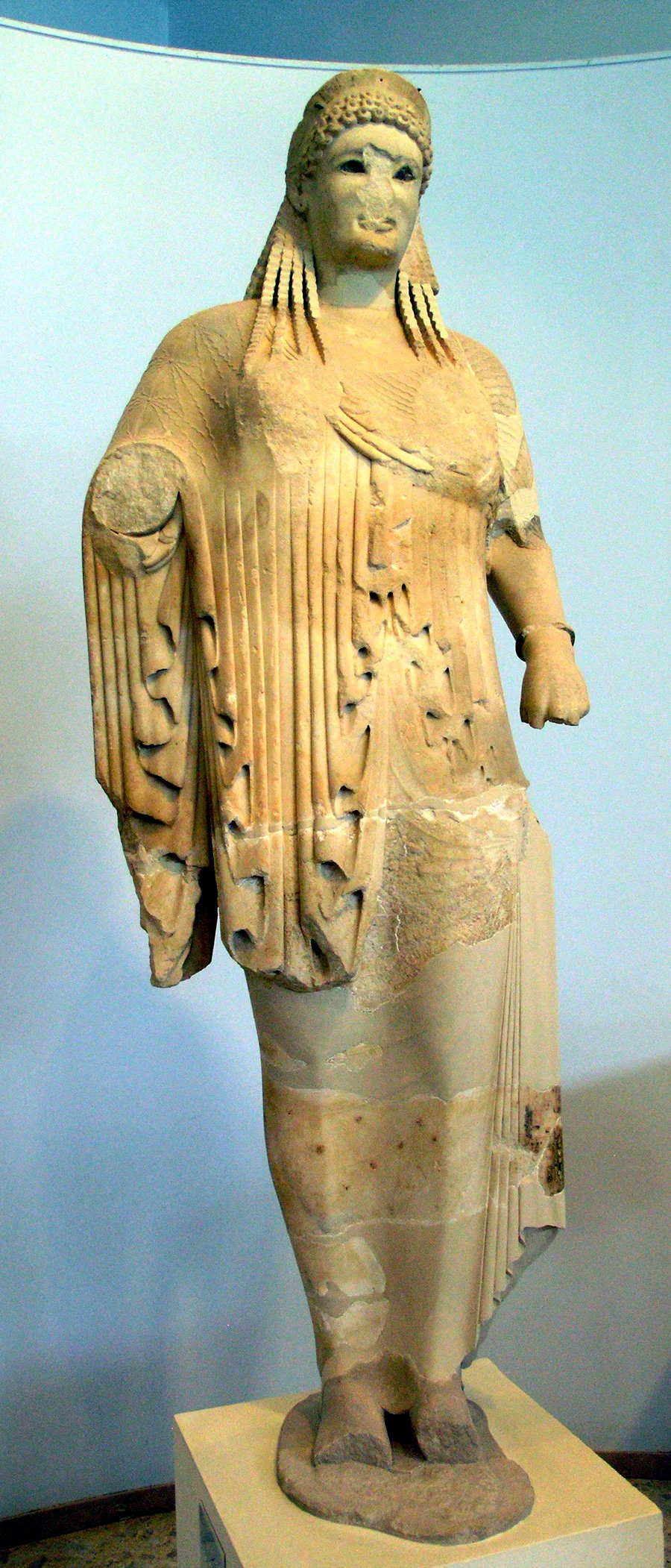

Antenor Kore
She is more than six feet of marble, and she has been staring at people the same way for roughly 2,500 years. The Antenor Kore - a statue of a young woman carved from Parian marble around 530 to 520 BC - stands in the Acropolis Museum with her weight in one hand and the ghost of a smile on a damaged face. Her eye sockets are empty, hollowed for inlays of glass or stone that once gave her a startling living gaze. She survived the sack of Athens, the centuries, and a burial. That she stands at all is a small miracle of devotion and luck.
A Gift to Athena
We know unusually much about who made her and why. Fragments of her marble base carry an inscription that names two men: Nearchos, a potter who dedicated the statue to the goddess Athena, and Antenor, son of Eumares, who carved it. That detail is quietly remarkable. A votive statue this grand was the kind of gift expected from the wealthy, yet here a craftsman - a potter - offered it from his earnings. Scholars have sometimes doubted that a simple artisan could afford such a thing, but the doubt may say more about modern assumptions than ancient reality. In sixth-century Athens a skilled potter or vase painter could grow genuinely rich, and the Acropolis held other dedications from men of the same trade. The kore is a monument to a working man's success as much as to a goddess.
How a Maiden Was Made
She belongs to a type the Greeks produced for generations - the kore, the standing draped maiden, always frontal, always meeting the viewer's eye along a clear vertical axis. The Antenor Kore wears the layered dress of her era: a fine chiton beneath a himation pinned at the shoulder with a fibula and falling in deep "omega" folds. With her left hand she gathers the cloth aside, and that single gesture sets the whole surface of the marble into motion, pleat crowding against pleat. Her hair, only partly preserved, breaks into tight curls at the brow and then spills in long locks across her shoulders and back, crowned above. At 201 centimeters tall, excluding her base, she is among the largest korai known - a maiden built on the scale of the gods she served.
Smashed and Saved
Her survival is a story of violence followed by reverence. When the Persians stormed and burned the Athenian Acropolis in 480 BC, they shattered the sanctuary's statues. The Athenians who returned could not simply re-erect the wreckage - the broken images were still sacred - so they gathered the fragments and buried them in the ground of the citadel. Archaeologists call this layer the Perserschutt, the "Persian debris." For more than two thousand years the Antenor Kore lay in that consecrated rubble. The destruction that should have ended her instead preserved her, sealing the marble away from weather and reuse until the diggers came.
Reassembled from the Rubble
She came back to the light in pieces, decades apart. In 1882 excavators east of the Parthenon found her lower body and her left arm; in 1886, west of the Erechtheion, they uncovered the upper part; sections of a calf turned up as well. The scholar Franz Studniczka was the one who matched her to the inscribed base bearing Antenor's name - a connection most experts have accepted ever since. Reassembled and now housed in the Acropolis Museum, she stands again where she once stood, a maiden carved before the age of Pericles, smashed in war, buried in piety, and patiently pieced back together by the people who came after. Look into her empty eyes and you are looking at one of the oldest faces in Athens.
From the Air
The Antenor Kore is displayed in the Acropolis Museum, at the southeastern foot of the Acropolis, near 37.9691° N, 23.7283° E. The Acropolis rock with the Parthenon is the obvious landmark directly to the northwest of the museum's glass-walled building. Athens International Airport (LGAV) lies about 33 km to the east. The statue was originally dedicated and buried on the Acropolis itself, a short walk uphill from where it now stands. Visibility across central Athens is typically excellent in clear weather.
Nearby Stories
- Great Sand Beach 5 km away
- Battle of Delium 7.7 km away
- Tower of Aliartos 9 km away
- HMHS Britannic 10 km away
- Saronic Gulf 15 km away
- Sousaki Volcano 17 km away
- Sanctuary of Apollo Maleatas 24 km away
- Skyros 66 km away