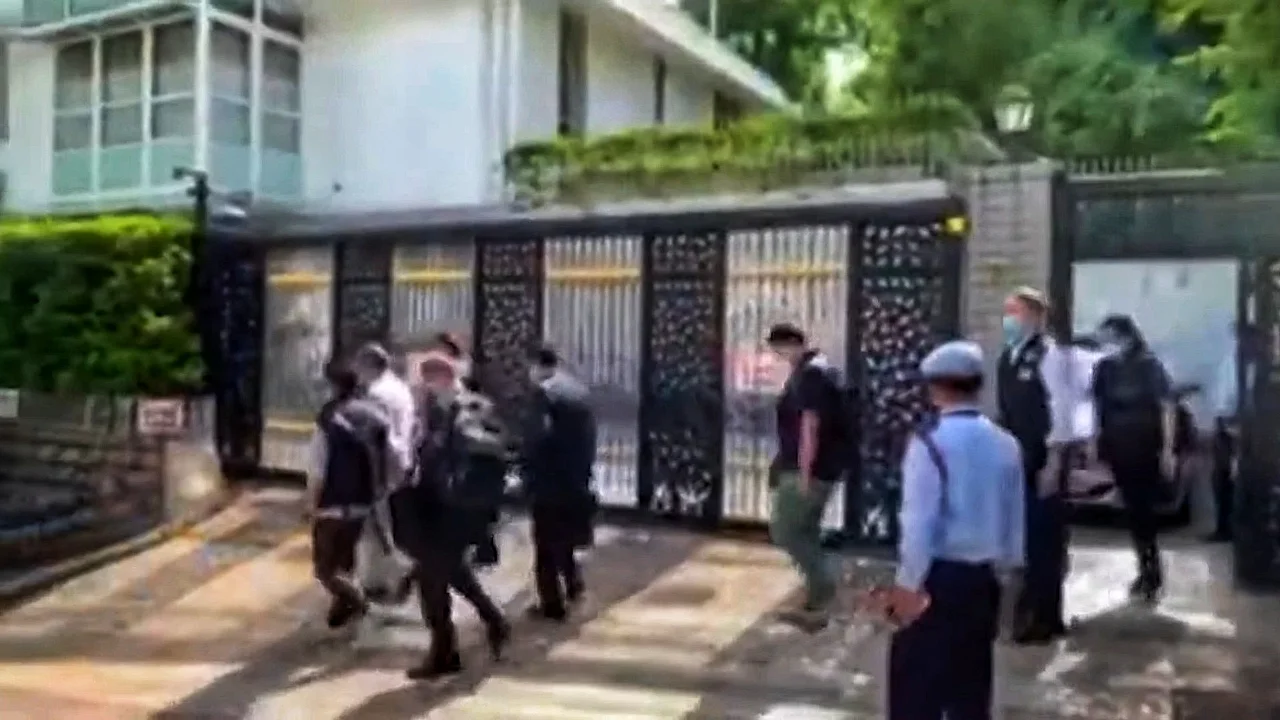

Apple Daily Raids and Arrests
On the morning of 10 August 2020, Jimmy Lai woke up expecting to be arrested. He had said so publicly, twice — in interviews on 16 and 29 June — and he had refused to leave Hong Kong despite every reason to do so. When police came to his home in Homantin that morning, he did not resist. He was handcuffed and driven to the Apple Daily headquarters in Tseung Kwan O, where nearly 200 officers were already moving through the building, searching desks, opening cabinets, taking computers and phones. Lai founded Apple Daily 25 years earlier as a scrappy tabloid that would say what others wouldn't. That morning, the newspaper watched its founder walk in in handcuffs.
The Paper That Wouldn't Whisper
Apple Daily launched in 1995 in a Hong Kong that still had press freedom in law and in practice. Jimmy Lai, already a successful businessman who had fled mainland China as a child, built the paper on a simple premise: tell the truth, especially about power. The paper covered corruption, published leaked government documents, and ran investigations that state-controlled outlets refused to touch. By the time the national security law took effect on 30 June 2020, Apple Daily had grown into Hong Kong's largest pro-democracy newspaper. Its newsroom understood what the law meant. Lai had told interviewers he expected to go to prison. He stayed anyway.
When the law was enacted, it created new offences — including 'collusion with foreign forces' — that carried sentences up to life imprisonment. Critics of the government feared from the beginning that the law's broad language could be applied to journalism. Those fears were not long in being tested.
The First Raid: August 2020
Nearly 200 police officers arrived at the Apple Daily headquarters in Tseung Kwan O Industrial Estate on the morning of 10 August 2020. Lai had already been arrested at home. Four senior executives — CEO Cheung Kim-hung, CFO Royston Chow Tat-kuen, Administrative Director Wong Wai-keung, and Animation Director Ng Tat-kwong — were taken in on suspicion of fraud and, in Chow's case, suspected collusion with foreign forces.
Editor-in-chief Ryan Law asked to see the search warrant. The request was ignored. Journalists from RTHK, Stand News, AFP, and Reuters were barred from the press area, while outlets identified as pro-government were allowed in. Computers, phones, and contact details of exiled activists were carried out in boxes. Handcuffed, Lai was brought back to the building at 11 a.m. so police could continue their search in his presence. He and Cheung left at around 1 p.m., after a three-hour operation inside the newsroom.
That afternoon, Hong Kong readers queued at newspaper stalls. Apple Daily normally printed around 70,000 copies. For the 11 August edition, the paper printed 350,000 — then raised the number to 550,000 before dawn.
The Second Raid: June 2021
On 17 June 2021, more than 500 officers from the National Security Department arrived before 7 a.m. Five executives were arrested in pre-dawn sweeps of their homes: CEO Cheung Kim-hung, COO Royston Chow Tat-kuen, editor-in-chief Ryan Law, vice-president Chan Pui-man, and Next Animation Studio chief executive Cheung Chi-wai. Ryan Law was led out of his Kornhill apartment in handcuffs. Chan Pui-man's home was entered by force; a search lasting two and a half hours removed laptops and a tablet that did not belong to her.
The police sealed the Apple Daily building. All employees — reporters, editors, cleaners — were gathered in the lobby, had their ID cards registered, and were told to wait. Officers opened drawers, turned on reporters' computers, and searched files. At least 44 computers were taken. The newspaper's archive — physical copies from January 2017 forward — was loaded into blue plastic boxes and driven away in a truck. The operation ran for more than five hours.
That day, the National Security Department announced the freezing of HK$18 million in assets belonging to Apple Daily, Apple Printing, and AD Internet Limited. The newspaper could not pay its staff. It could not survive.
Closure and Its Aftermath
On 21 June 2021, Apple Daily announced it would shut unless its frozen accounts were released. They were not. On 23 June, the paper said it would close 'in view of staff members' safety.' The final print edition ran on 24 June. The digital edition went dark at 23:59 Hong Kong Time. Readers queued one last time. The paper sold out.
In November 2022, six former executives — Cheung Kim-hung, Ryan Law, Chan Pui-man, Lam Man-chung, Fung Wai-kong, and Yeung Ching-kee — pleaded guilty before a panel of three designated national security judges. Jimmy Lai, who had decided to fight the charges, remained in custody. He had already been imprisoned on a separate conviction and faced national security charges that his legal team continued to contest. British human rights barrister Tim Owen, hired by Lai, won a ruling in the Court of Final Appeal allowing him to appear — but the Chief Executive then sought a Beijing interpretation of the law to restrict overseas counsel, a process that continued to delay the trial.
In August 2024, the Court of Final Appeal upheld Lai's conviction for participating in an unauthorized procession in 2019. He remained in prison. The trial on national security charges continued.
What Remained
People who worked at Apple Daily lost their jobs, their newsroom, and in several cases their freedom. The reporters who built the paper — who chose to stay in Hong Kong rather than leave — carried the weight of that choice. Some were arrested. Some fled. Some said nothing publicly at all.
Activists archived Apple Daily's news articles on blockchain platforms before the digital edition went offline, trying to preserve the record beyond the reach of deletion. Artists made work about what happened: a neon sign of Jimmy Lai in chains, an oil painting of Lai gagged by an apple. Both traveled to protests and parliaments in Australia and Europe.
The Hong Kong Journalists Association called the first raid an act that 'shaped white terror in the city.' The Foreign Correspondents' Club said it 'signaled the end of press freedom in Hong Kong.' Governments on every inhabited continent issued statements. None of it brought back the paper, or its people.
From the Air
The Apple Daily headquarters was located in Tseung Kwan O Industrial Estate, in the eastern New Territories of Hong Kong, at approximately 22.31°N, 114.27°E. From the air, the broader Tseung Kwan O district is visible as a modern urban development along Junk Bay (Tseung Kwan O Hoi). The nearest major airport is Hong Kong International Airport (VHHH), located on Lantau Island approximately 35 km to the west. Flying eastward from VHHH at 3,000–5,000 feet provides views of the harbor, Kowloon, and the New Territories coast. The industrial estate where the raids took place is not individually prominent from altitude, but the wider geography — the bay, the urban grid, the green hillsides of Sai Kung District to the northeast — frames the setting of these events clearly.
Nearby Stories
- Shek Pik 1.7 km away
- Tung Ping Chau 4.8 km away
- Hong Kong 12 14 km away
- Wanshan Archipelago Campaign 16 km away
- Pearl River Delta 18 km away
- Battle of Penghu 478 km away
- Penghu Air Raids 487 km away
- Cape Maobitou 596 km away