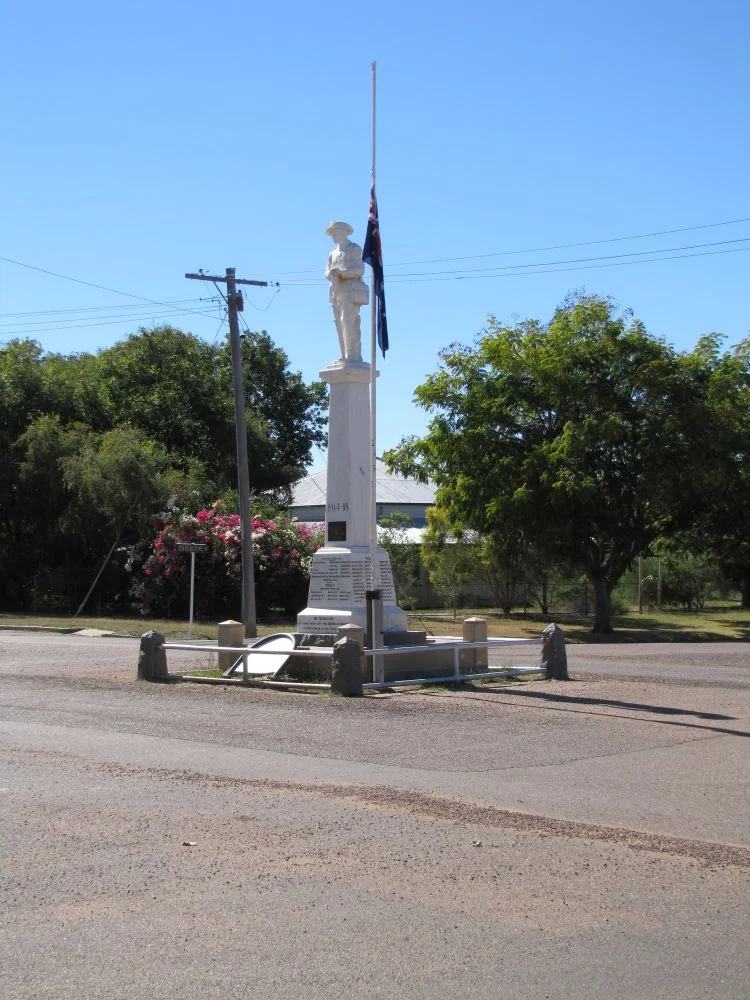

Aramac War Memorial
At the main crossroads of Aramac, a stone soldier stands with his head bowed and his hands folded on a reversed rifle. He is life-sized, and he is the tallest thing for streets around, deliberately grand for so small a place. The figure marks the spot the way a grave marks a churchyard, because in a sense that is exactly what it is. The men it honours died on the other side of the world, in cemeteries their families would never see. So the town built them a place to come home to. Unveiled in 1924, the Aramac War Memorial is one of Queensland's most intact "digger" memorials still standing where it was first raised.
A Town's Grief Set in Marble
Australia entered the First World War with a population of about five million and lost some 60,000 of them, roughly one in seven of everyone who served. No war before or since has cut so deeply into the country. Because British policy buried the Empire's dead where they fell, the families left behind had no graves to tend. Their answer was the war memorial: a substitute tomb, raised in the middle of town. The very word often carved on them, cenotaph, means "empty tomb." Aramac's stands at the heart of the settlement, surrounded by sandstone kerbing and granite posts, far larger in scale than a town this size would ever otherwise build. It was meant to be impossible to walk past without remembering.
Raised by the Women of Aramac
The memorial exists because a committee of mostly young women made it happen. They held entertainments, passed the hat, and gathered public subscriptions until they had raised enough to commission the monument and the fence around it. On 12 April 1924 the Aramac Shire Chairman, E. W. Bowyer, unveiled it, stepping in because the Queensland Governor could not attend. The stone records the names of 132 local men who served, among them fifteen who did not come back and eleven who were wounded. That detail matters. Australian memorials of this era honoured everyone who went, not only the fallen, because the whole country took fierce pride in an army made up entirely of volunteers. For a remote district of perhaps a few hundred families, 132 names is a staggering count, the measure of a community that emptied itself into a distant war.
The Digger
The figure on top is a "digger," the affectionate name for the Australian soldier, and in Queensland the digger statue became the overwhelmingly popular form of memorial. He stands at rest, head lowered, hands crossed on the butt of a rifle turned upside down, a tree stump carved behind one leg to brace the stone. The reversed arms are the ancient posture of mourning. Carved from Queensland's own Ulam marble on a base of grey granite, the Aramac digger was the work of F. M. Allan, a Rockhampton monumental mason who made many such memorials across Central Queensland. This one and the memorial at Bundaberg are reckoned the two most intact of Allan's diggers still in their original settings at a town intersection, the place the community chose so that no one could forget.
Still Standing at the Crossroads
A century on, the memorial remains exactly where it was raised, which is rarer than it sounds. Many Queensland war memorials were shifted to ease traffic, repainted, or unsympathetically repaired over the decades; Aramac's was left alone. It still occupies its full setting at the main intersection: the digger on his obelisk, the leaded names and AIF badge on the marble, the dates 1914 to 1918, the sandstone kerbing and granite corner posts, and the metal flagstaff at the south-western corner. It is also one of the few such memorials in the state never to have been painted, the marble left as the mason cut it. In a town this small the monument is impossible to overlook, and that was always the point. Each year on Anzac Day the community still gathers at the foot of the stone soldier, and the 132 names continue to do the quiet work they were carved to do, keeping a distant war present in the place the men came from.
From the Air
The Aramac War Memorial stands at 22.972°S, 145.245°E, at the central intersection of Aramac on Lodge Street, in Central West Queensland's flat black-soil country. From the air the town reads as a small, neat grid beside Aramac Creek; the memorial sits at the crossroads where the main streets meet. A respectful low pass at 1,500 to 2,500 feet AGL reveals the town plan, though the monument itself is too small to resolve from cruising height. The nearest sizeable airport is Longreach (YLRE), about 65 nautical miles to the south-west, with Barcaldine (YBAR) roughly 35 nautical miles south. The surrounding plains are open and largely treeless, so the township is easy to pick out; visibility is usually excellent except during summer wet-season storms.
Nearby Stories
- Edgbaston Reserve 3.4 km away
- Mount Cornish Homestead 27 km away
- Beaconsfield Station Sheep Wash 33 km away
- Shearers' Strike Camp Site, Barcaldine 37 km away
- Bexley Station 60 km away
- Augustus Charles Gregory 155 km away
- Brigalow Belt 241 km away
- Cullin-la-ringo Massacre 252 km away