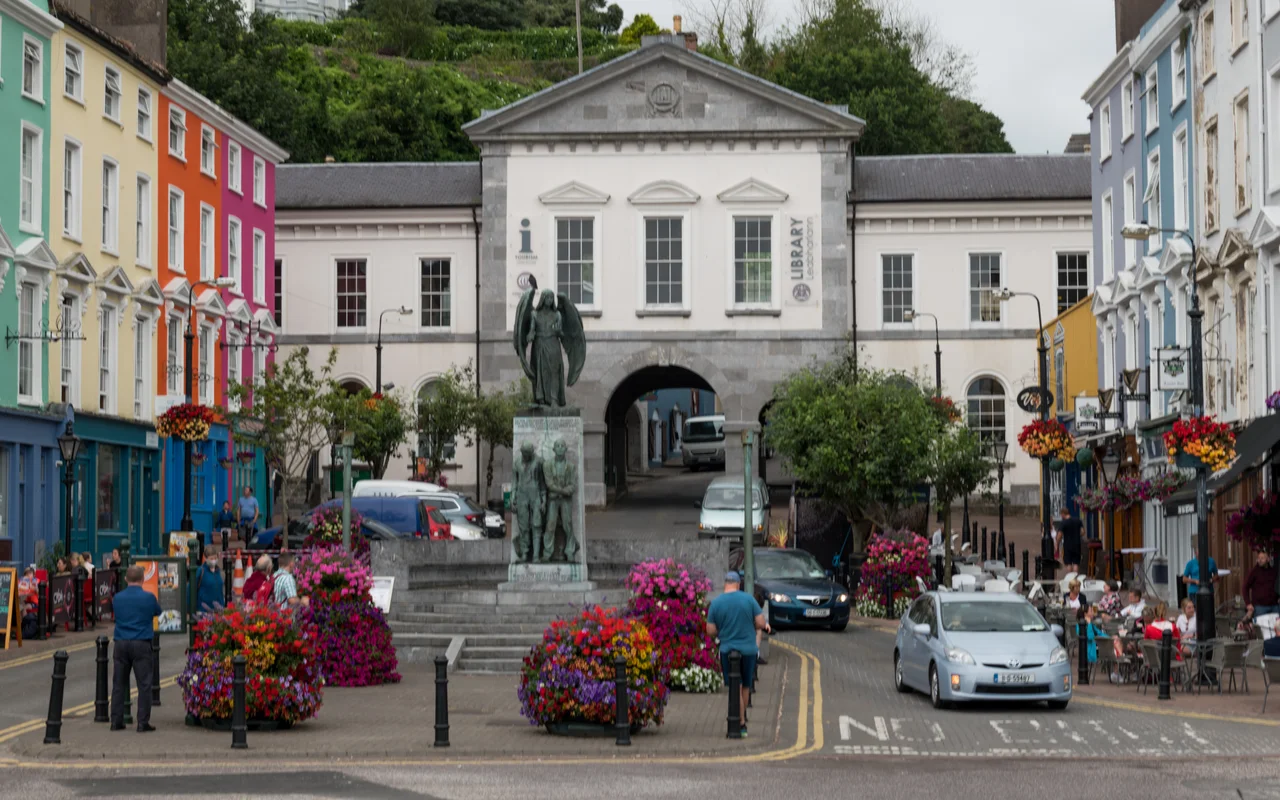

Arch Building, Cobh
It has had three names. Queenstown Town Hall when it served the Victorian port that hosted the British Atlantic fleet. Cobh Town Hall after 1920, when the town shed its imperial name during the Irish War of Independence. And the Arch Building today, after the three arches at its centre were given their own quiet identity. The building stands at one edge of Casement Square in Cobh, thirteen bays of grey limestone and cement-rendered brick facing the harbour, designed by Alexander Deane in the neoclassical style and officially opened on 27 May 1852. It looks today like what it has always been: a substantial municipal structure built to last. What it has been used for over the years is the story.
A Market House by the Smith-Barrys
The site began as a market house, commissioned in 1806 by John Smith-Barry of Fota House - an Anglo-Irish landlord whose seat lay on Fota Island a few kilometres up the harbour. The original 1806 building was modest. The Arch Building as it stands today owes its proportions to John's son James Hugh Smith-Barry, who in the mid-19th century commissioned a much larger scheme: a remodelled and enlarged building facing onto a new public space called Scotts Square. The architect was Alexander Deane, of the Cork firm that produced several of the most important public buildings in the county. The central section projects forward, faced in grey limestone, with a carriageway arch flanked by two smaller pedestrian arches. A modillioned cornice runs along the top. A pediment with a coat of arms in the tympanum crowns the centre. The wings, with round-headed windows on the ground floor and triangle-pedimented sash windows above, balance the composition with a quiet authority.
Bodies in the Assembly Hall
On the afternoon of 7 May 1915, the Cunard liner RMS Lusitania was struck by a torpedo from a German U-boat off the Old Head of Kinsale, less than twenty nautical miles south-west of Cobh. She sank in eighteen minutes. One thousand one hundred and ninety-eight passengers and crew died. Local fishermen and townspeople in Cobh - then still called Queenstown - put to sea in whatever boats they could find and spent days recovering bodies from the water and the beaches. The dead were carried up from the quays to the only building large enough to hold them: this one. Local fishermen laid them out in the assembly hall, row by row, while families came from across the Atlantic to identify their dead. Some of the unidentified are still buried just north of town, in the Old Church Cemetery.
Casement Square, and the Angel
When Queenstown became Cobh in 1920 - the local council passing the resolution on 2 July of that year - the square in front of the building was renamed too. Scotts Square became Casement Square, in honour of Roger Casement, the Irish nationalist who had been executed by the British in 1916 after attempting to import German arms for the Easter Rising. In 1968 the sculptor Jerome Connor unveiled, in the centre of the square, a memorial to the Lusitania victims: a bronze Angel of Peace standing above two fishermen, the same fishermen who had carried bodies up the hill fifty-three years earlier. The Angel still stands. The fishermen below her keep their faces toward the harbour and their backs to the building where the dead were laid out.
Library, Court, Library Again
In 1976 the building was converted into a public library - a project that cost £75,000 in mid-1970s money and turned the old assembly hall into reading rooms. A tourist information centre moved in as well, and the District Court took part of the space until that court closed in 2010. A significant restoration of the main frontage was completed in 2012, returning the limestone and cement to something closer to their original 1852 appearance. The Arch Building is now on Cork County Council's Record of Protected Structures: legally protected, historically central, and used every day by people picking up library books in the building where, more than a century ago, the dead of the Lusitania were brought in from the sea.
From the Air
Located at 51.851°N, 8.295°W in Casement Square, Cobh, on the southern shore of Great Island in Cork Harbour. The nearest airport is Cork (EICK) about 25 km west. From the air, Cobh stretches along the harbour edge as a tightly packed waterfront town climbing the hillside, with the spire of St Colman's Cathedral dominating the skyline above the Arch Building. The whole town remains largely unchanged since 1912, when the Titanic made her last port of call here.
Nearby Stories
- Walter Siepmann 6.3 km away
- Gaeltacht na nDéise 11 km away
- Fermoy 12 km away
- Canovee 14 km away
- Rathcoole Ambush 16 km away
- SS Folia (1907) 20 km away
- Cloghan Castle, Lough Hyne 35 km away
- SM U-27 91 km away