.jpg)
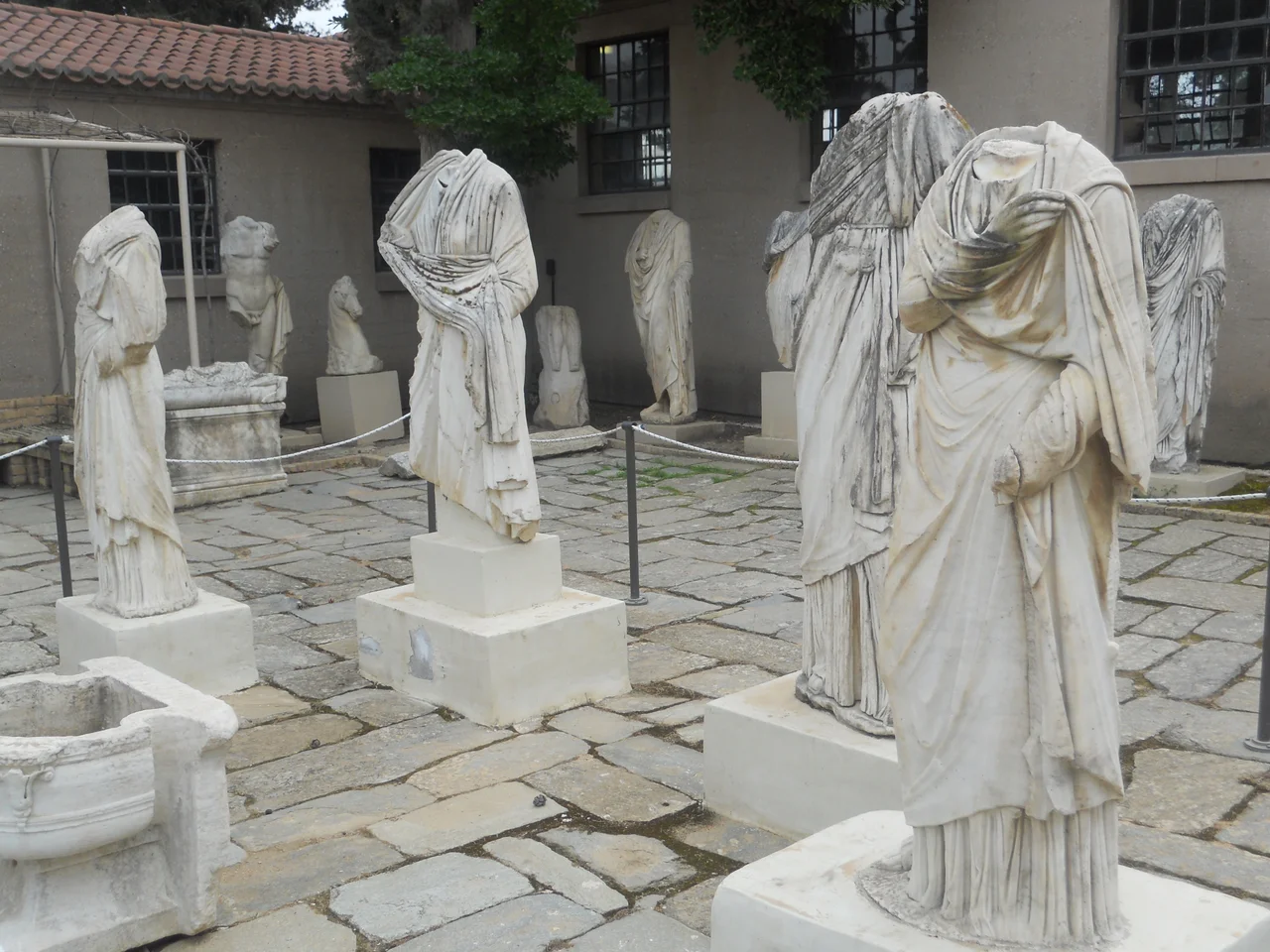
Archaeological Museum of Ancient Corinth
Seven columns of the Temple of Apollo have stood on this hill for approximately 2,500 years — through the sack of 146 BC, through the Roman reconstruction, through Byzantine churches and Ottoman rule and Greek independence. They were standing when archaeologists from the American School of Classical Studies in Athens began systematic excavations here in 1896, and they were standing in 1931 when construction began on the museum that would house what those excavations uncovered. The Archaeological Museum of Ancient Corinth sits inside the archaeological site itself, which means visiting it involves walking through the ruins rather than merely reading about them. The temple columns are visible from the museum entrance. The agora stretches out below. The Acrocorinth looms to the south. The museum does not need to work hard to put its objects in context.
An American Donation, a Chicago Design
The museum was built between 1931 and 1932, funded largely by a donation from Ada Small Moore and constructed by the American School of Classical Studies in Athens. Its architect, Stuart Thompson, drew on the 'Chicago school' of architecture — a rational, functional approach that produced a clean, unpretentious building suited to displaying objects rather than competing with them. In 1951, the west wing was extended, reorganising the interior around two atriums that gave the building a sense of interior light and space. Further renovations between 2007 and 2008 improved the galleries devoted to the prehistoric collections and the finds from the Sanctuary of Asclepius. By 2015, new large-scale works filled the east and south areas, and a major exhibition funded under the National Strategic Reference Framework brought together objects spanning the Geometric Period through the Roman destruction of 146 BC. The building has grown incrementally, each addition reflecting the continued productivity of the excavations around it — a museum that keeps needing more room because the ground keeps yielding more.
What the Ground Gave Up
The collections span an extraordinary range of time and material culture. Corinth was continuously inhabited from the Early Neolithic period (roughly 6500–5750 BC) through to the Roman era and beyond, and the excavations have produced objects from every phase of that occupation. Vases and cult figurines from the prehistoric period testify to intense early settlement. The Sanctuary of Demeter and Kore on the slopes of the Acrocorinth yielded hundreds of terracotta figurines — offerings left by worshippers over centuries. The Sanctuary of Asclepius, the healing god, produced votive body parts in terracotta: arms, legs, ears, and other anatomical offerings left by people hoping for cures. Sculptures, inscriptions, architectural fragments, and bronze objects fill the galleries, tracing the city's arc from a prosperous Greek polis to a Roman colony — a colony that Julius Caesar refounded in 44 BC as Colonia Laus Iulia Corinthiensis, making it the capital of the Roman province of Achaea. The museum holds the physical residue of all of it.
The Temple That Survived
The Temple of Apollo, seven of whose Doric columns still stand at the edge of the archaeological site, was built around 540 BC. It is one of the oldest monumental stone temples in Greece, and its survival — partial, worn, but structurally intact through the catastrophe of 146 BC and two subsequent millennia — is the kind of accident that archaeologists do not take for granted. When the Roman general Lucius Mummius destroyed Corinth in 146 BC, he killed the men, sold the women and children into slavery, and shipped the city's art to Rome. The temple was too large and too embedded in the hillside to be easily removed. It simply remained. The museum's exhibitions trace the city that grew up around it: first the Greek city of the archaic and classical periods, then the gap of abandonment after 146 BC, then the Roman city that Julius Caesar planted on the ruins a century later.
A Living Archive
The site around the museum encompasses far more than the Temple of Apollo. The Lechaion Road — the main paved road connecting ancient Corinth to its northern harbour — is partly excavated. The Fountain of Peirene, fed by a spring that ancient writers called the source of poetic inspiration, is accessible within the site. The agora, the stoa, a theatre, and the foundations of numerous temples and shops spread across the archaeological zone. The museum functions as the interpretive anchor for all of this — a place where the objects found across decades of excavation are brought together and given order. Visiting it after walking through the site reinforces what the individual objects, seen in isolation in a gallery, can sometimes obscure: that this was a city, densely inhabited, commercially active, culturally rich, destroyed and rebuilt and inhabited again. The museum makes that continuity visible.
From the Air
The Archaeological Museum of Ancient Corinth lies at approximately 37.91°N, 22.88°E, within the archaeological site of Ancient Corinth, roughly 5 km southwest of the modern city of Corinth in the northeastern Peloponnese. From the air, the site is marked by the distinctive silhouette of the seven surviving columns of the Temple of Apollo — visible as a pale stone cluster at the edge of the excavated area. The Acrocorinth rock rises immediately to the south. The nearest major airport is Athens International (LGAV / Eleftherios Venizelos), approximately 75 km to the east. Recommended viewing altitude: 2,000–4,000 feet AGL to distinguish the archaeological site from the modern urban area and appreciate the relationship between the ancient city, the Acrocorinth, and the Gulf of Corinth to the north.
Nearby Stories
- Stymfalia 3 km away
- Sanctuary of Asclepius, Epidaurus 4.6 km away
- German Submarine U-133 (1941) 5.9 km away
- Battle of the Trench (1821) 6.7 km away
- 1981 Gulf of Corinth Earthquakes 12 km away
- Aigeira 13 km away
- Agios Thomas, Boeotia 14 km away
- Agios Georgios (island) 36 km away