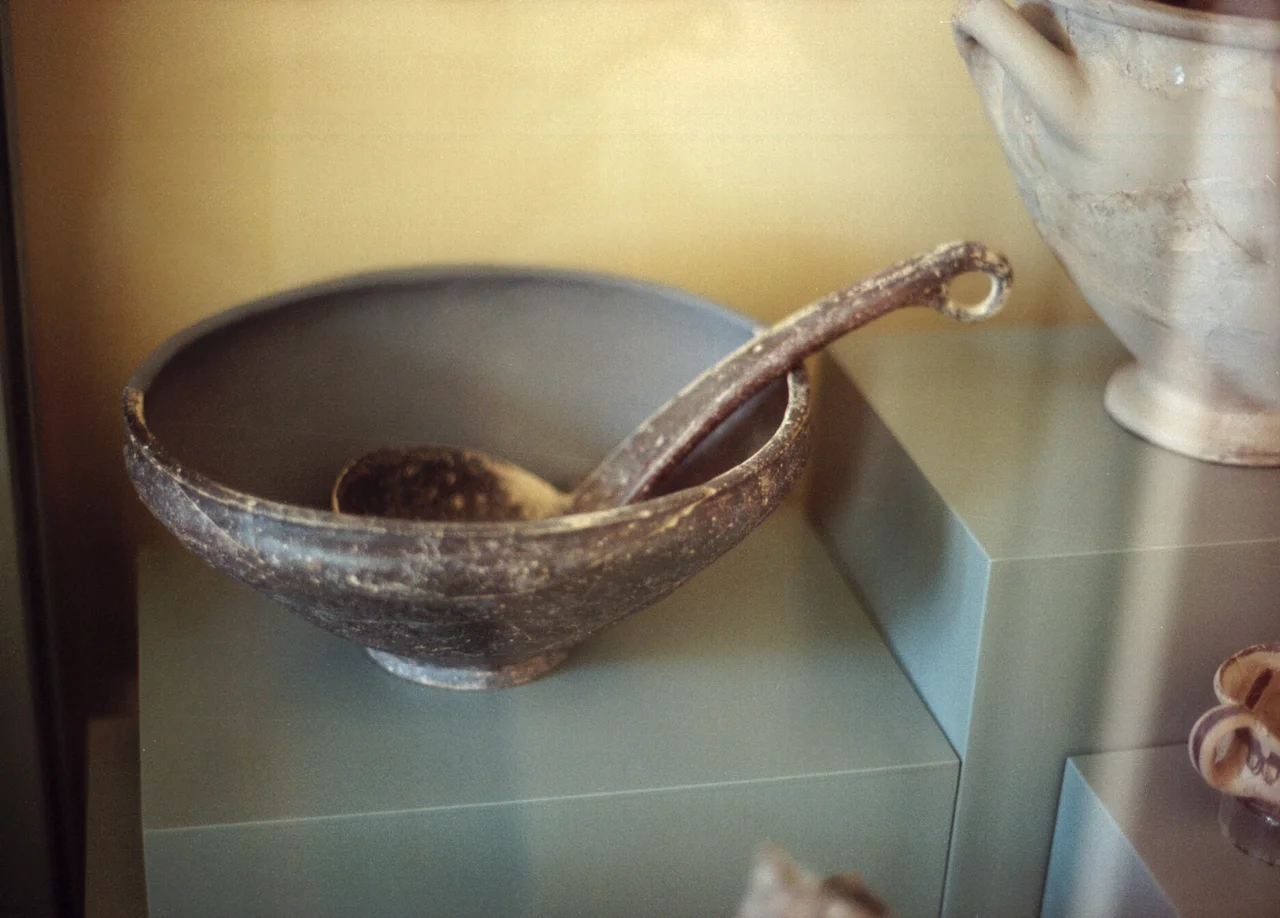

Archaeological Museum of Nemea
A California university built this museum and then gave it away. That is not how most institutions operate, but the story of the Archaeological Museum of Nemea has always been unusual. The University of California funded and constructed the building as part of its long-running excavation of the ancient sanctuary, then handed it to the Greek state in 1984. Today it stands at the entrance to the archaeological site, a few steps from the Temple of Zeus, its galleries arranged in rough chronological order from the Copper Age through the early Byzantine era — roughly six thousand years of human life in one narrow valley in the northeastern Peloponnese.
Gold from the 15th Century BC
The most striking objects in the museum are the pieces of gold jewelry from the 15th century BC, excavated from the Mycenaean cemetery at Aidonia. Gold rings bear relief carvings that reward close attention: hunting scenes, divine figures, ceremonial processions worked in detail finer than most modern jewelry. The fact that such objects survived at all — buried with the dead across three and a half thousand years — is its own kind of drama. That they can now be studied and handled, displayed in a glass case in a sunlit room beside the temple where ancient Greeks honored Zeus, adds something harder to name.
The museum also holds Mycenaean figurines from the 14th and 13th centuries BC, the so-called Bird Goddesses — small clay figures with abstract forms that once stood in shrines or were carried as protective talismans. A terracotta fragment of a female figurine from Phlius (ancient Flious) dates to between 4500 and 3200 BC. Early Helladic pottery from 2700 to 2200 BC fills other cases. Each object represents not just craft but a life, a community, a set of beliefs about how the world was ordered.
The Child in the Celery
Among the most thought-provoking pieces is a small figurine identified by the museum as probably representing Opheltes — the infant hero whose death, according to myth, gave rise to the Nemean Games. The catalogue notes cite Pausanias directly: Book II, chapter 15, verse 3. The figurine is tiny, terracotta, unremarkable in scale. But the story attached to it is not.
Opheltes was the infant son of King Lycurgus of Nemea. His nurse Hypsipyle, who had once been queen of the island of Lemnos before being taken as a slave, set him down on a bed of wild celery while she led the Seven against Thebes to water. A serpent killed the child. The Seven held funeral games in his honor, and those games became, in time, the Nemean Games. The judges of those games wore black robes as a sign of mourning, and victors received crowns of wild celery instead of olive or laurel — all in memory of a child who could not yet walk.
Through the Travelers' Eyes
The museum's collection includes something unexpected: images of Nemea made by travelers of the 18th and 20th centuries. These drawings and paintings document how the site appeared to visitors across the centuries — the three columns of the Temple of Zeus standing above the surrounding farmland, the valley green in spring and pale in summer heat, the sense of monumental ruin in a working landscape.
The juxtaposition of these historical views with the objects they surround makes the museum something more than a storage facility for excavated finds. It becomes a record of how the place has been seen, interpreted, and valued across different eras. Coins struck by ancient visitors to the sanctuary round out this thread — people who came to watch the games, worship at the temple, and left small metal objects as evidence of their presence.
What the Inscriptions Remember
The museum holds a collection of inscriptions from Nemea and the surrounding area, including Phlius and Petri — stone texts that preserve the names of athletes, dedications to the gods, administrative records of a sanctuary that once drew visitors from across the Greek world. Architectural fragments from the temples and other structures are displayed alongside these inscriptions, allowing visitors to see how the site's buildings were assembled and decorated.
The range of the collection — from Stone Age obsidian to Byzantine-era objects — reminds visitors that the valley was never empty between the great moments that history records. People lived here, farmed here, buried their dead here across a span of time that makes any single era seem brief. The museum holds that continuity in one place, beside the ruined temple, in the valley where Heracles was said to have killed the lion.
From the Air
The Archaeological Museum of Nemea is located at 37.808°N, 22.711°E, within the archaeological sanctuary beside the Temple of Zeus. Approach from the northeast at 4,000–5,000 feet for a view of the valley setting with the three standing columns visible as a landmark below. The nearest major airport is Athens International Eleftherios Venizelos (LGAV), approximately 80 km northeast. The valley floor is fertile and green in spring; the surrounding hills are dry limestone in summer. The village of Archaia Nemea is immediately southwest of the site.
Nearby Stories
- Aigosthena 2.2 km away
- Kefalari (Argolis) 2.4 km away
- Cleitor 4.2 km away
- Helike 8.7 km away
- Stemnitsa 9.1 km away
- Methana Volcano 12 km away
- Megara 18 km away
- 1981 Gulf of Corinth Earthquakes 24 km away